

This week I’m releasing a book: The Giving Mind.
I wrote it for my kids. For Gabriel, Noah, Daniel, and Eliana, who never stop asking why. It’s a message to them, written in a language my six-year-old can read, because she still has infinite questions about a world the rest of us have stopped questioning.
Over the last few years I’ve been speaking all over the country. Workshops, bootcamps, executive briefings, hospitals. When you do that much of it, you start to feel the temperature of a room the second you walk in. You hear what people are worried about. You hear what they wish someone would say out loud. You build a map of what this moment actually feels like from the inside, across industries and generations and zip codes.
One thing kept standing out.
My six-year-old was thinking about this very differently than everyone else I was meeting.
She had infinite hope. And she didn’t know enough yet to be concerned.
That gap, between what she sees and what the rooms full of adults see, is the whole reason this book exists.
Your family is the product. And you’re the product manager.
I’ve been a product manager for twenty years. So let me say what that word means before it gets used as a metaphor.
A product manager holds a lot in mind at once. The product as it lives in the heads of many different people, all writing it slightly differently inside themselves. The engineer sees one thing. The designer sees another. The exec sees a third. Your job is to hold all of those at once without losing the thread of what the thing is.
And you carry it from a hope to a shipped thing in the world.
That is also what parents do.
You hold a future you want for your child. You hold where your child wants to go, which is usually not the same place, and is allowed not to be. Somewhere in between, you’re trying to find the place that’s actually right for them, which is often a third option you couldn’t see when you started.
Holding all of that at once takes a lot. Cognitively. Emotionally.
A product manager also lives inside conflict. Constant conflict. Opinions pulling in different directions, priorities that won’t reconcile on paper, people who each believe their piece is the most important piece. Your job isn’t to pick a winner. Your job is to de-conflict. Find the version that honors as much of the truth as possible, and keep moving.
You hold where you were. Where you are. Where you’re going. And how you’re actually going to get there. Often through ideas that are orthogonal1, or flat-out contradictory.
Sound familiar yet?
When I started watching how my kids were using AI, I noticed they were asking it the kinds of questions I used to ask my parents.
Not homework questions. Not Google questions. The other ones. The ones you ask when you’re trying to figure out what kind of person you are, or what you think about something big, or whether a feeling you have is normal.
That’s when it hit me. Certain parts of parenthood had already transferred off of me. Quietly. Without a meeting. Without me signing anything.
Someone else was answering.
And as one of the product managers of this family, I realized I was no longer fully in charge of the product.
That’s the fear underneath the book.
The Giving Mind is written for ages four to eight, but it’s really for any age. It opens with this line:
Once there were humans. They loved to think. They read and they talked.
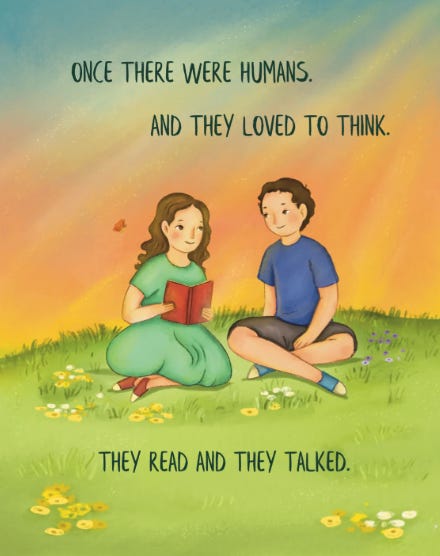
The first time I read it with my daughter, she stopped me.
“Papa, there are still humans. Why does it say once there were humans?”
That’s the whole book right there, in one question from a six-year-old.
So I tried something. I asked her: would you be upset if I took away your tablet at meals? Or if I said no shows tonight?
Yes, Papa. I’d be very sad.
I told her: when I was your age, I wasn’t sad when I was bored. I wasn’t sad without a device. I had the outdoors. I had my friends. We had a TV in the house, but nothing smart. Nothing that followed me into my pocket. Nothing that answered every question before I had the chance to sit with it.
That world is gone for her. She didn’t lose it. She was born after it left.
Once there were humans isn’t a science fiction opening. It’s an honest one.
Cyborg and Centaur
Ethan Mollick, in Co-Intelligence, gives us two words for how humans and AI work together. They’re worth borrowing.
A centaur keeps the seam visible. Human on top, machine below. Clear division of labor. I think, you execute. Or you think about one part, I think about the other, and we hand the work back and forth at a clean boundary. I know where I end and you begin.
A cyborg blurs the seam. Human and machine pass the baton mid-sentence. You’re writing a thought, the machine finishes it, you edit, it extends, you accept, you reject. By the time the sentence is done, neither of you could say cleanly who wrote which part.
Both are real. Both are useful. Both are happening in your house already.
My daughter won’t grow up choosing between centaur and cyborg. She’ll grow up cyborg by default. I grew up watching the internet arrive. She’ll grow up never knowing it wasn’t there. The seam between her thoughts and a machine’s will be the same way. Invisible to her from the beginning.
Which means the job of the product manager at home changes.
The machine is already inside. Going back to once upon a time isn’t on the table, and I wouldn’t lie to her about it if it were.
The job now is to make sure she knows where the seam is. Even when she can’t feel it. Even when everyone around her has stopped pointing at it.
The job is to give her a mind that can still tell.
That’s what The Giving Mind is trying to do. In small pages, for small hands. So that when the seam disappears, something in her still knows it was ever there.
Once there were humans.
They read. They talked. They loved to think.
Some of them still do.
Who This Is For
Parents who feel the question before they have words for it. Grandparents looking for a way in. Teachers. Anyone who still reads to a kid (or other adults) and wants the reading to matter. And anyone curious what years of sitting with this question does to a person over time, the way it reshapes what you pay attention to and what you stop being willing to let slide.
How to Read It
Read it with a child, not to one. Stop when they stop you. Let the silence sit there, even when it gets awkward. The book is built for interruption. For going back and forth. For coming back to it next week, and the week after that. A parent and teacher guide at the back gives you prompts to keep the dialogue going, at home or in the classroom.
What’s Coming
The Giving Mind is the first of four. Each book takes on a different dimension of what makes us human in the age of AI. The Giving Mind is about wonder and curiosity. The Giving Heart is about empathy and connection. The Giving Hands is about science and making. The Giving Feet is about purpose and journey. Mind, heart, hands, feet. The whole person. One book for each, because my daughter doesn’t need a theory of humanness. She needs something she can hold.
While I finish the remaining three, I’ll keep writing here on Substack. Same thread, different form.
About the Press
The Giving Mind is published by Small Light Press2, an independent press I founded to carry ideas that illuminate. The name comes from a simple belief: a small light, in a dark room, extinguishes an incredible amount of darkness. A lantern on a road. A candle at a bedside. Light is how we find each other.
The press runs two imprints. Lantern is for adult essays and long-form writing. Candle is for picture books. Both share the same conviction. Honest, careful writing changes things.
A Note on How This Was Made
AI was used to mock up some early ideas along the way. The ideas themselves, the writing, the editing, and the illustrations are all human. That distinction matters to me, and it matters to the book.
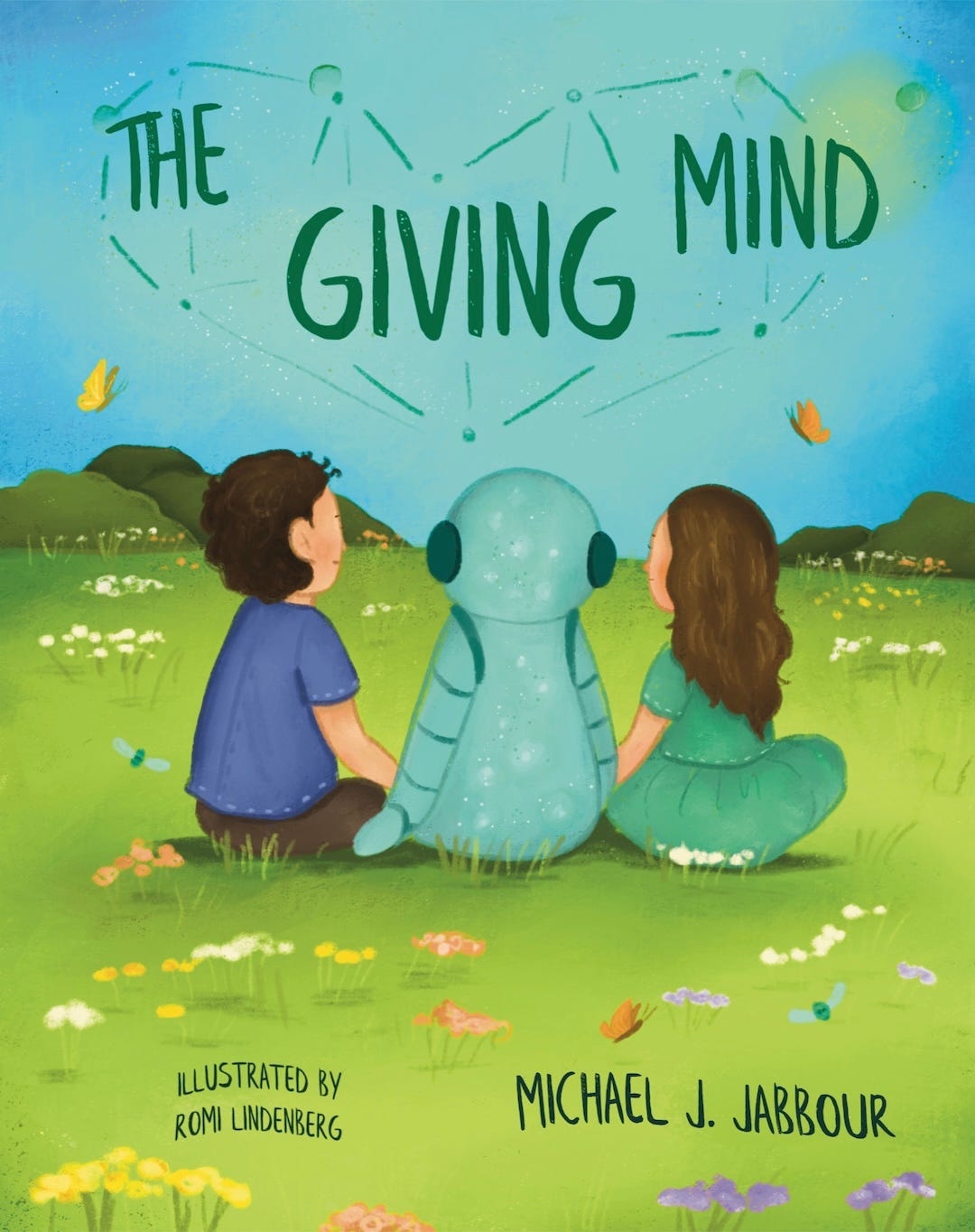
The Giving Mind is live on Amazon now.
Read it with a kid (or person) you love. Then tell me what they said back.
For Sarah, who dedicates her life to children and the art of childhood itself. And for Gabriel, Noah, Daniel, and Eliana, who never stop asking why. For every child who still has questions.
With thanks to Kari Auer, Tal L, and Liz Heflin for their editorial care, and to Romi Lindenberg, who brought these pages to life.
Orthogonal means at right angles to each other. Two ideas are orthogonal when they don’t directly contradict, but they also don’t line up. They point in different directions. A parent wanting a child to be safe and a child wanting to be brave aren’t opposites. They’re orthogonal. Most of parenting lives there.
More on the press, its imprints, and what’s next at smalllightpress.com.
Bought it on amazon - book is beautiful and filled with wisdom. Parent / discussion guide is in-depth reflective wisdom which will make us all better humans. Thank you!!
Congratulations, Michael! What a milestone. Buying it!