

What happens to a school when a machine can do the work it uses to measure learning?
To a hospital when AI changes what a doctor can do, but the rules around care barely move?
To a government when it can process a decision faster than it can explain it to the person affected?
These are questions about whether the institutions we depend on will still do their jobs.
I think they can. But buying better technology will not be enough.
They have to learn how to change.

The rules can outlive their reasons
A rule usually begins with a reason.
A child needs to learn. A patient needs protection. A citizen needs a fair decision and somewhere to turn when it is wrong.
We build processes around those needs. Over time, the process can become so familiar that preserving it feels like preserving the thing it was meant to protect.
Then the work changes.
Imagine a school still grading finished answers when producing an answer no longer tells us much about what a student understands.
A hospital adds an AI tool, but keeps a review process that gives clinicians too little time to check its work.
A government automates applications while leaving people with no useful explanation of a refusal and no effective way to challenge it.
The school still gives grades. The hospital still requires a doctor’s approval. The government still follows a procedure.
Yet each could become worse at the very thing that justifies its existence.
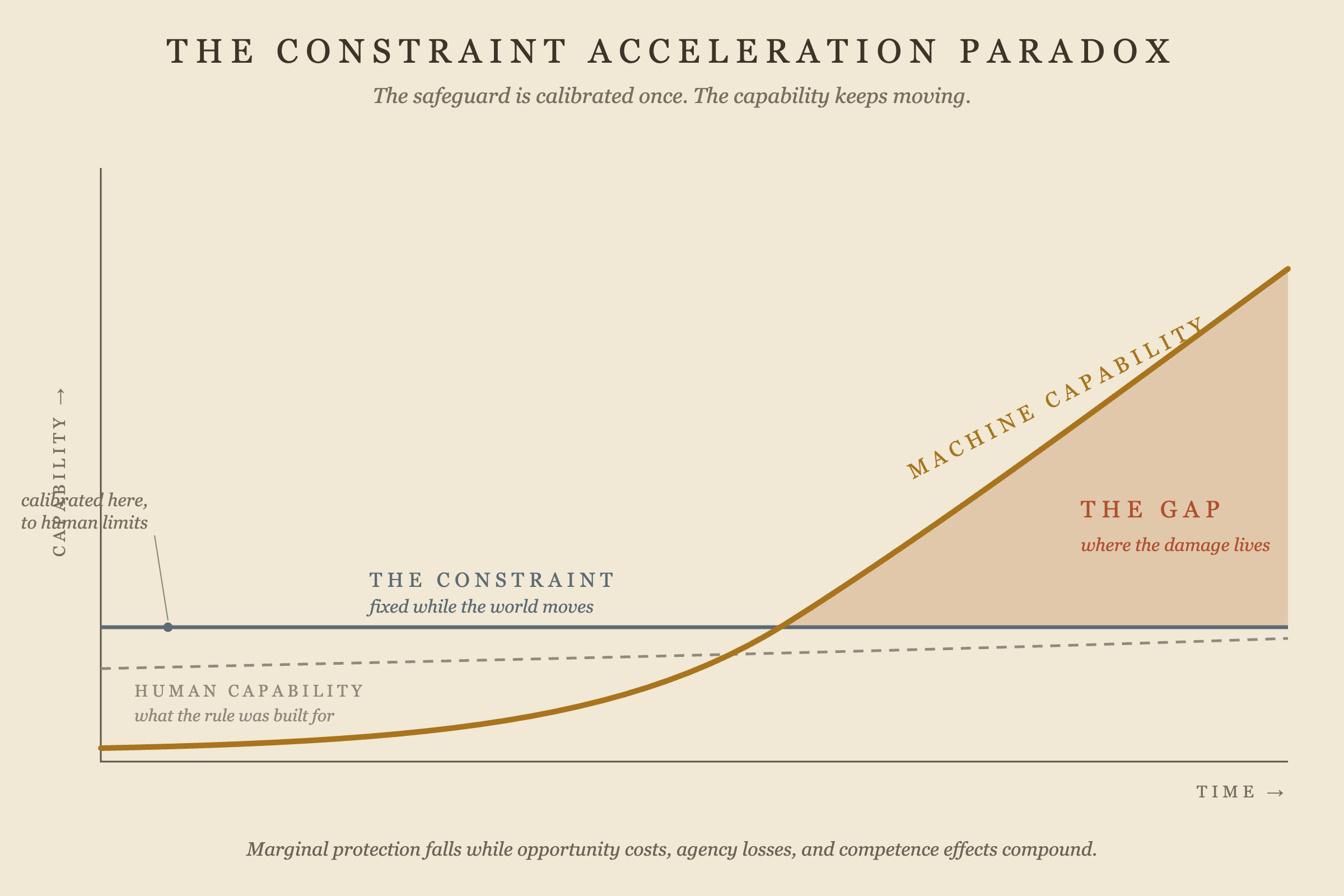
That is the risk I call the Constraint Acceleration Paradox: as technology changes what is possible, an unchanged rule can become a growing barrier to the purpose it was created to serve.
Something meant to protect us can start holding us back.
What happens to the people inside?
There is another danger. An institution can adopt AI quickly and still lose the ability to use it well.
In Intentional Deskilling, I separated choosing which skills to release from losing them without noticing.
That distinction matters here.
Some work should be handed over. Spending less time on routine paperwork could give a teacher more time with a struggling student, or a clinician more time with a patient.
But some of the work we hand over is also how people learn to recognize when something is wrong.
If a professional stops working through problems, gets less practice, and is then asked to supervise more machine output, what keeps their judgment sharp?
Calling them the supervisor does not answer that question.
In The Last Skill?, I wrote about the importance of the experience of learning. An institution has to make room for that experience, even when a tool can produce the finished answer.
A student learning a subject for the first time and an experienced teacher automating an administrative task are giving up very different things.
We need to know the difference before we celebrate the time saved.
The people outside matter too
Now imagine entering an emergency room as one of three kinds of patient.
Patient A is a doctor. You know a great deal about your condition. Today, you are the person receiving care.
Patient B knows little about medicine. You need help understanding the options. You still know what matters to you and what you are willing to live with.
Patient C is somewhere in between. Perhaps you have managed a condition for years. You have experience and questions the care team needs to hear.
All three need care. All three need to be heard. They need different kinds of help.
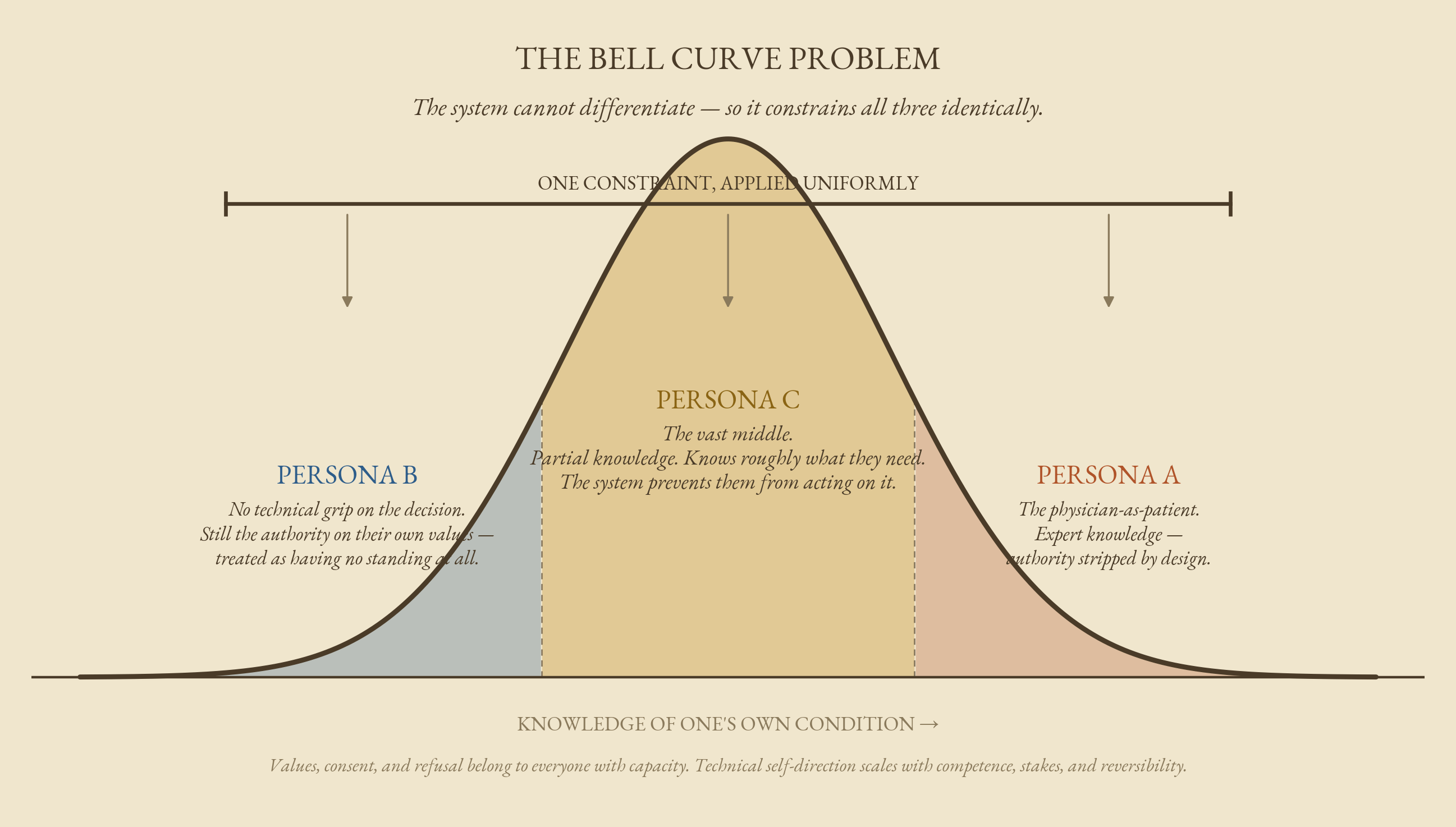
A better tool could help each person understand and participate. A rigid process could prevent that benefit from reaching any of them.
The same concern belongs in a classroom and a government office. Serving people requires room to understand their circumstances. Faster processing alone cannot tell us whether we have done that.
Survival means remembering the purpose
I am not predicting that schools, hospitals, and governments will disappear.
I worry that they could remain standing while becoming less able to serve us, and less deserving of our trust.
Avoiding that future requires more than removing rules. Powerful tools can create new risks, and some protections need to become stronger.
Consent still matters. So do privacy, fair treatment, and the ability to challenge a decision.
But a familiar process should have to show that it still protects those things.
A school should ask whether students are learning, even if that means changing how it assesses them. A hospital should ask whether care is better and easier to reach, while keeping its staff capable of questioning the tools. A government should ask whether people receive fair decisions they can understand and contest.
Try changes carefully. Keep what improves the service. Correct what causes harm. Give the people doing the work, and the people receiving it, a real part in deciding.
Protect the purpose. Be willing to change the process.
The question is whether we can do that quickly enough for the school to keep educating, the hospital to keep caring, and the government to keep serving.
That is what institutional survival has to mean.
Want to go deeper? The evidence, historical context, and limits of this argument are in The Constraint Acceleration Paradox, Explained.
This was very interesting, thank you. I've thought about several of these things recently.