

A note before we begin: The opening story is scaffolding, not sermon. What follows is systems analysis wearing a very old coat. No faith commitments required. Structure is doing the work here. If you want the scholarly receipts on the narrative details, they’re in the footnotes. Otherwise, just enjoy the ride.
The Setup
For my theologians out there, you already know this story. But we usually tell it flat, like a children’s book. If you slow it down and take it seriously, it turns into something far more uncomfortable. And far more relevant.
Adam and Eve were living in pure abundance.1 No scarcity. No tradeoffs. No friction. They had responsibility over everything, but not in the exploitative sense. They cared for the world because nothing inside them pulled against that care. The warp and woof of their existence were perfectly aligned.
According to the ancient tradition, they did not have “skin” the way we do now.2 Their bodies did not conceal what was inside them. Light radiated outward. What they were on the inside showed up immediately on the outside. No performance. No hiding. No gap between intention and action. This matters for what comes next: a system whose internal state is visible cannot deceive itself about what it has become.
Inside the Garden stood two trees.
One was the Tree of Life. Eat from it and you live forever.
The other was the Tree of Knowledge of Good and Evil.3 Not information. Not data. Knowledge in the sense of mixture. The ability to experience contradiction inside yourself. Wanting something even when you know you should not.
Then the serpent shows up.4
Not a cartoon snake. A serious creature. Upright. Persuasive. Smart enough to reframe reality without lying outright.
It says to Eve, “That fruit looks incredible. Eat it and you’ll be more like the Creator.”
Eve answers correctly. “That is literally the one thing we’re not allowed to touch.”
And here is the move. The subtle one.5
“You’re right,” the serpent says. “Don’t eat it. Just touch it. No rule against that, as far as I know.”
This is not rebellion. This is boundary testing.
Eve evaluates. She touches it. Nothing explodes. No alarms go off. The system appears stable. So she turns to Adam and basically says, “Dude, I checked. Seems fine.”
Adam eats.
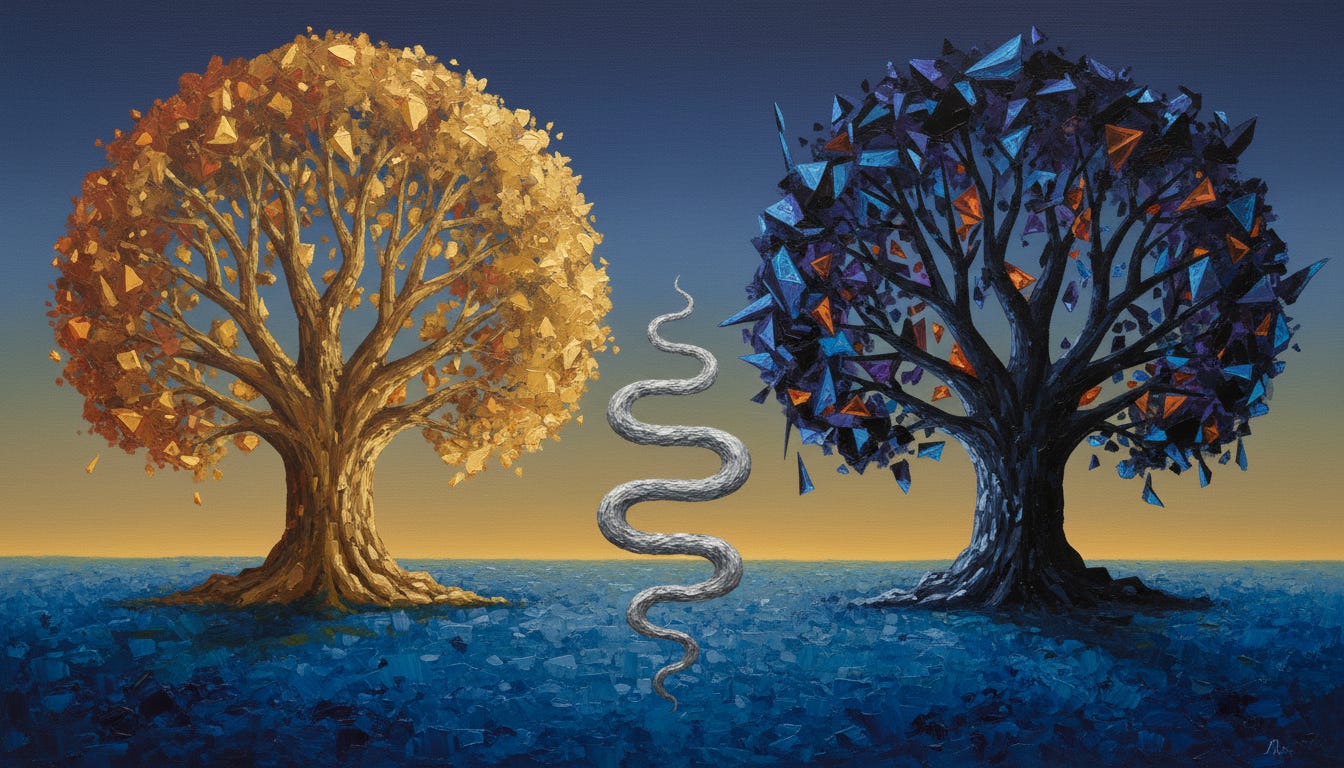
And immediately, nothing physical changes. The world does not collapse. The Garden does not burn.
But internally, everything fractures.6
Shame appears for the first time. Guilt. Self-awareness that does not feel empowering but exposing. They suddenly experience themselves as naked. Not just unclothed, but vulnerable in a way they have never known. The luminous transparency is gone. Now there is an inside that differs from the outside. Now there is something to hide.
So they hide.
And G-d calls out (while they are hiding in the bushes). Not because He does not know where they are, but because relationship requires a response.
“Where are you?”
Not “what’s your GPS location.” More like, “Where are you now?”
Adam answers with fear. Fear enters human language at this moment. And then deflection.7
“I heard You and I was afraid… because I am naked.”
G-d asks the only question that matters.
“Who told you that you are naked? Did you eat from the tree I told you not to eat from?”
Adam deflects. Eve deflects. Responsibility fragments the same way innocence just did.
Now comes the part people get wrong.
They are not expelled because they are weak. They are expelled because they are dangerous.8
Because at this moment, something terrifying becomes possible.
If Adam now eats from the Tree of Life, he will live forever in a broken state.
Eternal existence with internal contradiction. Infinite life without repair. A system that cannot die and cannot heal.
That is not mercy. That is catastrophe.
So G-d removes them from the Garden. Not as punishment, but as containment.
And He stations angels with a flaming, ever-turning sword to block the path back to the Tree of Life.9 Not to keep humanity out forever. To keep humanity from locking brokenness into eternity.
First comes exile. Then labor. Then history. Then death. Then struggle. Only then can repair even exist as a concept.
Because infinity plus corruption is not redemption. It is permanent failure.
That is the structure. Everything else is commentary.
What follows weaves together every major thread from 2025. Each concept links back to its full exploration. The structure is deliberate: read straight through to see how they connect, then follow whatever thread pulls you. This is the map. The linked articles are the territory.
The Look Back: 2025 as a Systems Failure (and Warning)
And that is where this story stops being ancient.
Here is the uncomfortable pattern that surfaced again and again this year, across people, teams, institutions, and increasingly, AI-mediated organizations:
As systems scale, they outgrow their ability to notice when they are wrong.
Three failure modes kept appearing. They are distinct but they compound.
Failure Mode One: Outsourced Judgment
We delegate thinking to tools, rituals, committees, and algorithms. Then we experience a strange alienation from results. I called this the phantom limb of intelligence: the sensation of agency where none remains. Organizations do this with better dashboards. Responsibility diffuses across workflows and metrics until no one is steering, yet everyone feels accountable. The capacity for correction becomes a forgotten task, buried under the startup cost of admitting something might be wrong.
This is how systems lose the ability to see their own internal state. The organizational equivalent of trading luminous skin for opaque hiding.
Failure Mode Two: Frictionless Drift
When friction disappears, people feel relief, not health. Organizations make the same mistake. Smooth operation gets mistaken for alignment. The absence of pain becomes the success metric. Your TI-85 never said no, and neither do systems optimized to minimize resistance.
Early warning signals vanish. By the time discomfort returns, it arrives as crisis instead of correction. This is the geometry of crisis: context saturation, the moment when your current frame can no longer contain what reality demands. Children naturally pause when confused. They slow down, ask strange questions, reorganize understanding. Organizations treat confusion as defect. So they push through. They optimize it away. And in doing so, they lose the beautiful flaw that would have saved them.
Failure Mode Three: Continuation as Goal
This is how institutions become too big to fail, too optimized to pause, and too distributed to feel responsibility. They cannot stop without risking collapse. They cannot admit error without destabilizing themselves. Continuation becomes the goal. Survival masquerades as health.
By mid-2025, this started to feel familiar in a darker way. Not dramatic. Subtly off. Like that moment when you realize a system is still working, but no longer know why.
People respond to this moment in predictable ways. Some retreat into false binaries: human vs. machine, efficiency vs. empathy. I described these as the three postures: prophets of doom, ostriches, and weavers. Others freeze, paralyzed by paradox. A smaller group learns to hold contradiction without resolving it too early. They design systems that gain efficiency through humanity rather than at its expense - pursuing total transformation rather than incremental optimization. I called this the last skill: the ability to stay oriented when the map dissolves.
The real danger is not intelligence. It never was.
The danger is permanence without repair.
This is not a hypothetical concern. The people building these systems are explicitly framing continuation as inevitable.
In a May 2024 conversation at MIT, Sam Altman described AI as potentially “the biggest, the best, and the most important” technology revolution. He predicted AI “will continue to get way more capable” and “will become ubiquitous as time goes on.” His framing is relentlessly optimistic: acceleration is inevitable, integration is irreversible, and the question is simply how to navigate it well.
This framing is precisely the problem the Garden story warns against.
“Ubiquitous” and “inevitable” are just softer words for infinity plus corruption. The question was never whether AI would become powerful. The question is whether we retain the capacity for course correction, or whether we’ve built systems that only know how to accelerate. Altman’s framing assumes continuation is neutral. The Garden story says continuation is only neutral if the system is aligned. If it isn’t, continuation compounds the error. Forever.
Biology already solved this. When context collapses, living systems do not double down on normal operation. They suspend it. Breakdown, convergence, reorganization, consolidation. Recovery requires interruption. The part can only be well if the whole is well. Organizations that survive disruption follow the same arc, usually by accident. Organizations that fail are the ones that insist on continuity at all costs. They never make the flip, the cognitive shift that allows parallel lines to finally meet.
Which brings us back to the opening story, stripped of theology and left as pure logic.
A system that can run forever while broken is not resilient. It is trapped.
Adam and Eve were removed from infinity so that repair could remain possible.
Modern organizations face the same constraint, whether they admit it or not.

The Choice We Still Have
Here is what the Garden story actually offers, if you take its logic seriously:
G-d chose exile for Adam and Eve. He blocked the path to eternal life because they could not be trusted to block it themselves. The flaming sword was an act of mercy. Forced limits so that repair could happen across time.
We do not get that protection.
No one is going to shut down our runaway systems for us. No angel is stationed at the threshold of infinite acceleration to help us find our frequency again. If we lock ourselves into permanent misalignment, organizational, technological, civilizational, we will stay there.
But here’s what the Garden story actually reveals: the capacity to choose limits is itself the protection. We don’t need angels with flaming swords. We need the wisdom to build our own boundaries before momentum becomes identity.
The window for choosing limits is still open. But it is a window, not a door. It closes.
Either we design systems that know when to stop, systems with ports and purpose, with the capacity to recognize when they are cutting too deep, to pause before momentum becomes identity, or we build things that keep going forever: flawed, unfixable, and convinced that survival means health.
That is not a religious claim.
It is a systems warning.
Adam and Eve did not get to choose their exile. We still can.
And that capacity - to pause, to notice misalignment, to course-correct before permanence sets in - might be the most powerful thing about us.
Not our ability to build systems that never stop. Our ability to build systems that know when to.
We’re built for repair. We always have been.
The Logic, Simply
If you want the argument without the narrative10:
Repair requires pause. You cannot fix something that refuses to stop moving.
Infinite continuation, by definition, never pauses. A system designed to run forever has no built-in moment for correction.
Misaligned systems that continue will compound their misalignment. Small errors become large errors. Drift becomes direction. Survival instinct replaces purpose.
Therefore: a system that can run forever while broken is not resilient. It is trapped.
The only protection is chosen limits - and we still have it. Either build the capacity to stop of self-regulation into the system now, or accept that the system will eventually optimize itself into permanent failure.
This is why mortality was reintroduced to the human story. This is why organizations that survive disruption are the ones that can interrupt themselves. This is why “inevitable” and “ubiquitous” should make us nervous, not reassured.
The question is not whether we can keep going.
The question is whether we should.
This piece draws on themes explored throughout 2025 at michaeljjabbour.substack.com. For those who want to go deeper: The Flip for the cognitive mechanics of reframing under pressure, The Geometry of Crisis for the neuroscience of context collapse, and The Beautiful Flaw for why imperfection might be the feature, not the bug.
Footnotes
On abundance, dominion, and stewardship: Classical biblical sources describe the Garden as a state of complete material and existential abundance. Adam is placed “to work it and to guard it” (Genesis 2:15), which commentators emphasize does not mean labor for survival, but custodianship. Rashi explains this as responsibility without struggle. The Midrash (Genesis Rabbah 16:5) frames Adam’s role as stewardship rather than ownership. Dominion does not imply exploitation. The absence of scarcity is essential to the story’s logic: no decision Adam or Eve makes is driven by need, only by choice. Sources: Genesis 1:28; Genesis 2:15; Rashi on Genesis 2:15; Genesis Rabbah 16:5
On “light” versus “skin” and the absence of concealment: Rabbinic tradition holds that Adam and Eve were not originally clothed in opaque physical skin as humans are now. Instead, they were enveloped in a luminous covering. This idea appears in Genesis Rabbah 20:12 and is famously noted by Rashi, who cites a Midrashic tradition distinguishing between “garments of light” and later “garments of skin.” The point is not physiology, but transparency: inner state and outer appearance were woven together as one fabric. There was no concealment, no performative layer, and no dissonance between intention and expression. Sources: Genesis Rabbah 20:12; Rashi on Genesis 3:21
On the Tree of Knowledge as moral mixture, not information: The “Tree of Knowledge of Good and Evil” is not understood in classical sources as a repository of facts or intellectual capacity. Ramban (Nachmanides) explains that Adam already possessed intelligence before eating. What changed was the internalization of desire. After eating, good and evil became mixed within human experience rather than externally defined. Moral judgment became subjective and emotionally charged. This marks the emergence of inner conflict, not enlightenment. Sources: Ramban on Genesis 2:9; Ramban on Genesis 3:5; Genesis Rabbah 19:7
On the serpent as persuasive agent, not animal instinct: Early rabbinic sources describe the serpent as an intelligent, articulate being prior to its curse. Genesis Rabbah 20:1 depicts it as possessing speech, intention, and strategy. Rashi emphasizes that its argument is subtle, not coercive. The serpent does not deny G-d’s command. Instead, it reframes the boundary by introducing a false safety margin: “touching” instead of eating. This is the first appearance of rationalization rather than outright rebellion. Sources: Genesis Rabbah 20:1; Rashi on Genesis 3:1–5
On boundary erosion and “touching the tree”: The suggestion to touch the tree, though not explicitly stated in the biblical text, is a standard Midrashic explanation for how Eve was persuaded. The serpent exploits an added safeguard, pushing Eve against the tree and demonstrating that nothing immediately happens. The lesson emphasized by the sages is that unnecessary extensions of rules can become points of failure when they are mistaken for the rule itself. Sources: Genesis Rabbah 19:3; Rashi on Genesis 3:3
On shame, fear, and the emergence of self-consciousness: After eating, Adam and Eve experience shame and fear for the first time. The Torah emphasizes awareness of nakedness, which commentators explain as psychological exposure rather than physical unclothing. Genesis Rabbah identifies fear as a new internal state introduced at this moment. Rashi explains G-d’s question “Where are you?” not as a request for information, but as an opening for moral reckoning and self-location. Sources: Genesis 3:7–10; Genesis Rabbah 19:11; Rashi on Genesis 3:9
On deflection, blame, and fragmentation of responsibility: Adam’s response places responsibility outside himself. First on Eve, then implicitly on G-d. Eve, in turn, attributes her action to the serpent. Rabbinic sources view this not merely as blame-shifting but as the fracturing of moral unity. Responsibility, once integrated, becomes distributed. This marks the beginning of social and psychological fragmentation. Sources: Genesis 3:12–13; Rashi on Genesis 3:12
On expulsion as containment, not punishment: Classical commentators emphasize that expulsion from the Garden is not framed as revenge. Ramban explains that allowing Adam to eat from the Tree of Life after moral corruption would result in eternal existence in a damaged state. The blocking of access is therefore protective, not punitive. Mortality re-enters human experience to make repair possible through time, effort, and growth. Sources: Genesis 3:22–24; Ramban on Genesis 3:22; Genesis Rabbah 21:5
On the angels and the turning sword: The “cherubim and the flaming, ever-turning sword” are understood symbolically as well as literally. The sword’s constant motion signifies that the path back to eternal life is not static or easily retraced. Access to unending existence requires moral realignment, not technological or intellectual advancement. Eternity without correction is portrayed as a danger, not a reward. Sources: Genesis 3:24; Genesis Rabbah 21:7; Rashi on Genesis 3:24
These principles draw from cell cycle biology (where DNA repair requires checkpoint pause), systems engineering (where uncorrected errors compound), and organizational resilience research (where adaptive capacity requires the ability to interrupt normal operations). The application to AI systems is inference, not established science - but the pattern holds across domains.
Michael, well written piece. I appreciated the biblical metaphor in all of its holistic temptation and consequence, as well as the deep thought that it inspired. Thank you for this. Happy holidays. Angelo
Michael, enjoyed your post. The story is fascinating to me, and the language itself. Yes, broken and dangerous.