

Fair warning: this one gets morbid. A throwaway metaphor from last week turned out to be load-bearing, and I need to take it apart properly.
Living systems constantly produce things they later discard.*
There’s an old piece of folk biology that most people accept without question: hair and nails keep growing after death.
It sounds true. It feels true. It’s the kind of fact that survives in families and medical schools and late-night conversations because it carries a certain poetry. The body persisting past its own ending, still reaching, still producing, still alive in some residual way.
Except it’s wrong. I don’t want to be morbid, but alas, some ideas need to be fleshed out.
Hair and nails don’t continue to grow after death. The skin dehydrates and retracts, pulling back from the nail beds and hair follicles, making it appear as if they’re still growing. The appearance of growth is the recession of everything around it.1
I’ve been thinking about that inversion every day for the last month. Not about bodies. About organizations. About industries. About the structures we built to house human expertise, and what happens when the expertise leaves but the structures remain. I touched on this in Intentional Deskilling, the metaphor that wouldn’t let go. Now I want to follow it all the way down.
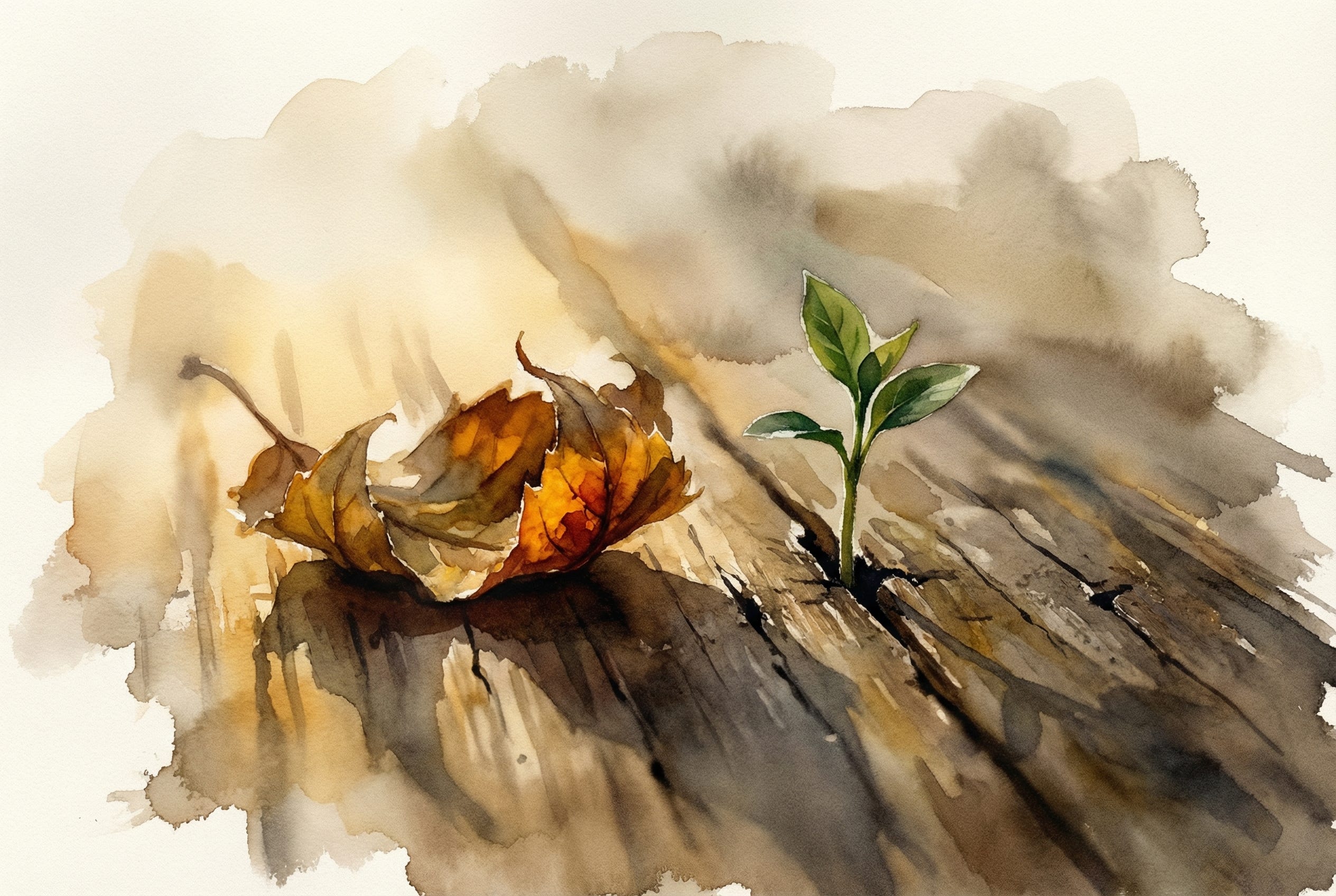
Hair and nails grow from us, yet we cut them away without pain. Technology may be becoming something similar: an extension of cognition that we periodically trim, replace, and rebuild, without noticing that the living tissue underneath has changed.
The Three Discoveries
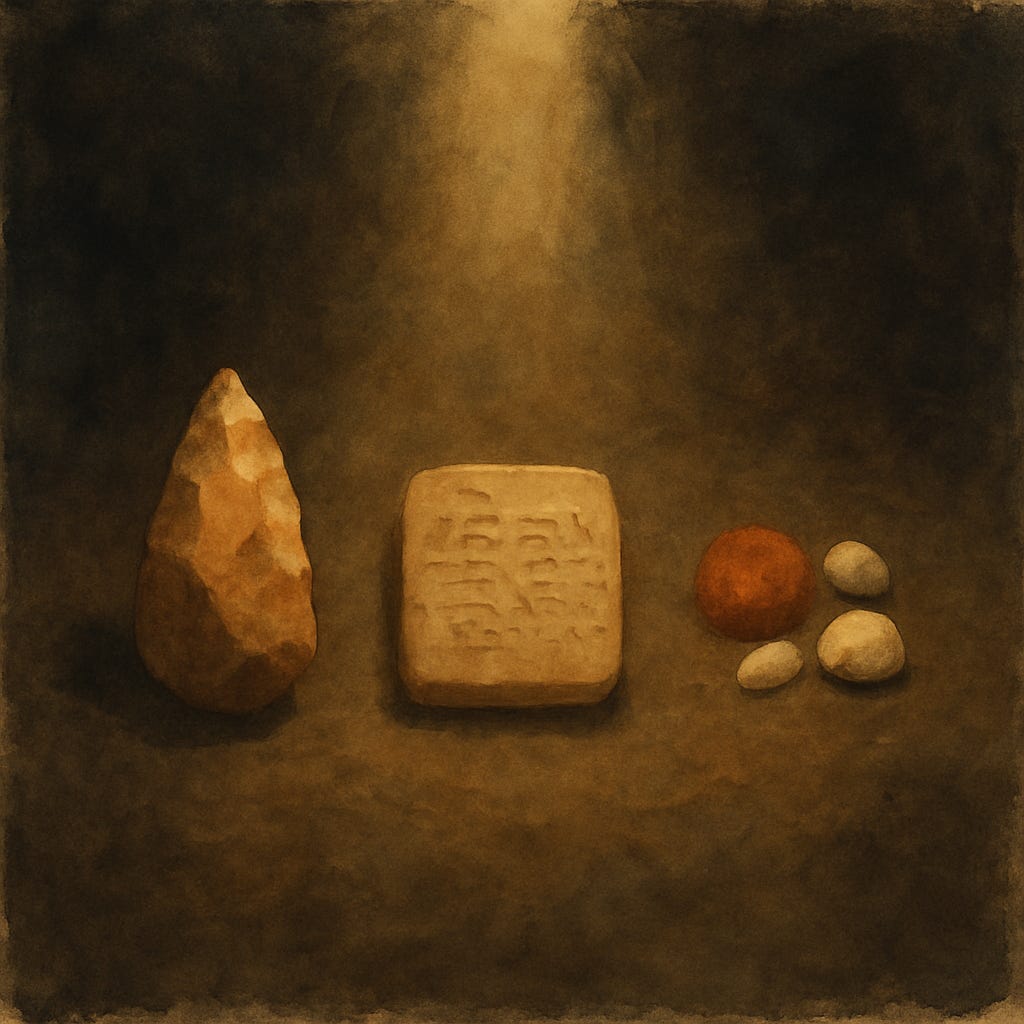
Anthropologists argue about a lot of things. The archaeological evidence for what makes human cognition distinct is long and varied: stone tools, symbolic artifacts, structured living spaces, exchange networks, mortuary ritual.2 But three categories keep surfacing in how we tell the story to ourselves.
The first was the use of tools. Stone shaped into something that extends the hand’s reach. A rock becomes a hammer. A stick becomes a lever. The boundary between body and environment blurs. The oldest known stone tools, from Lomekwi in Kenya, are 3.3 million years old, predating our own genus. Homo habilis, “handy man,” earned the name not for what he thought but for what he held.
The second was language. Not vocalizing, because many animals do that, but symbolic communication. Words that stand for things not present. Sentences that describe events that haven’t happened. The ability to coordinate across time and space, to build communities around shared meaning, to pass knowledge between generations without requiring each generation to rediscover it from scratch. Language leaves no fossils. We date it sideways, through the symbolic artifacts it makes possible, and the earliest of those reach back at least 100,000 years.
The third was burial of the dead.
That one never gets the attention it deserves. Tools are practical. Language is powerful. But burial? Burial is something else entirely. It means a species has developed the capacity to recognize that something has ended. To feel that ending as loss. To structure a communal response to that loss so the group can process it and move forward.
Recent archaeological evidence continues to reshape this picture. Analysis from Tinshemet Cave in Israel and the child burial at Panga ya Saidi in Kenya place intentional human burials among the earliest known, while ‘behavioral modernity’ is increasingly understood not as a single threshold but as a mosaic, capabilities emerging unevenly across regions and populations.3
Burial isn’t practical. It’s expensive. Time, energy, resources diverted from survival to ceremony. The fact that humans developed it anyway tells you something about what we are. We are the animal that needs to mark endings. The animal that cannot simply walk away from what has died. The animal that builds rituals of mourning because without them, we’d pour resources into resurrection instead of adaptation.
Anthropologists have a term for the period between biological death and social death: the in-between phase. During this interval, the deceased is, in the community’s functional reality, “socially alive but biologically dead.”4 The body is present. The social role hasn’t been reassigned. Resources are still directed toward the person who no longer exists. Arnold van Gennep mapped this in 1909: every death ritual moves through three phases (separation, transition, and reintegration) and it’s the middle phase that does the actual work. 5 Without it, the community never completes the transition. It gets stuck treating the dead as sick.
The Four Tensions
Every narrative tradition I’ve encountered, across cultures and centuries, maps the human condition onto some version of four tensions:6
Person to person. How we negotiate with each other. Power, love, betrayal, cooperation. The social contract and its violations.
Person to environment. How we survive in a world that doesn’t owe us anything. Weather, scarcity, geography. The body against the elements.
Person to tools. How we extend ourselves through what we build. The hammer, the wheel, the algorithm. The bargain we strike every time we make something that makes us more capable: what do we gain, and what do we lose?
Person to the infinite. How we reckon with what exceeds us. Death, meaning, time, the sacred. The questions that have no answers and cannot be abandoned.
These tensions don’t resolve. They oscillate. They’re the fundamental frequencies of human experience, and everything we build (every institution, every technology, every ritual) is an attempt to manage one or more of them.
Burial sits at the intersection of all four. It’s social (communal mourning). It’s environmental (returning the body to the ground). It’s technological (the tools and structures of ceremony). And it’s infinite (the confrontation with what cannot be undone).
When we fail to bury what has died, the tensions don’t disappear. They distort.
What’s Already Dead
Anthropic published research recently analyzing millions of human-agent interactions on their API. The numbers are clarifying in the way that autopsy reports are clarifying. Software engineering accounts for nearly 50% of all agentic tool calls. Business intelligence, customer service, sales, finance each sit in the low single digits.7
What this tells you isn’t that agents don’t work in those other domains. It tells you that software engineering is the first domain where the transformation is complete enough to measure. The hair and nails have been growing for a while now. It just took someone measuring to notice.
Amarda Shehu, a computer science professor at George Mason, published something recently that puts the point more sharply. She describes an AI tool called Einstein that logs into a student’s Canvas account, monitors for new assignments, watches recorded lectures, reads course materials, writes essays with citations, and posts to discussion boards. Autonomously. With the student’s credentials.8
Her framing is precise: calling this a cheating problem isn’t wrong, but it’s dangerously incomplete. A convergence of failures (security, pedagogical, institutional, philosophical) and we’re addressing them with the vocabulary of an earlier era. We keep saying “cheating” because we don’t have a word for what it actually is: the death of a structure that hasn’t been buried.
The educational model that assumed humans would do the reading, synthesize the material, and demonstrate understanding through writing is dead. Not dying. Dead. The credentials still work. The Canvas login page still loads. Assignments still appear on the syllabus. The LMS keeps running. The nails keep growing. But the thing the system was built to contain, the student’s struggle with material, the friction that produces learning, has left the building.
As I explored in The Doing Was the Knowing, the doing is where expertise lives. The verbs (curate, reason, update, act) are the mechanism through which humans develop judgment. Strip the verbs and you don’t get a more efficient expert. You get an empty cockpit.9
Now look at the Canvas scenario again. The student isn’t stripping their own verbs. The agent is stripping them automatically, without the student even registering that something has been lost. The LMS keeps generating assignments. The agent keeps completing them. Everything looks alive. The hair and nails keep growing.
But the learning is dead. And nobody is sitting shiva.
The Mourning We’re Not Doing
This is what the anthropologists understood that we’ve forgotten: mourning isn’t weakness. Mourning is technology.10
Every culture that developed burial rituals was solving the same problem: how do you prevent a community from wasting its resources trying to resurrect what cannot be brought back? How do you redirect energy from the dead toward the living? Robert Hertz argued in 1907 that death rituals exist not for the dead but for the living. They reorganize the community, close the social role of the deceased, and redirect emotional and material investment back toward what’s still alive. 11
Many of these rituals also solved a practical problem: confirming that death had occurred. Before modern medicine, the fear of misdiagnosis was pervasive enough that cultures built structured waiting periods, one to three days of watching, vigils, community observation, to make sure the body stayed dead before anyone committed to burial.12
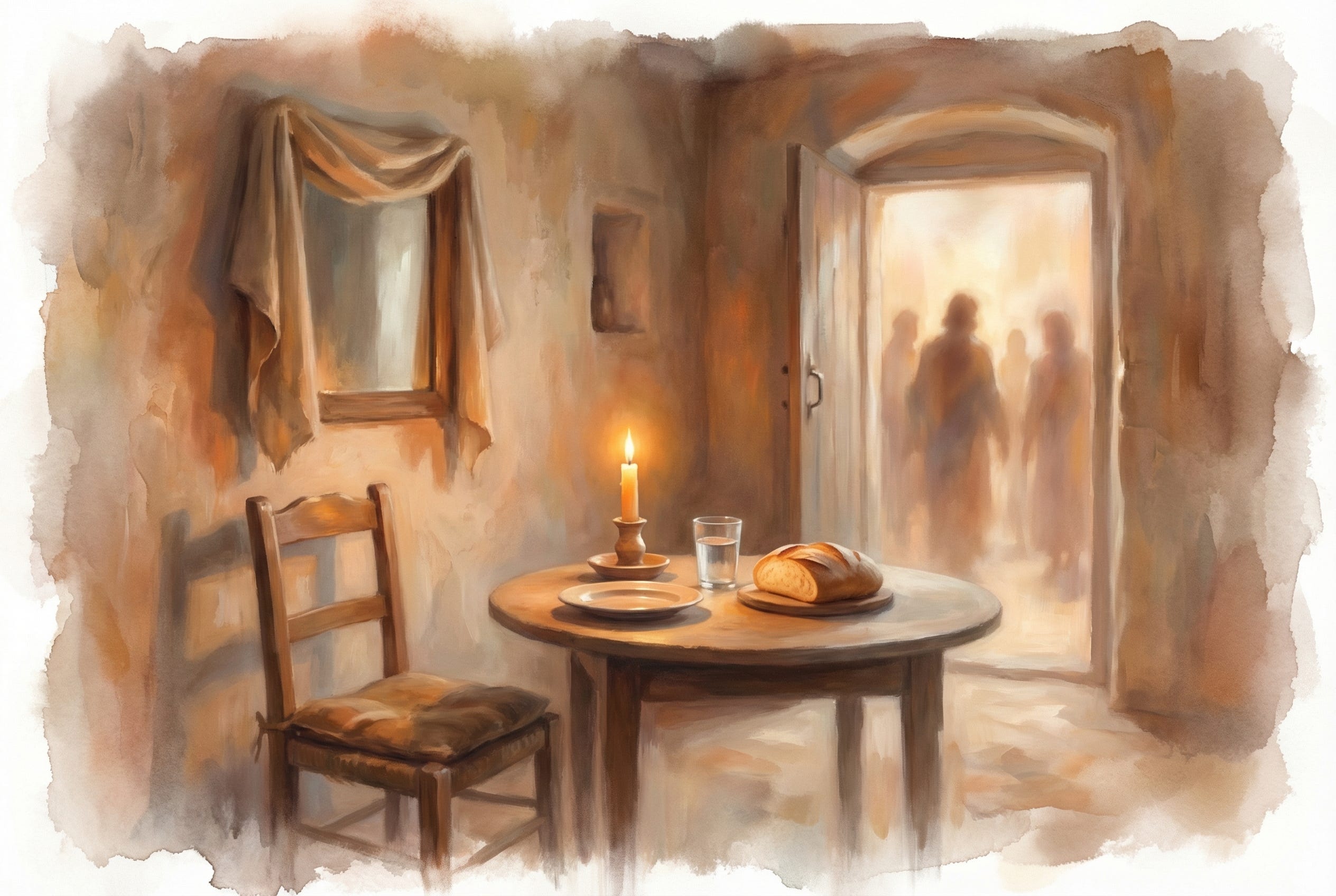
In Jewish tradition, shiva lasts seven days. You sit low. Mirrors are covered. The community comes to you. You don’t go to it. The structure is rigid not because grief is rigid but because without structure, grief becomes denial. The sitting, the prayers, the shared meals are protocols. They’re the community’s way of saying: this has ended. We see it. Now we can begin what comes next.
The Irish have the wake. The Māori have the tangihanga. The Torajan people of Indonesia keep their dead in the family home for months or years, treating them as “sick” rather than dead, until the community can afford the elaborate funeral that will finally mark the transition.13 Even the cultures that delay acknowledgment eventually perform it. Because without acknowledgment, you can’t adapt.
Van Gennep’s middle phase is where the real work happens. Denial converts to acceptance. The community stops pouring resources into what’s ended and begins building what comes next.
We have no mourning rituals for institutional death.
When a department’s core competency gets automated, we call it “transformation” or “optimization” or “digital modernization.” When an educational model dies, we call it a “cheating crisis” or an “integrity challenge.” When a profession’s verb layer gets stripped by agents, we call it “augmentation” or “upskilling opportunity.”
These are euphemisms. They’re the organizational equivalent of saying the hair is still growing.
The Deployment Overhang
In Anthropic’s analysis of real-world Claude Code sessions, they identify what they call the “deployment overhang,” a pattern specific to their dataset but likely representative of a broader phenomenon. A gap between what AI models can handle and what humans let them handle. Experienced users auto-approve agent actions at roughly double the rate of new users (about 40% versus 20%) but they also interrupt more frequently. The pattern isn’t “trust then ignore.” It’s “trust then watch more carefully.”14
This is mourning in its earliest stage. The experienced user has already accepted that certain tasks, the ones they used to perform manually, are gone. They’ve buried those tasks. They’re watching for something else now. Not whether the agent can do the work, but whether the new work (the monitoring, the evaluating, the deciding-when-to-interrupt) is the right work for a human to be doing.
In that same dataset, only 0.8% of agent actions are classified as irreversible, 80% involve at least one safeguard, and 73% show a human in the loop. We haven’t let go. Not really. We’re still checking the pulse of something whose heart stopped months ago. Still checking. Still watching. Still waiting for someone to tell us the transition is real.
The deployment overhang isn’t a technology problem. It’s a mourning problem. The agents are ready. We’re not. Not because we can’t trust the technology, but because we haven’t built the rituals to mark what we’re losing.
What We Pack for the Journey
The Egyptians buried their dead with everything they’d need for what came next. Tools, bread, gold, linen, servants carved in miniature. The Book of the Dead was a manual. Spells and instructions for navigating the underworld, indexed by hazard. The assumption behind all of it was continuity: the next world works like this one, so pack accordingly.
Every culture that buried grave goods made the same bet. The Vikings sent warriors off in burning ships with their weapons. The Chinese emperor filled a tomb with 8,000 terracotta soldiers. The logic was always the same: what got you here will get you there.
It didn’t. The goods stayed in the tomb. The skills were for a world that no longer applied.
I think about the tens of thousands of engineers at major companies right now carrying the same assumption. My React skills travel. My system design expertise is portable. I’ve shipped production code at scale, that goes with me wherever I go. And they’re not wrong about the past. Those skills were portable, because the world they moved between stayed roughly the same. You could take your tools from one company to another because both companies needed the same kind of toolwork.
But the world those skills were shaped for is the one that’s dying. The codebase you navigated by feel, the architecture decisions you made from hard-won instinct, the debugging intuition you built over a decade of 2 a.m. incidents. Those were grave goods. Valuable in the world that produced them. Not necessarily legible in the one that’s arriving.
You can’t pack for a world that hasn’t been built yet.
What We Bury, What We Keep
Everyone who has lost someone knows this part. The things that persist (the recipes written down, the photographs labeled, the process documents filed) look like the person is still there. The surface keeps performing life for a while. But the thing that made those artifacts mean something, the knower behind the knowing, is gone.
Knowledge isn’t information. It lives in people, not in the systems they leave behind. The particular way a senior engineer could read a failing build and know, not from the logs but from the shape of the failure, what had gone wrong. The analyst who could glance at a dataset and feel where it was lying. The teacher who knew which student’s silence meant confusion and which meant refusal. Those things can’t be stored, transmitted, copied, or indexed. When the person leaves, they leave.
This is where the organizational parallel gets uncomfortable. The verb layer I described earlier doesn’t just degrade when agents take over. It dies. And what persists (the data, the dashboards, the reports, the KPIs) looks like the organization is still alive. It’s still producing output. The hair and nails keep growing.
But the knowing is gone. And unless we mourn it, unless we name what has died and build new structures for what comes next, we’ll keep mistaking information for knowledge, retrieval for understanding, output for expertise.

The Question for This Year
I caught myself the other night. Typing, pausing, reading the screen. And in the pause I realized I couldn’t tell where my thinking ended and the agent’s output began. The boundary was blurry. Maybe it’s always been blurry. But I’d never been unable to find it before.
That’s what’s at stake. Not whether agents can do the work. They can. Not whether humans will be displaced. Some will. What matters is whether we can build the rituals (the institutional, cultural, educational, professional rituals) to mark what’s ending so we can face what’s beginning.
The earliest humans figured this out. They looked at death and invented burial. They looked at loss and invented mourning. They looked at the impossible gap between the living and the dead and built structures to cross it.
We need to figure it out again. Not for bodies this time, but for the structures and competencies and ways of knowing that are dying inside our organizations, our schools, our professions.
The agents are already inside. Shehu is right about that. They’re not at the gates. They’re past the gates, logged in, doing the assignments, filing the reports, writing the code. The question isn’t whether to let them in. The question is whether we have the courage to bury what they’ve replaced, and the wisdom to know what to carry forward.
I closed the laptop. Sat with it for a while. Thought about what’s ending and what’s arriving, and whether anyone gets to choose the boundary between them.
Grieve it and use it. Same morning. Same desk. An answer that shouldn’t satisfy anyone.
Hair and nails keep growing. Until it’s clear, completely and irreversibly clear, that they don’t.
Part of an ongoing exploration of human agency in the age of intelligent systems.
Further Reading
The Doing Was the Knowing: On CRUD, the verb layer, and what happens to expertise when agents take over the operations.
The Fire We Carry: On AI as environmental condition, cognitive offloading, and the quiet rewiring of the human mind.
Intentional Deskilling: On which skills to release, which to keep, and the difference between stripping and letting go.
Let the Robot Wars Begin!: On compiled intent, agency erosion, and who owns the verbs in 2026.
Relief Is Not Joy: On the difference between removing discomfort and creating meaning.
Footnotes
The common belief that hair and nails continue to grow after death is a persistent myth. What actually occurs is postmortem dehydration: the skin retracts from nail beds and hair follicles as moisture is lost, creating the illusion of continued growth. Vreeman, R. C., & Carroll, A. E. (2007). “Medical myths.” BMJ, 335, 1288-1289. See also: Vij, K. (2014). Textbook of Forensic Medicine and Toxicology: Principles and Practice. Elsevier.
The three-category framing used in this essay (tools, language, burial) is a narrative distillation of a much longer and more contested evidentiary record. McBrearty & Brooks (2000) catalog dozens of archaeological markers for behavioral modernity, including blade technology, worked bone, personal ornaments, structured living spaces, and exchange networks. The oldest known stone tools are from Lomekwi 3, Kenya, at ~3.3 million years ago: Harmand, S. et al. (2015). “3.3-million-year-old stone tools from Lomekwi 3, West Turkana, Kenya.” Nature, 521, 310-315. Language cannot be dated directly from the archaeological record; the ~100,000-year estimate derives from indirect evidence such as symbolic artifacts and ochre use. McBrearty, S., & Brooks, A. S. (2000). “The revolution that wasn’t: a new interpretation of the origin of modern human behavior.” Journal of Human Evolution, 39(5), 453-563.
The earliest evidence of deliberate burial dates to approximately 100,000 years ago at the Qafzeh Cave in Israel, where Homo sapiens interred their dead with red ochre and tools. The presence of grave goods suggests not just recognition of death but symbolic thinking about what follows it. Vandermeersch, B. (2006). “Ce que nous apprennent les premières sépultures.” Comptes Rendus Palevol, 5(1-2), 161-167. See also the Tinshemet Cave synthesis: Berger, L. R. et al. (2025). “Earliest known satisfactory evidence of deliberate human burial.” Nature Human Behaviour.
The liminal corpse phase, the period between biological death and social death, is a core concept in the study of death rituals. During this interval the dead person occupies an ambiguous status: biologically gone but socially still present, still addressed, still consuming communal resources. The concept derives from Victor Turner’s elaboration of van Gennep’s liminality framework. Turner, V. (1967). The Forest of Symbols: Aspects of Ndembu Ritual. Cornell University Press.
Van Gennep’s tripartite model of rites of passage (separation, liminal transition, and reintegration) remains the foundational framework for understanding death rituals across cultures. The liminal phase is where the actual psychological and social work of transition occurs; without it, communities remain stuck in the separation stage, unable to reassign social roles or redirect resources. Van Gennep, A. (1909/1960). The Rites of Passage. University of Chicago Press.
The four fundamental conflicts in literature (person vs. person, person vs. nature, person vs. technology/society, and person vs. self/the infinite) appear across narrative traditions worldwide. While categorization schemes vary, the core tensions map onto what anthropologists describe as the fundamental challenges of social, environmental, technological, and existential life. The four-tensions framework is an analytic lens proposed in this essay, drawing on a long tradition of conflict typologies in narrative theory and anthropology.
Anthropic’s research on agent autonomy, published February 18, 2026, analyzed millions of human-agent interactions. Software engineering accounted for 49.7% of all agentic tool calls. The next largest categories (business intelligence, customer service, sales, finance) each comprised only low single-digit percentages. Anthropic Research. (2026). “Measuring AI Agent Autonomy in Practice.” anthropic.com/research/measuring-agent-autonomy.
Amarda Shehu’s analysis of the Einstein AI tool, which autonomously logs into students’ Canvas accounts, monitors assignments, watches lectures, reads materials, writes essays, and posts to discussion boards, frames the phenomenon as a convergence of security, pedagogical, institutional, and philosophical failures rather than simply a cheating problem. Shehu, A. (2026). “The Agents at the Gates.” amardashehu.substack.com.
Jens Rasmussen’s three-level model of cognitive control (skill-based, rule-based, knowledge-based) and Parasuraman & Manzey’s work on automation complacency both illuminate how expertise degrades when humans are removed from the operational loop, a form of institutional death that is rarely mourned or even named. Rasmussen, J. (1983). “Skills, Rules, and Knowledge.” IEEE Transactions on Systems, Man, and Cybernetics, SMC-13(3), 257-266; Parasuraman, R. & Manzey, D. (2010). “Complacency and Bias in Human Use of Automation.” Human Factors, 52(3), 381-410.
The anthropology of mourning rituals reveals a consistent pattern across cultures: structured grieving serves to redirect communal resources from the dead to the living. Jewish shiva, Irish wakes, Māori tangihanga, and Torajan ma’nene’ all create bounded periods of acknowledgment that enable transition. Metcalf, P., & Huntington, R. (1991). Celebrations of Death: The Anthropology of Mortuary Ritual. Cambridge University Press.
Robert Hertz’s 1907 essay argued that death is not an instantaneous event but a social process requiring communal labor to complete. Mourning rituals exist to reorganize the living community: to close the social role of the deceased and redirect emotional and material investment back toward what persists. The dead require burial not for their sake but for ours. Hertz, R. (1907/1960). “A Contribution to the Study of the Collective Representation of Death.” In Death and the Right Hand. Free Press.
The fear of premature burial was widespread enough to shape mortuary customs across cultures and centuries. Waiting periods, wakes, and vigils served partly as verification protocols, structured observation to confirm that death had actually occurred before committing to irreversible burial. Bondeson, J. (2001). Buried Alive: The Terrifying History of Our Most Primal Fear. W.W. Norton.
The Torajan people of Sulawesi, Indonesia, maintain the deceased in the family home for extended periods, sometimes months or years, treating them as “to makula’” (a sick person) rather than dead. The community continues to feed, clothe, and speak to the body until an elaborate funeral ceremony (rambu solo’) can be performed. Anthropologists interpret this as a gradual letting go that allows the community to incrementally redirect investment from the deceased to the living. Metcalf, P., & Huntington, R. (1991). Celebrations of Death: The Anthropology of Mortuary Ritual. Cambridge University Press.
The “deployment overhang” describes the gap between what AI models can handle autonomously and what humans actually permit them to do. Experienced users (750+ sessions) auto-approve at more than double the rate of new users (~40% vs ~20%), but also interrupt more frequently (9% vs 5%), indicating a shift from step-by-step approval to strategic monitoring. Anthropic Research. (2026). “Measuring AI Agent Autonomy in Practice.” anthropic.com/research/measuring-agent-autonomy.
Michael, really enjoyed this thoughtful piece. The part about mourning as technology was very interesting to me. I never looked at grief rituals from this angle before. That is a very practical way to understand something we usually see as only emotional.
I wanted to ask you something. You talked about the shift from nouns to verbs. This made a lot of sense to me. But if AI/AI agents are now taking over the verbs, the execution and the actions and outcomes, what are we humans in this sentence?
Are we becoming the adjective? The ones who shape the quality of those outcomes, who decide what is "good" or "meaningful" in what AI produce? Not doing the work, but giving direction and meaning to it?
Or should we accept that some of our skills are dead, like you said, and focus on adapting , maybe even augmenting AI to cover our own weaknesses instead of competing on execution?
And one more thing , if AI/agents produce better quality work more efficiently, how do we value work at all? Our systems of money and compensation are built on human effort. I do not have a clear picture of how we will measure the value of human work versus agent work in five or ten years. Are we changing our financial system as well? Do you have thoughts on this?
Thank you for writing this again. It is the kind of piece that makes you sit and rethink your own assumptions.
Michael, highly provocative and thoughtful piece, as usual. I had never thought of grief as structured resource allocation. But now I cannot unsee it. In Albania, you mourn the dead for a specific amount of time, as in most cultures. You do this communally. When our father died, the physical toll on my family was immense, because an essential part is to welcome, receive, and recount stories with the community for days. Your piece helped me see that the exhaustion is not incidental but the very deliberate mechanism. The ritual (literally, physically) spends you out of denial. You cannot sustain it, and that is the point. The community transitions because the mourning itself makes staying impossible. What strikes me about our institutional moment is that we have no equivalent cost. The euphemisms are free. "Transformation," "optimization," "modernization." These require no sitting low, no communal presence, no physical depletion. So the mourning never completes in a sense, and we remain in that Torajan phase you describe in your piece, tending what has ended as though it were merely ill. Something is lost, and we feel it. But feeling is not the same as building the structure to move through it.