

How the cost of finding patterns went from fortune to free
I'm watching something strange happen in our labs. A designer pulls a color palette from a sunset photo using an AI image-picker, merges it with animation physics from a Pixar paper via a pre-built engine, adds interaction patterns from a 1960s Braun appliance manual found in a digital pattern library, and ships a working prototype before lunch.
This should feel revolutionary. Instead, it feels inevitable.
We've crossed a threshold where the energy required to find and apply patterns—any pattern, from any domain, from any era—has effectively collapsed to zero for anyone with a modern phone and stable bandwidth. But this isn't new behavior. Humans have been pattern thieves for thousands of years. What's new is the physics of it all.

The Pattern Thieves We've Always Been
Vivaldi extended what Corelli had started with the concerto grosso form and helped popularize the solo violin concerto. Not invented from nothing—evolved and amplified.
Islamic mathematicians took Hindu numerals, Greek geometry, and Babylonian astronomy, stirred them together, and gave us algebra (Al-Khwarizmi, c. 820 CE). The word itself—al-jabr—means "the reunion of broken parts."
Crick and Watson didn't discover the double helix in isolation (Elkin, 2003). They borrowed X-ray crystallography patterns from Rosalind Franklin (Photo 51 was shown to Watson without her permission—a crucial ethical breach), chemical insights from Chargaff, and structural intuitions from Pauling. The breakthrough was in the assembly, not the elements.
This is what humans do. We're cognitive magpies, stealing shiny patterns from wherever we find them. The difference between then and now isn't the stealing—it's the cost of the heist.
When Patterns Had Weight
In 1991, if you wanted to use a compelling chord progression you heard in a jazz record, you needed:
The record itself ($15-30)
Time to transcribe by ear (hours)
Music theory knowledge to understand what you heard (years)
An instrument to reproduce it (hundreds to thousands)
Recording equipment to capture it (thousands)
Total activation energy: Prohibitive for most.
Today, Shazam identifies the song instantly. AI extracts the chord progression in seconds. MIDI transforms it into any instrument you want. The entire workflow happens on a phone you already own.
The technical barriers have collapsed—though legal and licensing costs often remain, and LLM inference still carries compute costs. It's an economic phase transition in cognitive work. Like water becoming steam, the fundamental properties have changed.
The Exponential Collapse I'm Seeing
What's happening in our teams isn't gradual improvement. It's a discontinuous jump.
Last month, I watched a team implement a complex authentication flow. Not by learning OAuth—by recognizing that the pattern they needed already existed, pre-packaged, tested by millions, ready to deploy. The conversation went like this:
"We need users to log in securely." "Use this auth pattern." "But how do we—" "You don't need to know how. You need to recognize and apply."
They had it working in under an hour. (Yes, they still need to verify security and compliance—but the implementation barrier vanished.)
This same collapse is happening everywhere:
Architects pulling passive cooling patterns from termite mounds and applying them to office towers (like Harare's Eastgate Centre)
Musicians mixing church hymns with hip-hop beats
Engineers applying graph-neural-network (GNN) solvers—first proven on protein-folding graphs—to logistics routing (AWS Science Blog, 2022)
Writers mixing narrative structures from different centuries and cultures in real-time
The boundaries between domains are dissolving because the cost of crossing them has vanished.
The Universal Patterns Emerging
My friend Sam Schillace pointed out something I'd been sensing but couldn't articulate: some patterns work because they match human biology. The octave recurs in most documented tonal systems because of how our cochlea processes the 2:1 frequency ratio - among several theories (Jedrzejczak, 2012). The hero's journey appears widely across mythologies because it maps to recurring social challenges (Campbell, 1949).
These aren't arbitrary patterns—they're affordances. They work because they align with how humans are built.
I suspect we're about to see the same thing in software. Just as movies converged on certain shot patterns (establishing shot, close-up, reaction shot) because they match how we process visual narrative, apps will converge on interaction patterns that match how we process digital experiences.
The difference? It took cinema decades to find these patterns. Software will find them in months.
A New Physics of Value Creation Emerges
In the Licensed Software Era, value was trapped in artifacts. You paid for the thing itself. High activation energy meant expertise was scarce and expensive.
In the SaaS Era, value flowed through services. You paid for access. Medium activation energy meant expertise was still valuable but increasingly democratized.
In the AI-Native Era we're entering, value emerges from outcomes. You pay for results. Low activation energy means expertise shifts from knowing how to knowing what's worth doing.
In the Post-Scarcity Era approaching, value will concentrate in attention and taste. You'll pay for curation and judgment. Near-zero activation energy means the ability to choose becomes more valuable than the ability to create.
This isn't speculation. I'm watching it happen in real-time with teams and others.
The Paradox No One's Talking About
Here's one thing that continued to bother me: when finding patterns becomes free, creating new patterns becomes exponentially harder.
Think about it. Every song now competes with every song ever recorded, instantly accessible. Every design competes with every design ever documented. Every idea competes with every idea ever digitized. More than 100,000 new tracks hit all major digital streaming platforms each day—that's 2.8 million per month flooding into a catalog of 202 million existing tracks, where 87% generate zero income (Variety, 2022).
We're approaching a creativity event horizon where the gravitational pull of existing patterns becomes so strong that escape velocity—true originality—requires exponential or super-exponential energy.
Yet paradoxically, this same force enables combinations that were impossible when patterns lived in silos. The country musician who never heard hip-hop beats. The app designer who never studied vintage poster layouts.
The startup founder who never learned Toyota's assembly-line methods. Those boundaries are gone.
What I Tell Teams Now
The old model was: become an expert in a domain, master its patterns, carefully apply them. That made sense when activation energy was high. Mastery was valuable because pattern access was expensive.
The new model is: become fluent in pattern recognition across domains, develop exquisite taste, compose fearlessly. The skill isn't in knowing patterns—it's in knowing which patterns serve which purposes.
I see three responses to this shift:
Those who resist it, insisting on building everything from first principles. They're like musicians refusing to use samples, creating unnecessary friction in pursuit of phantom authenticity.
Those who surrender to it completely, becoming pure pattern-matchers with no original thought. They're remixers without taste, creating noise from signal.
Those who surf it, using the collapsed activation energy to explore more widely, combine more boldly, and ship more purposefully. They understand that when finding patterns is free, choosing patterns becomes art.
The Deeper Implication
We're not just changing how we work. We're changing what work is.
When a Renaissance artist spent years learning to mix pigments, that knowledge had value. When anyone can access any color instantly, the value shifts to knowing which color serves the emotional moment.
When a programmer spent months learning a framework, that knowledge had value. When anyone can deploy any framework instantly, the value shifts to knowing which framework serves the human need.
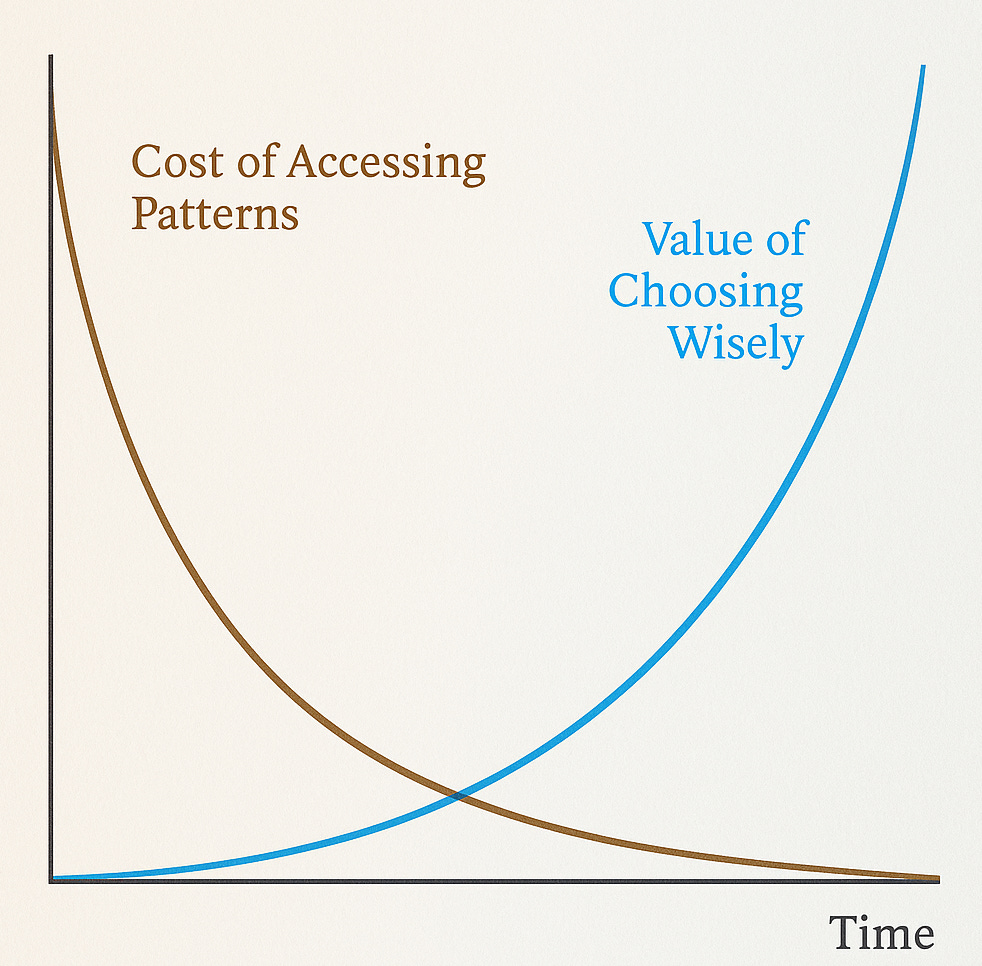
The curve isn't just exponential—it's exponential in both directions. The cost of accessing patterns plummets while the value of choosing wisely soars.
Your Organization's Physics
Every organization I work with is somewhere on this curve, usually without knowing it:
Some still operate like pattern access is expensive. They hoard knowledge, create elaborate training programs, build moats around expertise. They're optimizing for a physics that no longer exists.
Others have recognized the shift but haven't adapted their value model. They give away pattern access for free, wondering why their margins are collapsing. They're playing by new rules with old economics.
The ones thriving? They've recognized that when patterns become commodities, curation becomes currency. They're not selling the patterns—they're selling the taste to choose them and the judgment to apply them.
The Question That Matters
So here's what I'm asking every leader, every creator, every team:
If you could access any pattern from any domain instantly—which you increasingly can—what would you build?
And more importantly: how would you decide?
Because that decision, that act of choosing, that application of taste and judgment—that's where human value concentrates as activation energy approaches zero.
The patterns are all there, waiting. They always have been. For thousands of years, we've been building our world from these reusable components. The difference is that now, for the first time in human history, the cost of reaching them has effectively vanished.
What remains is the cost of choosing wisely.
And that cost? It's going up.
What patterns are you seeing collapse in your domain? What's becoming free that used to be expensive? And what's becoming expensive that used to be free? Would love to hear your observations.
References
Al-Khwarizmi, M. (c. 820 CE). Al-Kitāb al-mukhtaṣar fī ḥisāb al-jabr wal-muqābala [The Compendious Book on Calculation by Completion and Balancing].
AWS Science Blog. (2022). Supply chain network optimization. Retrieved from https://aws.amazon.com/blogs/supply-chain/supply-chain-network-optimization-cutting-through-complexity-to-maximize-efficiency/
Campbell, J. (1949). The Hero with a Thousand Faces. Bollingen Series XVII.
Chamber Music Society of Lincoln Center. (n.d.). Virtuosity in Vivaldi's Concertos. When Vivaldi was starting out, the concerto form popularized by Rome-based composer Arcangelo Corelli dominated Italian instrumental music. Retrieved from https://www.chambermusicsociety.org/news/virtuosity-in-vivaldis-concertos/
Elkin, L. O. (2003). Rosalind Franklin and the Double Helix. Physics Today, 56(3), 42-48. The diffraction photograph of the B form of DNA taken by Rosalind Franklin in May 1952 was by far the best photograph of its kind.
Jedrzejczak, W. W., et al. (2012). Musical Ratios in Sounds from the Human Cochlea. PLOS ONE, 7(5), e37988. The physiological roots of music perception are a matter of long-lasting debate. Recently light on this problem has been shed by the study of otoacoustic emissions (OAEs), which are weak sounds generated by the inner ear.
Variety. (2022, October 7). Music Streaming Hits Major Milestone as 100,000 Songs are Uploaded Daily to Spotify and Other DSPs. Retrieved from https://variety.com/2022/music/news/new-songs-100000-being-released-every-day-dsps-1235395788/