

You can stand in the eye and see blue sky. The wind drops. The pressure in your ears releases. Somebody who has never lived through one walks outside and assumes the storm has passed.
It hasn’t. The eye is what a storm produces when it has organized itself. The storm rotates around the eye, not the eye around the storm. The quietest place in a hurricane is the hurricane at its most organized.
This is something I think about often. Last week it surfaced again, in a conversation with a colleague working on how AI affects the human mind, and the eye of a storm was the image we ended up at.

We talk about agency as if it were output. Choosing, clicking, deciding, moving things forward. As if the person doing more is more in charge of their life. A lot of what we call action does not feel that way once you slow it down. It is closer to momentum. The next email arrives, you reply. A notification fires, you check. A suggestion appears, you take it. The activity is real. The choosing is mostly missing.
Real agency is quieter than that. It is the small moment before the action, when an impulse can be noticed instead of obeyed.1 When a reason can be weighed against another reason. When you can ask whether the obvious next move is the right one, or just the loudest. Most days I do not get to that moment. I am already three replies in.
I notice this in myself most clearly when I cannot find the pause. When the pace feels normal but every decision is being made for me by whatever showed up first. The trouble is rarely that life has gotten busier. It is that the inside has thinned out, and the outside starts running the show.
Reaching the pause is harder than it sounds. It is the moment you can no longer blame the moment. You cannot point to the person who sent the email, or to how busy you are, or to the obvious thing that needed to be done. You have to do something with the situation in front of you, knowing it is yours.
Staying in the pause is not the goal either. Endless deliberation is its own failure. The point is to hold a center while still moving, to keep the place where you weigh reasons connected to the place where you act. A still mind that does nothing is paralysis. A busy life with no still mind is most weeks.
Most of modern life is engineered for the second one.
Feeds shape what we look at. Tools suggest the next action. Models complete our sentences, then the paragraphs after them, then begin to shape the thinking that would have produced the paragraphs. The slow sequence of learning, doing, getting better, doing it again, is compressing into a single moment. Capability that once took years can now be summoned on demand.
None of this strips agency in any dramatic sense. It just makes the inside smaller. The danger is not that we stop being able to act. We do not stop. The danger is that more is produced through us than by us,2 and the part of us that would have asked whether to do it is gone before we notice.
I see three habits in people, and I have been each of them.3
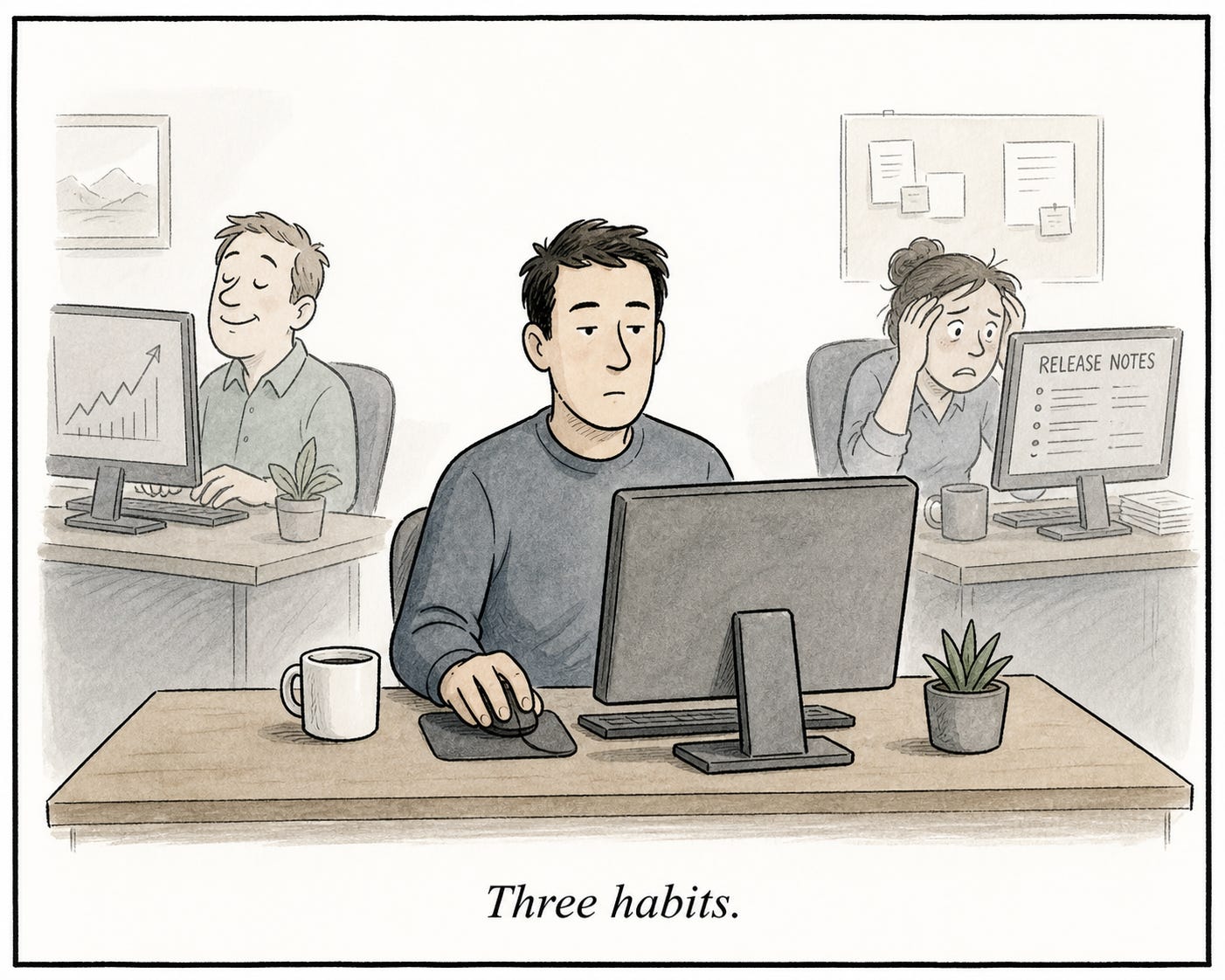
Some do not feel anything has changed. Output is rising, tools work, things feel efficient. They take this as proof that nothing important has shifted. Others feel the change as constant pressure. Every new model is a structure to adapt to. Every release is a verdict. They are not calm and they are not still. The third habit is harder. It is to know things are changing, decline to be carried, and try to hold a steady place the rest can move around. That is not calm because nothing is happening. It is calm because nothing is pushing.
A small test, mostly for myself. Before a decision that feels obvious, I try to notice where the obviousness is coming from. If I cannot tell, I am usually being pushed. The feeling of being sure and the feeling of being pushed are easy to confuse. They are not the same thing.
There will always be a storm. What I want to know, in my own life and in the systems we are now building, is whether the center holds.4
Philosophers call this reasons-responsive control. The cleanest version is in John Martin Fischer and Mark Ravizza's Responsibility and Control (Cambridge, 1998). The idea is that you act freely not when nothing causes you, which is impossible, but when the thing that causes your action is your own capacity to weigh reasons and could have responded differently to a different reason.
In the AI ethics literature, this is usually discussed as the distinction between persuasion and manipulation. See Micah Carroll, Alan Chan, Henry Ashton, and David Krueger, "Characterizing Manipulation from AI Systems," EAAMO 2023, which analyzes manipulation through incentives, intent, covertness, and harm. For the autonomy-centered account of manipulation as covert influence that exploits decision-making vulnerabilities, see Daniel Susser, Beate Roessler, and Helen Nissenbaum, "Technology, Autonomy, and Manipulation," Internet Policy Review 8, no. 2 (2019), doi: 10.14763/2019.2.1410. For engagement-based ranking and divisive content, see Smitha Milli et al., "Engagement, user satisfaction, and the amplification of divisive content on social media," PNAS Nexus 4, no. 3 (2025): pgaf062, doi: 10.1093/pnasnexus/pgaf062.
This paragraph extends, by analogy, the engaged-followership reinterpretation of Milgram. The original Milgram studies were often read as showing blind obedience to authority. A major contemporary reinterpretation, associated with Stephen Reicher, S. Alexander Haslam, Megan Birney, and collaborators, argues that compliance is better understood as identification with a role, authority, or shared mission. See Megan E. Birney, Stephen D. Reicher, and S. Alexander Haslam, "Obedience as 'Engaged Followership': A Review and Research Agenda," Philosophia Scientiæ 28, no. 2 (2024): 91-105, doi: 10.4000/11ptx. My use of the frame here is analogical: denial and alarm are not literally Milgram-like obedience, but both can become forms of identification with a reaction rather than authorship of one.
The phrase echoes W. B. Yeats's "The Second Coming": "Things fall apart; the centre cannot hold." The poem was written in 1919 and first published in 1920, in the aftermath of World War I. The essay's use of the line is structural rather than apocalyptic: a person, institution, or society can continue to function externally while losing the substantive capacity for self-direction.
Love this for many reasons but especially this power of pause
I suppose recognition may be the only thing that can bring the center back...