

How clear thinking, healthy neural loops, and the right algorithms enable us to create human agency in an age when AI (and work) never stops.
Happy Mother's Day! A day that reminds us the most lasting human skill we pass on isn't output—it's agency. In that spirit, I'm naming this collection "The Arc: Exploring how humans stay human in the age of AI."
The Core
Agency isn't output. It's authorship.
It's noticing real options, choosing one you stand behind, and acting on it. You build this capacity by anchoring to first-principle "Lego bricks," running them through a brain loop of working-memory and metacognition, and letting well-designed AI cancel the busy-work that clogs your thinking.
1. The Ask From the Chief
"Minutes before I came to see you, I told parents their child didn't make it. Ten minutes from now I'll do it again. It's the most important part of my job, to express humanity where our families need it most. My residents are drowning in charts, emotions, team supervision. How can AI help us be more human—more present—in those rooms?"
That ask from a leader in pediatric cardiology after one of my conversations with hospital staff captures the paradox at the heart of our technological moment. Technology promises efficiency but often steals presence. Yet this doctor's question points toward something deeper—the possibility that the right AI, deployed with the right intention, might actually restore our humanity rather than diminish it.
When was the last time you felt fully present in a high-stakes moment? Not just showing up, but bringing your whole self—your values, your attention, your capacity to truly see the person across from you?
2. What We Mean by Agency
Agency is the ability to hold options in mind, weigh them against your own first principles, and move. It is not autopilot, reflex, or outsourcing decisions to habit loops; those states still generate behavior, but the individual no longer authors the link between value and action.
Bandura calls this “proxy” or “collective” control rather than personal agency. No mystical free‑will debate required; it's a repeatable neural process—and we can train it (Bandura, 2018).
Think of agency as a three‑step loop: See options → Choose for your own reasons → Act & learn. The stronger the loop, the more life feels like steering, not drifting.
This definition builds on what researchers call "agentic capacity" (Bandura, 2018)—our power to influence our own functioning and life circumstances. Not just theoretical freedom, but practical effectiveness.
If agency can be trained, it can be manufactured.
Not mass-produced, but deliberately crafted—one neural circuit at a time
3. First Principles: Lego Bricks That Never Lie
Grab a Lego brick. No matter what dragon or star‑fighter you build, the brick stays true to its studs and dimensions. First principles are those unbreakable bricks in thought: Energy is conserved. Every child deserves dignity in pain. Build on wobbly bricks, castles collapse. Strip a mess to bricks, you can build anything.
This "from-first-principles" approach draws from Aristotle's conception of axioms (Feser, 2019) and has been modernized by figures like physicist Richard Feynman and entrepreneur Elon Musk as a way to reason through complex problems by returning to bedrock truths rather than inherited assumptions.
4. Logic: The Seatbelt on Creativity
Once the bricks are on the table, logic keeps the car on the road.
Formal tools (truth tables, Bayes' theorem) are just ways to double‑check those moves so hidden cracks don't take us down. Dual-process work since (Evans & Stanovich, 2013) reinforces the point: analytic “System 2” is the seatbelt that keeps intuitive “System 1” from drifting off the road.
This logic framework echoes what psychologists call "System 2" thinking (Kahneman, 2011)—the deliberate, analytical processes that keep our faster "System 1" intuitions in check.
5. The Brain Loop in Plain English
Pull the Bricks – Your hippocampus fishes first principles from the depths of memory (Eichenbaum, 2017).
Juggle Options – Working memory (dorsolateral PFC + parietal) holds these 3 to 4 bricks in the air, sketching "what-ifs" in real time (D'Esposito & Postle, 2015).
Watch Yourself Think – Metacognition (anterior cingulate + insula) stands guard, checking for overload or bias (Fleming & Dolan, 2012).
Pick & Fire – Your valuation circuit (linking orbitofrontal cortex and basal ganglia) carries the vote, committing to action (Stalnaker et al., 2015).
Store the Lesson – Each spin (through the hippocampus) writes brick + outcome back to memory, updating the system (Schapiro et al., 2017).
This is the physical footprint of agency—not mystical, but magnificently real.
6. Two Tiny Habits to Expand the Loop
(10 min total)
Habit A: Picture-Echo Game (4 minutes)
Download a free “2-back” app (search for “N-back” in your app store).
Start the game. You’ll see one picture every second.
Tap only when the current picture matches the one from two pictures ago.
(It goes fast. Stay sharp.)
If you miss 2 or fewer, the game gets harder next time.
Why it matters: This game strengthens your working memory—the mental “desk” where you juggle multiple ideas at once.
Habit B: Say–Solve–Store Chain (6 minutes)
Grab a partner.
They say a math problem, like “3 + 4 = ?”
You answer (“7”), and they immediately say a random word (e.g., “maple”).
Repeat with 4–5 math/word pairs.
Try to recall all the words, in the exact order they were said (“maple, cat,..”).
Switch roles and repeat.
Why it matters: This trains your brain to multitask and “chunk” info—reducing mental overload in real-life situations.
📅 Tip: Do this once in the morning and once mid-afternoon. Just 10 minutes a day.
Studies show the drills reliably boost skills on tasks that look a lot like the game itself—other short-term-memory puzzles and similar tests (Morrison & Chein 2011). Whether that improvement carries over to everyday decisions that have little to do with memory games is still an open question; recent reviews say “interesting, but not proven yet” and call for more data (Evans & Stanovich 2013).
7. Quick Self‑Check on Metacognition
(5 min Friday ritual)
1. Create a personal 10-item awareness checklist with statements like:
• "I notice when fatigue affects my decisions"
• "I catch myself when I'm rushing to judgment"
• "I recognize when emotions are clouding my thinking"
Rate each 1-5 (1=rarely true, 5=consistently true)
2. Review one key decision from your week:
• What assumption proved correct? ("Patient needed space, not solutions")
• What didn't work as expected? ("Tried to multitask the conversation")
3. Test your memory calibration:
• Choose three new terms or facts you learned this week
• Predict which one you'll remember in an hour (set a reminder)
• Check your prediction when the reminder fires
Track these three scores (awareness rating, decision accuracy, memory calibration) in a simple spreadsheet. If they decline over time, it's your early warning system for burnout or overload.
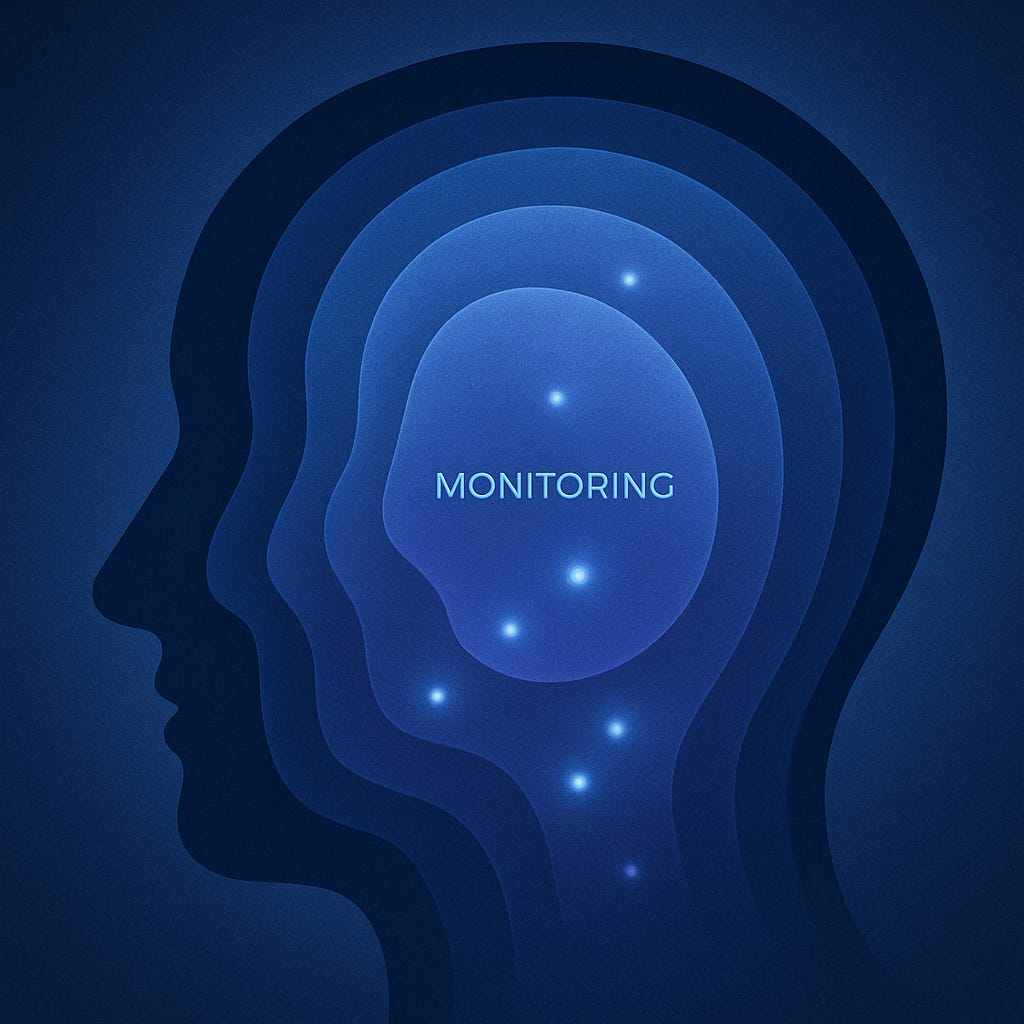
This metacognitive practice draws from research on cognitive calibration and debiasing (Dunlosky & Metcalfe, 2009), showing that routine self-assessment significantly improves decision quality.
8. Where AI Fits (and Where It Doesn't)
Litmus test: If the tool frees working memory and sharpens metacognition, keep it. If it dulls either, rethink.
AI processes linearly. Humans think topologically.
Sam Schillace reviews this fundamental difference in cognitive architecture that explains why AI struggles with certain kinds of tasks—and why it should complement rather than replace human thought. The right tools amplify our non-linear cognitive strengths rather than flattening them into AI's more constrained topology.
This approach aligns with cognitive-offloading work (Risko & Gilbert 2016), yet benefits are highly task-dependent and can back-fire—for example, offloading trivia to a computer improved location memory but reduced recall of the facts themselves.
AI runs algorithms. Humans run experiments. AI optimizes. Humans transform.
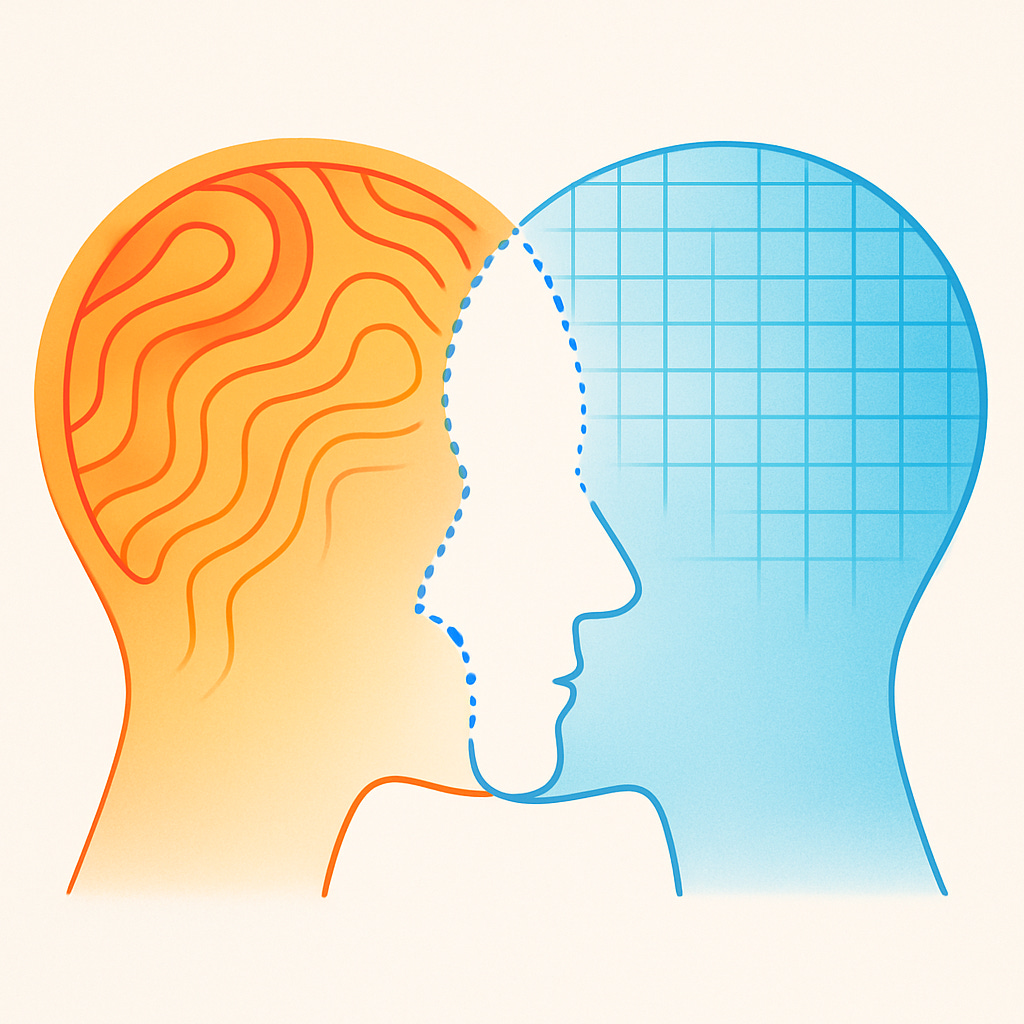
Remember that over-offloading can erode metacognitive calibration over time; build in periodic “no-tool” drills to keep the internal circuits honest (Risko & Gilbert 2016; Malik & Malik 2020).
9. The First & Last Principle
Human presence with the person in need is sacred.
Everything else—chart fields, calendar invites, org charts—is negotiable.
Presence is the boundary between personal agency and mere automation.
Run the three levers: free the scratch-pad, watch the watcher, audit the bricks.
Let AI be your sous-chef, not your replacement.
You don't just manufacture efficiency.
You manufacture agency at scale.
Because in manufacturing agency, we don't just produce better decisions. We produce more present humans. And presence—fully being there for another person—is the rarest resource in our accelerated world.
Because technology isn't meant to replace human meaning-making—it's meant to amplify it. Not to make us superhuman, but to keep us fully human in a world pulling us away from ourselves.
Next Steps
Try the two habits for 7 days. Note any drop in "where‑was‑I?" moments.
Share one story where automation bought you a moment of real human presence.
Pass this playbook to someone buried in busy‑work.
Because the point of all this tech is to keep us human, not make us superhuman. Not more output. More presence.
References
Bandura, A. (2018). Toward a psychology of human agency: Pathways and reflections. Perspectives on Psychological Science, 13(2), 130-136. https://doi.org/10.1177/1745691617699280
D'Esposito, M., & Postle, B. R. (2015). The cognitive neuroscience of working memory. Annual Review of Psychology, 66, 115-142.
Dunlosky, J., & Metcalfe, J. (2009). Metacognition. SAGE Publications.
Eichenbaum, H. (2017). Memory: Organization and control. Annual Review of Psychology, 68, 19-45.
Evans, J. St. B. T., & Stanovich, K. E. (2013). Dual-process theories of higher cognition: Advancing the debate. Perspectives on Psychological Science, 8, 223-241.Bandura, A. (2018). Toward a psychology of human agency: Pathways and reflections (pp. 131-132).
Feser, E. (2019). Aristotle's revenge: The metaphysical foundations of physical and biological science. Editiones Scholasticae.
Fleming, S. M., & Dolan, R. J. (2012). The neural basis of metacognitive ability. Philosophical Transactions of the Royal Society B: Biological Sciences, 367(1594), 1338-1349.
Kahneman, D. (2011). Thinking, fast and slow. Farrar, Straus and Giroux.
Malik, A., & Malik, P. (2020). Cognitive offloading: An emerging concept – a review study. International Journal of Home Science, 6(2), 80-84.
Morrison, A. B., & Chein, J. M. (2011). Does working memory training work? The promise and challenges of enhancing cognition by training working memory. Psychonomic Bulletin & Review, 18(1), 46-60. https://doi.org/10.3758/s13423-010-0034-0
Risko, E. F., & Gilbert, S. J. (2016). Cognitive offloading. Trends in Cognitive Sciences, 20(9), 676-688.
Schapiro, A. C., Turk-Browne, N. B., Botvinick, M. M., & Norman, K. A. (2017). Complementary learning systems within the hippocampus: A neural network modelling approach to reconciling episodic memory with statistical learning. Philosophical Transactions of the Royal Society B: Biological Sciences, 372(1711), 20160049.
Stalnaker, T. A., Cooch, N. K., & Schoenbaum, G. (2015). What the orbitofrontal cortex does not do. Nature Neuroscience, 18(5), 620-627.
Further Reading
Out of Time - How AI acceleration changes our experience of productivity and downtime
The Last Skill - Why learning through friction remains essential when AI makes answers frictionless
The Warp and Woof of Computational Intelligence - How humans and AI form an intertwined tapestry
AI Thought is Different - How the linear topology of AI cognition fundamentally differs from human thought's parallel, self-modifying architecture
Your reflections and corrections are welcome in the comments!