

The Ninety-Two Day Standoff
For three months, fifteen books sat on my desk. I'd read them in parts, annotated sections, flagged key passages. The task was simple: catalog them into a research matrix with page counts, summaries, tags, and links. The kind of administrative tidying that separates serious research from scattered insights.
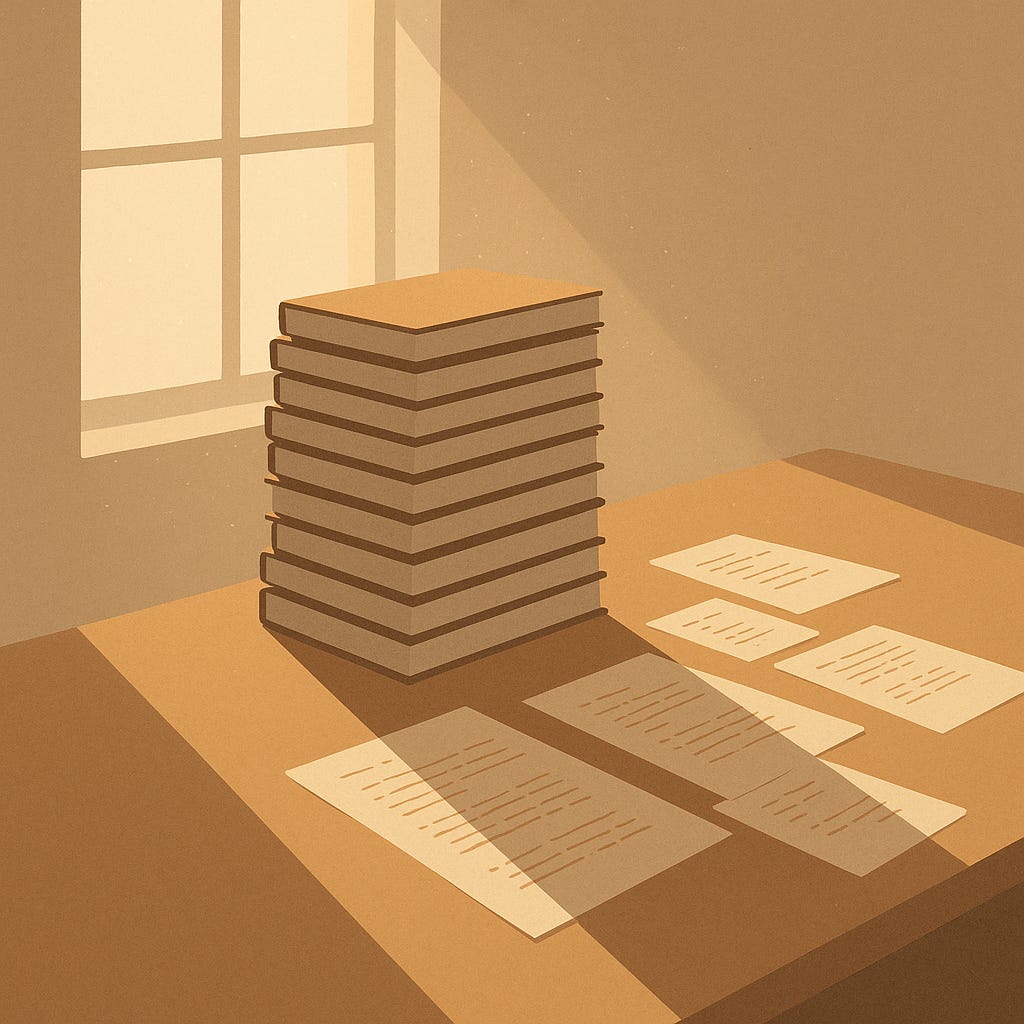
Every morning, I'd see the stack. Every morning, I'd calculate: fifteen minutes per book for proper documentation, maybe twenty with interruptions. Five hours total. Not impossible. Not even particularly hard.
Yet for ninety-two days, those books remained uncataloged and disorganized.
This wasn't procrastination in the classical sense. I wasn't afraid of the work or uncertain about the outcome. I was trapped by what chemists call activation energy—the minimum input required to initiate a reaction. In human terms: the invisible tax of context-switching, tool-finding, format-deciding, and the gnawing suspicion that any "quick task" is lying about its duration.
The Chemistry of Inaction
In chemistry, activation energy is elegant and predictable. Mix zinc and sulfur as fine powders and they'll sit on your lab bench indefinitely, completely stable. Touch that mixture with a heated metal rod, however, and a violent reaction erupts—light, heat, and the formation of zinc sulfide. The reaction was always favorable, always waiting to happen. It just needed that initial push over the energy hill.
Human tasks work the same way, but our activation energy is psychological. It's not measured in temperature but in perceived friction—the mental load of transitioning from current state to task state. And unlike chemical reactions, our threshold is contextual, fluctuating, often irrational.
That stack of books? The actual work energy was maybe 3 units (on some arbitrary scale). But the activation energy—opening Excel, remembering my citation format, finding ISBN lookups, context-switching from whatever I was actually doing—felt like 30 units.
So the books sat. Judging me. Accumulating dust and guilt in equal measure.
The Loop That Traps Us
I've watched this pattern in hundreds of workshops, in every organization I've worked with. Tasks don't fail because they're hard. They fail because they're awkward. They live in the Forgotten Task Loop:
Intent → Perceived Overhead → Deferral → Memory Decay → Guilt → Refreshed Intent
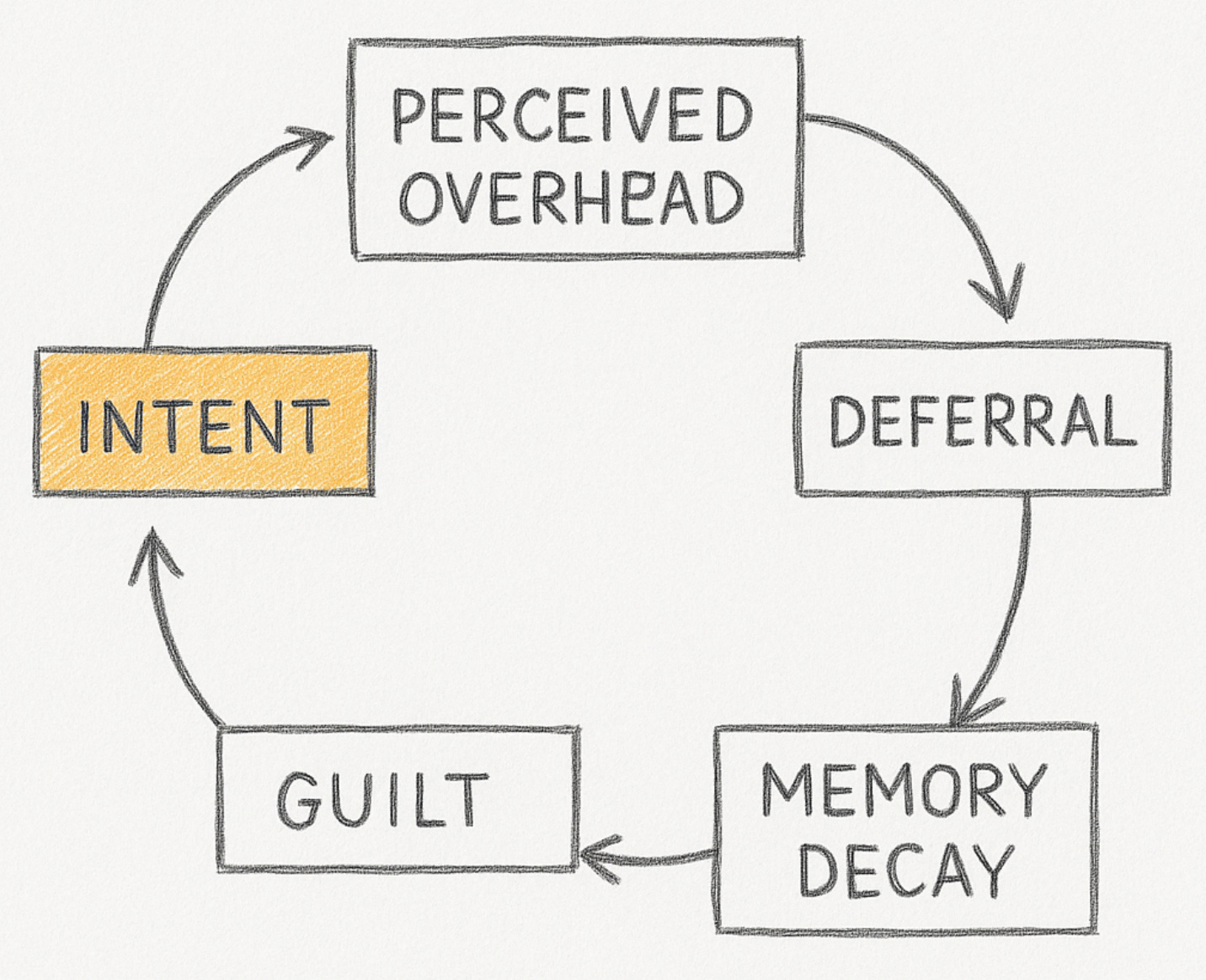
Each cycle makes the task heavier. The guilt compounds. The context becomes hazier. What started as "organize these books and summarize my findings" becomes "figure out what I was trying to do with those books and also why I'm avoiding this task."
When the energy to start exceeds the energy to complete, the task becomes functionally impossible, regardless of its actual difficulty.
The Five-Minute Redemption
Last week, something shifted. Not my motivation—that had been constant for three months. Not my schedule—I'd had dozens of "free" five-hour blocks. What changed was my approach to the activation barrier itself.
I grabbed my phone, took fifteen photos of book covers, and uploaded them to an AI agent with a single instruction:
"Create a CSV with title, author, year, page count, genre tags, 5-bullet summary of key concepts, Amazon link. Also generate a one-page brief for each book focusing on relevance to AI-human collaboration research."
Five minutes later, I had:
A perfectly formatted CSV ready for my research database
Fifteen one-page briefs I could annotate
A bibliography file ready for Zotero import
Zero guilt
The task wasn't accomplished through willpower or better time management. It was accomplished by removing the activation barrier entirely.
Activation-Energy Surgery (A.E.S.)
This experience crystallized into a practice I now use daily. I call it Activation-Energy Surgery—the deliberate removal of startup friction from necessary but annoying tasks. Three principles:
1. Atomize — Define only the artifact you want, not the process
Wrong: "I need to organize my research"
Right: "I need a CSV with these seven columns"
2. Externalize — Push all scaffolding work to an AI assistant
Don't describe how to do it. Describe what done looks like.
3. Standardize — Use consistent schemas so outputs plug directly into existing workflows
The CSV format I requested? It's the same one I've used for three years. No adaptation required.
The Forgotten Tasks Hiding in Plain Sight
After the book victory, I went hunting for other forgotten tasks—those zombies shuffling around the edges of productivity. Here's what I liberated:
Meeting Archaeology
Input: Six weeks of scribbled notes
Output: Structured "Decisions & Owner" matrix + action items CSV
Time saved: 3 hours → 10 minutes
Contract Comparison Matrix
Input: Stack of vendor proposals
Output: Side-by-side feature comparison with flagged differences
Time saved: 4 hours → 20 minutes
Literature Monitoring
Input: ArXiv categories + keywords
Output: Weekly digest with 2-line "why this matters" for each paper
Time saved: 2 hours/week → 5 minutes/week
Slide Deck Innovation
Input: Research notes + past presentation structures
Output: Fresh keynote outline with narrative arc and transition points
Time saved: 6 hours → 30 minutes
The Compound Effect
Here's the math that changed my mind:
Average "forgotten tasks" per month: 8
Actual work time per task: 45 minutes
Activation overhead per task: 3 hours
Total monthly drain: 28 hours
After A.E.S.:
Time per task: 10 minutes
Monthly investment: 1.3 hours
Time reclaimed: 26.7 hours/month
That's three full working days, every month, liberated from the activation tax.
But the real gain isn't time—it's compound momentum. Every completed task removes a psychological weight. Every cleared backlog item frees cognitive RAM. Agency isn't just about choosing what to do—it's about having the mental space to choose well.
The Resistance to Ease
There's something in us that resists making things too easy. Some inner voice insists that real work requires struggle, that shortcuts are cheating, that if we're not suffering, we're not serious.
This is the same voice that insists we build everything from first principles, even when patterns exist. We're moving from an era of construction to one of curation. Fighting this shift doesn't make us more authentic—it makes us less effective.
The books don't care how they got catalogued. The research doesn't know whether its bibliography was compiled by hand or machine. What matters is that the work moves forward.
Guardrails for the Eager
Before you photograph your entire backlog, some boundaries learned through minor disasters:
Truth Pass: Always spot-check 10-20% of generated content, in some cases 100% may require review. AI excels at structure but can hallucinate details. That Amazon link? Click it. That page count? Verify it.
Scope Limiting: Include explicit constraints: "If uncertain about any field, leave it blank with a note rather than guessing."
Privacy Barriers: Redact sensitive information before uploading. Client names, personal addresses, financial data—handle with appropriate paranoia.
Attribution Clarity: When sharing AI-assisted outputs, be transparent. Not as confession but as methodology.
Your Forgotten Tasks
As I write this, I can feel your forgotten tasks from here. They're in that folder you avoid opening. That notebook section you skip past. That recurring calendar reminder you've snoozed seventeen times.
They're not forgotten because they're unimportant. They're forgotten because their activation energy exceeds your available momentum. Every time.
So here's my provocation: What if the problem isn't your willpower, your organization, or your commitment? What if it's just physics—an activation barrier that needs lowering, not a personal failing that needs fixing?
Take ten minutes. Identify one forgotten task. Don't try to do it. Just describe what "done" looks like and hand that description to an AI assistant. See what comes back.
Because in the age of AI, the question isn't whether we can do everything ourselves. It's whether we should waste our finite activation energy on tasks that no longer require it.
Lower the start. The finish will follow.
What's your ninety-two-day task? Share it below—I'll write you a prompt that might finally set it free.