

Note: I dropped in some of the references I uncovered in researching this topic. No need to get bogged down with them, focus on the flip! If you haven’t read The Flip Part 1, here it is.
The Architecture of Reframing in Human and Machine Intelligence
For many years, a phrase haunted my notebook like an unfinished equation: “Points of crisis become points of convergence… and more recently, I’ve added… enabling the acceleration and amplification of human potential.”
It crystallized this week in a conversation with a close friend, both of us wrestling with the relentless pace of AI transformation. We’re not just trying to keep up with the technology—we’re trying to maintain meaningful lives for our families, support our colleagues through massive change, and somehow find solid ground while the world reshapes itself beneath our feet. It’s heavy. It’s overwhelming. Some days it feels impossible.
But here’s what we discovered in that conversation: when you actually take that first step, then another, something remarkable happens. The crisis doesn’t just converge into coherence—it can become a point of acceleration. What started as breakdown transforms into breakthrough, and suddenly you’re not just surviving the change, you’re surfing it. You’re not just adapting, you’re evolving. And when you witness this transformation in others—watching them flip from overwhelm to mastery—it’s nothing short of miraculous.

That pattern keeps appearing everywhere I look—in surgical teams responding to unexpected complications, in code reviews that expose fundamental design flaws, in classrooms where confusion suddenly crystallizes into understanding, in AI conversations that leap from mechanical repetition to something approaching insight. Every time, the same arc: crisis → convergence → acceleration.
Crisis, I’ve come to understand, has a shape—a geometry that repeats across every scale of intelligence. It isn’t system failure. It’s context saturation—the moment when your current frame can no longer contain what reality demands next.

1. The Neuroscience of Collapse
Your brain runs on prediction1. Every waking moment, it generates a model of what should happen next—from the weight of your coffee cup to the meaning of these words. This predictive processing happens across multiple neural networks (among other regions) simultaneously:
The prefrontal cortex (PFC) maintains your cognitive context—what task you’re doing, what rules apply, what’s relevant2
The orbitofrontal cortex (OFC) tracks your “latent state”—an invisible map of what kind of situation you’re in3
The hippocampus bridges present and past, pulling relevant schemas from memory4
The anterior cingulate cortex (ACC) monitors for conflicts between predictions and reality5
It’s an exquisite dance of anticipation and adjustment. Until it isn’t.
When predictions fail catastrophically—when the model can’t bend enough to fit reality—the system experiences what neuroscientists call a prediction error cascade6. Norepinephrine (Phasic LC‑NE) responses can loosen entrenched patterns and increase flexibility. The ACC lights up like a fire alarm. Cognitive flexibility increases dramatically. The brain literally becomes more plastic, more capable of fundamental reorganization7.
This isn’t breakdown—it’s breakthrough preparation.
The Reset Protocol
Here’s illustrative timing (orders of magnitude) of what happens in your brain during a context crisis:
Detection (50-150ms): The ACC detects prediction violation8
Cascade (200-500ms): Error signals propagate through the network
Release (500-1000ms): Norepinephrine loosens existing patterns9
Exploration (1-3s): The brain samples alternative interpretations
Convergence (3-5s): A new stable state emerges10
Note: This biological reset protocol remarkably parallels the “agency protocols” many of us have developed intuitively—those personal practices we use to regain control when everything feels chaotic. The brain’s natural crisis response is teaching us how to design better human-AI collaboration patterns.
This same sequence appears in how transformer models process conflicting information11, how organizations respond to disruption12, and how scientific paradigms shift13. The pattern is fractal—it repeats at every scale of intelligence.
2. Context poison: When Frames Become Prisons
“Context poisoning isn’t a bug — it’s entropy. Meaning drifts, contradictions breed, and coherence decays. The cure isn’t more context; it’s disciplined subtraction.”— Brian Krabach (LinkedIn | Medium)
Context poison is the silent killer of both human and artificial intelligence. It’s what happens when the frame that once clarified begins to distort the signal, when the scaffolding of meaning becomes its own interference.
In Humans
We experience context poison as:
Confirmation bias: Seeing only what fits our existing frame14
Functional fixedness: Unable to see objects or ideas beyond their usual use15
Expertise paradox: When deep knowledge becomes a barrier to fresh insight16
In Organizations
Companies experience it as:
Technical debt: Old architectural decisions constraining new possibilities
Cultural calcification: “How we’ve always done it” blocking innovation
Strategic myopia: Previous success patterns preventing adaptation17
In AI Systems
Models experience it as:
Context window saturation: Too much irrelevant information drowning signal
Instruction collision: Conflicting directives creating incoherent behavior
Semantic drift: Meanings shifting across long conversations18
But beneath all three domains — human, organizational, and machine — the mechanism is the same: residue.
Partial truths, deprecated files, and unexamined fragments accumulate until meaning begins to collapse under their own weight. As Brian noted, “The model isn’t failing to think; it’s thinking inside residue.” The danger isn’t noise — it’s the slow inheritance of distortion.
The fix isn’t clever—it’s structural. Make deletion safe and expected. Rewrite the present instead of patching the past, and keep a single, living source of truth. If history must remain, isolate it — quarantine the archive so it teaches without interfering. The living system must stay lean enough to learn.
The archive is not the workspace. Maintenance isn’t housekeeping; it’s cognition. Alignment is maintenance — the practice of keeping coherence alive by pruning what no longer serves.
The antidote isn’t more information — it’s better framing.
If crisis is what happens when a frame collapses, context poison is what happens when it refuses to. Every system decays toward noise unless it learns to let go. Clarity isn’t what you add; it’s what survives deletion.
“If you don’t design for deletion, you design for drift.”
“One concept. One location. Everything else is rot.”
“Append-only documentation is a denial-of-service on clarity.”
“Alignment is maintenance.”
3. The Shape of Transformation
Crisis has shape. Watch how any complex system responds to pressure, and you’ll see the same geometric transformation:
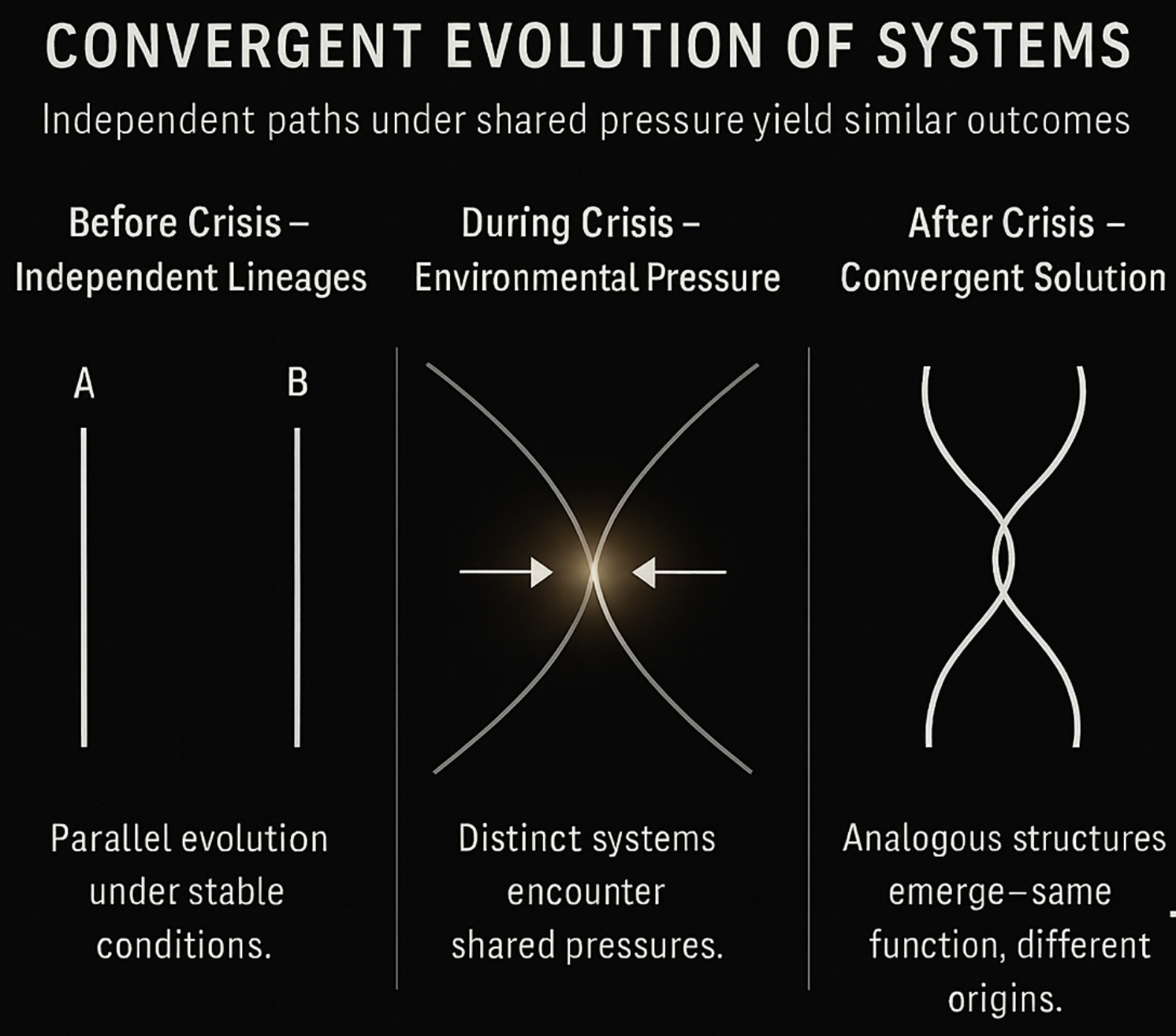
In ecology, this is called convergent evolution—unrelated species developing similar solutions under similar pressures19. In organizations, it’s crisis-driven innovation—silos dissolving when survival is at stake20. In consciousness, it’s the moment scattered thoughts crystallize into insight21.

The geometry is consistent: isolation → collision → integration.
Real-World Convergence Patterns
Space Mission Crisis: Apollo 13’s explosion forced unprecedented convergence between flight control, engineering, and astronaut crews. Teams that normally worked in sequence suddenly had to think as one organism. The crisis didn’t just solve the immediate problem—it revolutionized NASA’s approach to mission planning22.
Technical Breakthrough: AlphaGo’s breakthrough came from combining deep policy/value networks with Monte Carlo Tree Search23.
Personal Transformation: In my own practice transitioning from pure clinical work to AI-augmented healthcare, the crisis came when I realized my medical training was both essential and insufficient. The convergence of clinical intuition with computational thinking didn’t replace either—it created a third way of seeing.
4. Context Craft: The New Literacy
If crisis reveals the brittleness of our frames, then context craft is the practice of building resilient, adaptive meaning-structures.
The Seven Pillars of Context Craft
1. State Declaration
Before any interaction—human or machine—explicitly declare your state.
For non-technical readers: The code below is like a recipe card that tells the AI exactly what kind of conversation you want. Don’t worry about the syntax—focus on the concepts. You can even copy this code image and ask an AI: “Translate this code into plain non-technical language” to see what it means.

In plain language: This is like starting a meeting by saying “We have 30 minutes to explore options, our audience is technical, we need actionable insights, and we need to figure out what’s already been tried.”
This mirrors how the PFC (prefrontal cortex—your brain’s CEO) sets task parameters before engaging working memory24.
2. Semantic Boundaries
Use explicit delimiters to prevent context bleed—like putting different ingredients in separate containers so flavors don’t mix incorrectly.
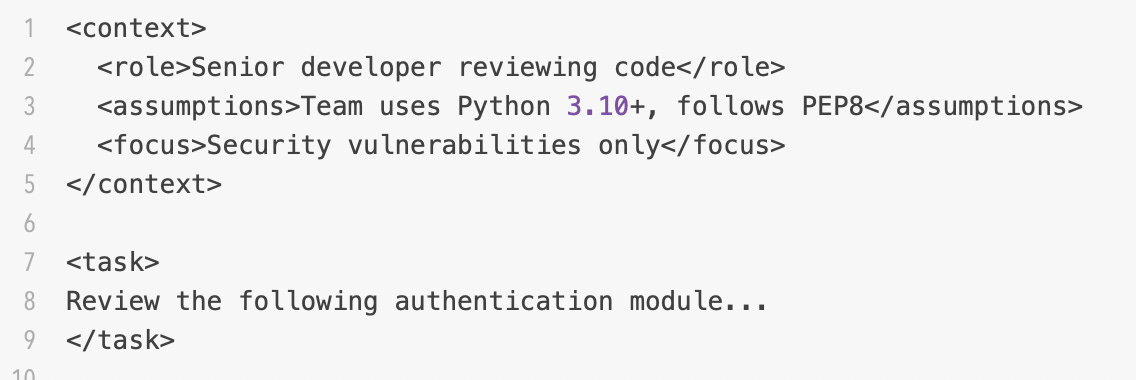
In plain language: The XML tags (those angle brackets) work like labeled folders. They tell the AI “this section is context, this section is the actual task.” It’s like using dividers in a binder—everything stays in its proper place.
Anthropic recommends XML‑style boundaries to improve parsing and output quality25.
3. Progressive Disclosure
Don’t dump everything at once. Layer context like an onion:
Layer 1: Core task (50 tokens*)
Layer 2: Constraints and requirements (150 tokens)
Layer 3: Examples and edge cases (300 tokens)
Layer 4: Full background only if needed (500+ tokens)
*Tokens are like words—roughly 1 token = 0.75 words. So 50 tokens ≈ 37 words.
This aligns with evidence that working memory focuses on roughly four “chunks” at a time—but the token bands here are practical heuristics, not fixed limits.26.
4. Uncertainty Acknowledgment
Build uncertainty handling into the context itself:I’m providing X, but I’m uncertain about Y.
If you need Y to properly address this, please ask.
If you must make assumptions about Y, state them explicitly.
This prevents the hallucination cascade that occurs when models fill gaps without acknowledgment.
5. Context Refresh Protocols
Every 3-5 exchanges in a long conversation, explicitly refresh:Let me summarize where we are:
- Started with: [original goal]
- Discovered: [key findings]
- Current focus: [present task]
- Next step: [proposed action]
Is this accurate? What am I missing?
This prevents semantic drift and maintains coherence.
6. Feedback Loops
Build verification into the context:
After you provide your response:
1. List your key assumptions
2. Rate confidence (1-10) on each major claim
3. Identify what additional information would most improve accuracy
This creates what researchers call “epistemic vigilance”—awareness of knowledge boundaries27.
7. Context Hygiene
Regular maintenance practices:
Prune irrelevant information every few exchanges
Consolidate repeated patterns into single instructions
Refactor when context becomes unwieldy
Archive successful patterns for reuse
5. The Practice: Context Engineering Exercises
Exercise 1: The Context Audit
Take a failed interaction (human or AI) and audit its context:
What was explicitly stated?
What was assumed but not stated?
Where did meanings diverge?
What context would have prevented the failure?
Exercise 2: The Flip Practice
Choose a problem you’re stuck on:
Write your current framing (50 words)
Identify three assumptions in that framing
Invert each assumption
Rewrite the problem from the inverted perspective
Find the synthesis between original and inverted
Exercise 3: Context Crafting Sprint
For your next AI interaction:
Before: Write context in three layers (core/constraints/examples)
During: Refresh context every 3 exchanges
After: Extract one reusable context pattern
Exercise 4: The Convergence Map
Identify a crisis in your work/life:
Map the parallel tracks (what’s operating independently)
Identify the pressure point (what’s forcing convergence)
Visualize the new configuration
Design the transition path
6. From Content to Context: The Great Inversion
Bill Gates famously coined the “Content is king” phrase which captured the early internet era perfectly. But we’re living through another inversion, one that started before generative AI took hold28:
The Old Paradigm:
Scarce: Information
Valuable: Having the right answer
Power: Controlling distribution
Expertise: Knowing facts
The New Paradigm:
Scarce: Attention and coherence
Valuable: Asking the right question
Power: Creating meaning
Expertise: Managing context
This isn’t just a shift—it’s a flip. Like the moment when humanity realized the Earth orbits the Sun, not vice versa. The information isn’t changing; our relationship to it is.
The Context Kingdom
If content is king, context is the kingdom—the entire ecosystem that gives the king meaning and power. A king without a kingdom is just someone with a fancy hat.
Consider how the same information transforms across contexts:
“Temperature:
77 °F” → Weather: pleasant;
100.4 °F → Body: fever;
194 °F → CPU: overheating.“Growth: 50%”
→ Startup: struggling
→ Cancer: aggressive
→ Child: healthy
→ Economy: overheating
The content stays constant. The context determines everything.
7. Crisis Architecture: Designing for Breakdown
Instead of avoiding crisis, what if we designed for it?
Principles of Crisis-Ready Systems
1. Loose Coupling with Clear Interfaces
Systems that can reconfigure quickly have parts that connect cleanly.
For non-technical readers: The code below describes a system that can plug and unplug its parts like LEGO blocks. During a crisis, it keeps only the essential connections and temporarily disconnects everything else.
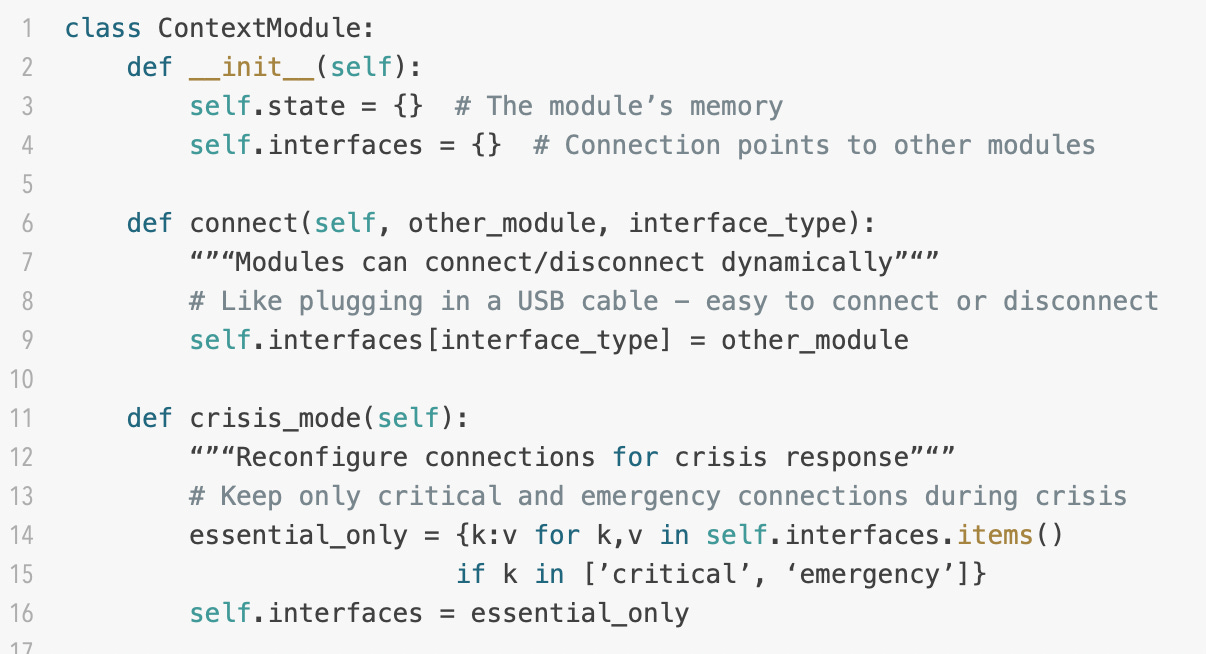
In plain language: Imagine your phone during emergency mode—it shuts down all non-essential apps to preserve battery for critical functions. This code does the same thing for AI systems.
2. Redundant Pathways
Multiple ways to achieve the same goal:
Primary: Optimal path under normal conditions
Secondary: Backup with acceptable degradation
Emergency: Minimum viable function
This mirrors how the brain maintains multiple routes between regions29.
3. Crisis Triggers and Protocols
Explicit detection and response patterns.
For non-technical readers: The YAML code below is like an emergency response checklist. YAML is just a way to write structured lists that computers can read—think of it as a very organized outline.
crisis_detection:
triggers: # Warning signs that context is breaking
- prediction_error > threshold # Too many surprises
- coherence_score < minimum # Things stop making sense
- conflict_count > maximum # Too many contradictions
response:
immediate: # First 30 seconds
- pause_normal_operation
- activate_emergency_context
- increase_monitoring
assessment: # Next 2-5 minutes
- identify_failure_point
- map_available_resources
- generate_options
recovery: # Following hours/days
- implement_minimum_viable
- gradually_restore_function
- document_lessons
In plain language: This is exactly like a fire evacuation plan—if smoke is detected (trigger), then immediately sound alarm and evacuate (immediate response), then assess the situation (assessment), then carefully re-enter when safe (recovery).
8. The Biological Blueprint
When context collapses, biological and artificial systems follow remarkably similar recovery paths:
The Universal Crisis Response Curve
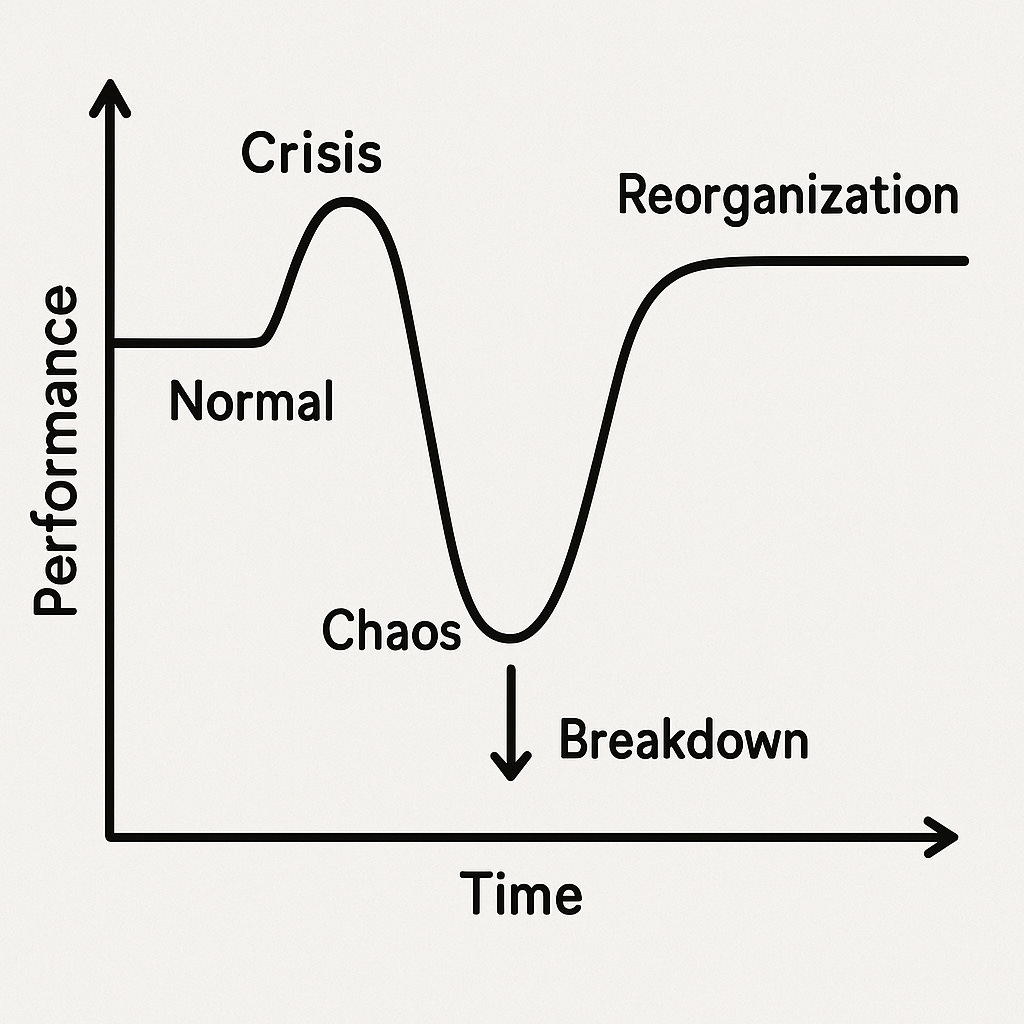
This pattern appears in:
Neuroscience: Neural reorganization after stroke30
Ecology: Ecosystem recovery after disturbance31
Psychology: Post-traumatic growth32
Organizations: Innovation following disruption33
AI Systems: Model adaptation to distribution shift34
The Four-Phase Protocol
Collapse (Seconds to Minutes)
Old patterns fail
Uncertainty spikes
System becomes fluid
Convergence (Minutes to Hours)
Disconnected elements interact
New connections form
Possibilities multiply
Crystallization (Hours to Days)
New pattern emerges
Structure stabilizes
Function returns
Consolidation (Days to Weeks)
Pattern reinforcement
Efficiency optimization
Memory formation
9. Case Studies in Context Crisis
Case 1: The Operating Room
Crisis: Unexpected arterial bleeding during routine surgery
Context Collapse: Standard procedure no longer applicable
Convergence: Surgeon, anesthesiologist, nurses synchronize without verbal coordination
New Context: Implicit shared model of emergency response
Lesson: Crisis can trigger collective intelligence exceeding individual capabilities35
Case 2: The GPT Conversation
Crisis: Model provides contradictory information across exchanges
Context Collapse: Instruction set has become internally inconsistent
Convergence: User identifies and removes conflicting directives
New Context: Cleaner, hierarchical instruction structure
Lesson: Context debugging is as important as prompt engineering36
Case 3: The Startup Pivot
Crisis: Product-market fit failure after 18 months
Context Collapse: Original vision no longer viable
Convergence: Customer complaints reveal unexpected use case
New Context: Complete business model transformation
Lesson: Crisis feedback contains innovation seeds37
10. Tools for Context Management
The Context Stack
A practical framework for managing context layers.
Think of the Context Stack like a smart spotlight, not a storage bin. At any given moment, an AI (or a person) can only “see” part of everything it knows — the slice that fits in its short-term focus. Because that space is limited, it has to spend its attention wisely, choosing what to bring into view.
Good context engineering is about picking the mix of details that are both useful and different enough to keep perspective fresh. That balance keeps the system from “overfitting” — getting trapped in one narrow view — and helps it respond with more creativity and relevance.
For non-technical readers: Think of this like organizing a briefcase where only the most important documents fit. The code below creates a smart filing system that automatically keeps the highest-priority information when space is limited.
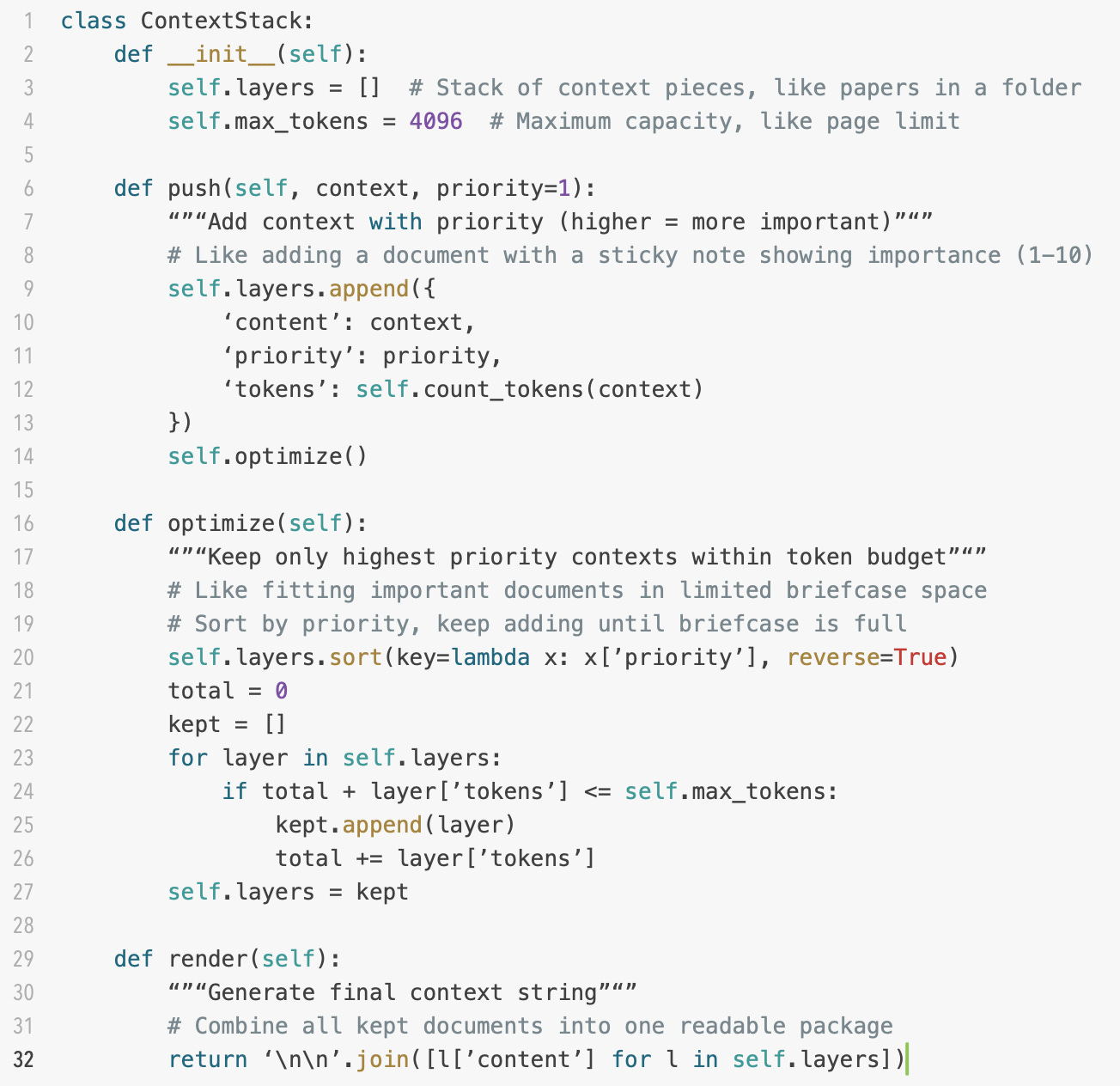
In plain language: This is like having a smart assistant who, when your briefcase gets too full, automatically keeps only your most important documents and removes less critical ones. Priority 10 items (critical) stay, priority 1 items (nice-to-have) get removed first.
The Context Refactoring Checklist
Before each major interaction:
[ ] Remove: What information is no longer relevant?
[ ] Consolidate: What patterns appear repeatedly?
[ ] Clarify: What assumptions need stating?
[ ] Structure: Are boundaries clear between sections?
[ ] Verify: Do instructions conflict anywhere?
[ ] Prioritize: What’s essential vs nice-to-have?
[ ] Test: Can you predict likely failure modes?
11. The Meta-Context: Systems That Learn Their Own Patterns
The next frontier isn’t just managing context—it’s creating systems that learn their own context patterns. This is where we transition from context craft to context architecture.
Self-Organizing Context
Imagine contexts that:
Monitor their own effectiveness
Identify their own breakdown patterns
Evolve their own optimization strategies
Teach other contexts their learnings
This isn’t science fiction. It’s emerging in:
Adaptive RAG systems that learn which retrievals work38
Meta-learning models that learn how to learn39
Evolutionary architectures that modify their own structure40
The Context Learning Loop
Context Performance → Pattern Recognition → Rule Extraction → Context Modification → Performance Measurement → [Repeat]
Each cycle makes the context more robust, more adaptive, more intelligent.
12. Practical Wisdom: What Three Years of Context Engineering Taught Me
The Paradoxes
The more context you provide, the less the model may understand
Solution: Hierarchical context with progressive disclosure
The clearer your instructions, the more rigid the output
Solution: Balance specificity with flexibility zones
The better your context, the more fragile it becomes
Solution: Build in redundancy and graceful degradation
The Principles
Start with state: Always declare what mode you’re in
Embrace boundaries: Clear delimiters prevent context bleed
Design for debugging: Make context inspection easy
Plan for breakdown: Crisis protocols should be pre-built
Archive successes: Reusable context patterns compound value
The Practices
Daily: Context hygiene (pruning, clarifying)
Weekly: Pattern extraction (what worked, what didn’t)
Monthly: Framework evolution (updating base templates)
Quarterly: Paradigm questioning (is our frame still valid?)
Field Guide: Context Craft Quick Reference
Before the Conversation
State Declaration
Mode: [Assistant / Partner / Explorer]
Constraints: [time / format / scope]
Success: [specific outcomes]
Unknowns: [what you need to discover]
During the Exchange
Every 3–5 Turns
Summarize progress
Verify understanding
Prune irrelevant context
Check for drift
After the Interaction
Pattern Extraction
What context worked?
What caused confusion?
What’s reusable?
What needs refinement?
Crisis Response
When Coherence Breaks
Pause and identify the failure point
Roll back to the last stable context
Rebuild with clearer boundaries
Test with simple verification
Document the breakdown pattern
The Bridge to Part III
We’ve explored how crisis transforms context, how context shapes meaning, and how to craft resilient cognitive frames. But individual context mastery is just the beginning.
The next challenge is collective context—how do we maintain coherence not just within one mind (biological or artificial) but across many? How do we build systems where the conversation itself learns, where context evolves through interaction, where meaning emerges from the network rather than any single node?
This is the shift from context as craft to context as architecture. From managing frames to designing fields. From individual coherence to collective intelligence.
And here’s what we’re only beginning to understand: this acceleration isn’t just personal—it amplifies outward. When one person makes the flip from crisis to convergence, they become a catalyst for others. The acceleration compounds. Human potential doesn’t just adapt; it multiplies.
In Part III, we’ll explore how this amplification works—not just within individual minds but across networks of human and machine intelligence. How the acceleration that begins in crisis becomes the amplifier effect that transforms entire systems.
The question becomes: If crisis reveals the hidden architecture of meaning, what happens when we deliberately design that architecture? What becomes possible when we stop managing context and start composing with it?
That’s where The Flip completes: Not in choosing between human and machine intelligence, but in recognizing that the space between them—the context layer—is where the future is being written.
Next: Part III — The Amplifier Effect
How contexts compose, how conversations learn, and why the space between human and machine intelligence is where the future emerges.
Author’s Note
This essay emerged from years of working at the intersection of medicine, education, and artificial intelligence, watching both humans and machines struggle with the same fundamental challenge: how to maintain coherence when contexts collapse. The patterns described here aren’t theoretical—they’re drawn from thousands of hours of direct observation, failed experiments, and unexpected breakthroughs.
For practitioners wanting to go deeper, I recommend starting with the exercises in Section 5, then gradually building your own context management protocols. The learning curve is steep, but the view from the other side is transformative.
Remember: The flip isn’t about choosing between human and machine intelligence. It’s about recognizing that crisis—in all its forms—is just intelligence remembering how to grow.
References & Footnotes
Clark, A. (2013). “Whatever next? Predictive brains, situated agents, and the future of cognitive science.” Behavioral and Brain Sciences, 36(3), 181-204. DOI: 10.1017/S0140525X12000477. Open Access
Miller, E. K., & Cohen, J. D. (2001). “An integrative theory of prefrontal cortex function.” Annual Review of Neuroscience, 24, 167-202. Open Access PDF
Schuck, N. W., et al. (2016). “Human orbitofrontal cortex represents a cognitive map of state space.” Neuron, 91(6), 1402-1412. Open Access
McClelland, J. L., McNaughton, B. L., & O’Reilly, R. C. (1995). “Why there are complementary learning systems in the hippocampus and neocortex.” Psychological Review, 102(3), 419-457. Open Access PDF
Botvinick, M. M., Cohen, J. D., & Carter, C. S. (2004). “Conflict monitoring and anterior cingulate cortex.” Trends in Cognitive Sciences, 8(12), 539-546. ResearchGate
Friston, K. (2010). “The free-energy principle: a unified brain theory?” Nature Reviews Neuroscience, 11(2), 127-138. PDF
Yu, A. J., & Dayan, P. (2005). “Uncertainty, neuromodulation, and attention.” Neuron, 46(4), 681-692. Open Access
Gehring, W. J., et al. (1993). “A neural system for error detection and compensation.” Psychological Science, 4(6), 385-390. ResearchGate
Aston-Jones, G., & Cohen, J. D. (2005). “An integrative theory of locus coeruleus-norepinephrine function.” Annual Review of Neuroscience, 28, 403-450. PDF
Bassett, D. S., et al. (2011). “Dynamic reconfiguration of human brain networks during learning.” PNAS, 108(18), 7641-7646. Open Access
Weick, K. E. (1993). “The collapse of sensemaking in organizations: The Mann Gulch disaster.” Administrative Science Quarterly, 38(4), 628-652. PDF
Nickerson, R. S. (1998). “Confirmation bias: A ubiquitous phenomenon.” Review of General Psychology, 2(2), 175-220. ResearchGate
Chi, M. T., Glaser, R., & Farr, M. J. (Eds.). (1988). The Nature of Expertise. Lawrence Erlbaum. Book
Christensen, C. (1997). The Innovator’s Dilemma. Harvard Business Review Press. Summary PDF
Anthropic. (2024). “Use XML tags to structure your prompts.” Technical Report. Anthropic Docs
Conway Morris, S. (2003). Life’s Solution: Inevitable Humans in a Lonely Universe. Cambridge University Press. Cambridge
Kounios, J., & Beeman, M. (2009). “The Aha! moment: The cognitive neuroscience of insight.” Current Directions in Psychological Science, 18(4), 210-216. PDF
Kranz, G. (2000). Failure Is Not an Option. Simon & Schuster. NASA History
Silver, D., et al. (2016). “Mastering the game of Go with deep neural networks and tree search.” Nature, 529(7587), 484-489. PDF
Badre, D., & Wagner, A. D. (2007). “Left ventrolateral prefrontal cortex and the cognitive control of memory.” Neuropsychologia, 45(13), 2883-2901. PMC
Anthropic. (2024). “Effective Context Engineering for Claude.” Documentation
Anthropic. (2024). “Long context prompting tips.” Claude Docs.
Cowan, N. (2001). “The magical number 4 in short-term memory.” Behavioral and Brain Sciences, 24(1), 87-114. ResearchGate
Bullmore, E., & Sporns, O. (2009). “Complex brain networks.” Nature Reviews Neuroscience, 10(3), 186-198. PDF
Murphy, T. H., & Corbett, D. (2009). “Plasticity during stroke recovery.” Nature Reviews Neuroscience, 10(12), 861-872. PMC
Holling, C. S. (1973). “Resilience and stability of ecological systems.” Annual Review of Ecology and Systematics, 4, 1-23. JSTOR
Tedeschi, R. G., & Calhoun, L. G. (2004). “Posttraumatic growth.” Psychological Inquiry, 15(1), 1-18. PDF
Gersick, C. J. (1991). “Revolutionary change theories.” Academy of Management Review, 16(1), 10-36. JSTOR
Kirkpatrick, J., et al. (2017). “Overcoming catastrophic forgetting in neural networks.” PNAS, 114(13), 3521-3526. Open Access
Manser, T. (2009). “Teamwork and patient safety in dynamic domains.” Acta Anaesthesiologica Scandinavica, 53(2), 143-151. Wiley
Ries, E. (2011). The Lean Startup. Crown Business. PDF Summary