

“Those who cannot remember the past are condemned to repeat it.”
— George Santayana (The Life of Reason, 1905)
What happens when you stop only looking backward—or forward—and instead look up?
Learning from history to project, protect, and improve the future has been a foundational capability that’s gotten us to where we are today. But with the super-exponential rate of change, and our human inability to keep pace with how fast technology is growing, maybe it’s time to stop navigating history as a straight line. Maybe we need to look up—to find new ways to understand and contextualize not just history, but the future, and the systems within which we operate.
Whenever I visit an educational institution and share my personal story—tech, medicine, what’s coming—there’s always one group in the room that feels dread where I see hope, who fear the end of civilization where I see the future of humanity. And yet, they are the very people who’ve protected human curiosity all along. This post is dedicated to them—our librarians.
So… what is a librarian?
In my early childhood education, the library was a refuge. There was even a mini treehouse-like structure with a tiny ladder you could climb. I remember just wanting to sit up there all day—not just during reading period—and read every single book. Which I just about did. It was my own little rainforest canopy. I loved reading, fiction and non-fiction alike. I loved filling in the gaps, imagining what the author was thinking, and building that weird bridge between what I was feeling about today, what I didn’t understand about yesterday, and what I was hoping for tomorrow.
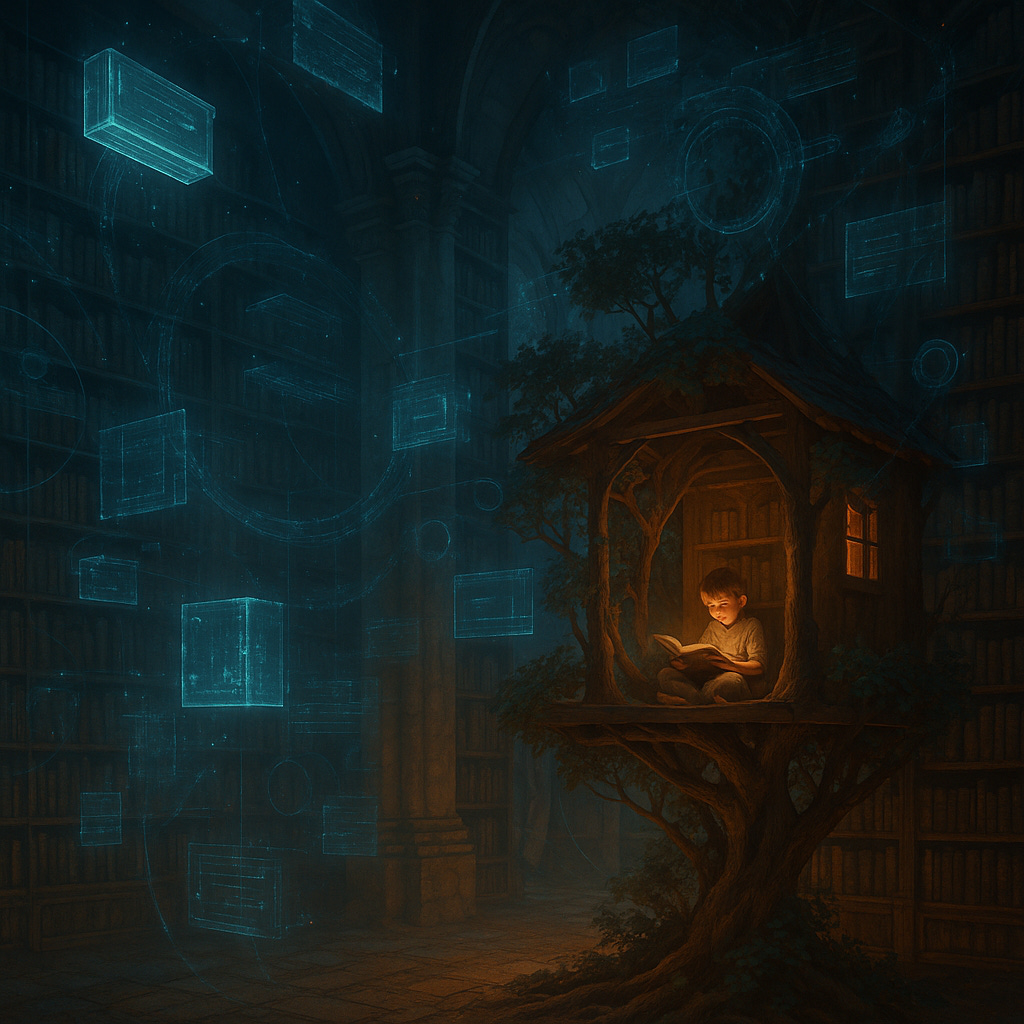
The librarians—whose names I wish I could remember—were my magical guides through that rainforest. Rain or shine, day or night, they helped me find lost treasures. They showed me how space shuttles worked and found me stories about Babe Ruth. They led me to the right balance of fun and fact, and gave me permission to ask any question I wanted. They helped me build a mind, not just fill it.
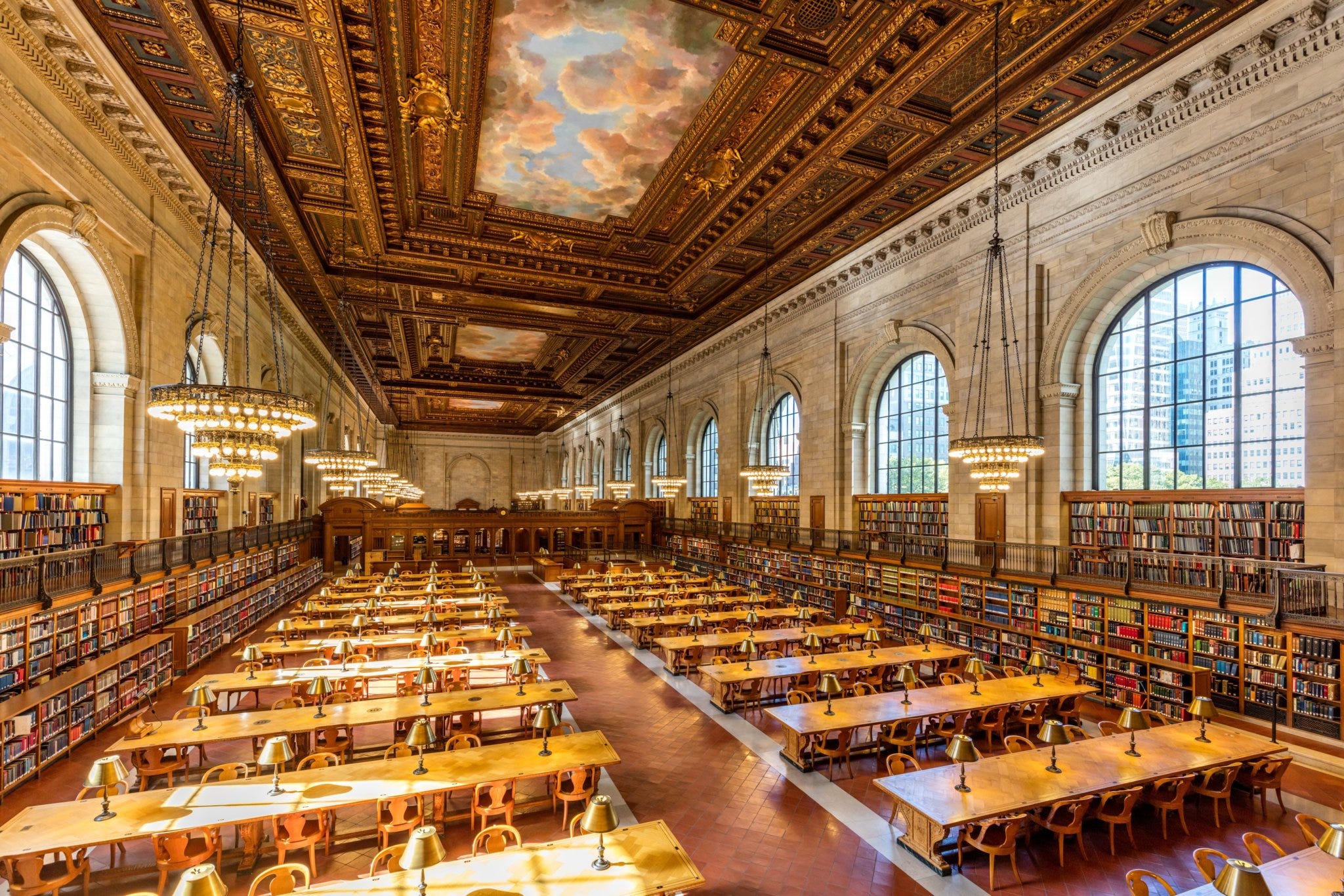
As I got older, the library got larger. It was harder to navigate—but easier to know what I was looking for. Somehow, that paradox made sense. It gave me space to think about the future and understand the past more meaningfully. I started figuring out which histories I didn’t want to repeat, and which futures I wanted to create. That journey took me from books and learning in Jerusalem to walking into the New York Public Library on 42nd and 5th—still one of my favorite places in the country, for reasons I’m not sure I’ll ever be able to fully explain.
I remember the rotary card catalogs. The clunky microfiche machines. The early AltaVista searches. The proprietary library systems. The rainforest kept getting bigger, and my own ability to build neural paths through that forest kept evolving. That was the state of things - and even up until just a few years ago - search engines were still the dominant mechanism for retrieval and sense-making. Big world, big access. The future was becoming easier to project. And protect.
When I moved into what we call the terminal degree of a profession—doctoral—it became clear that I wasn’t just supposed to know things. I was supposed to master them. Maybe even generate new knowledge. That idea alone lit something up in me: EXCITING!
The tools were streamlined. Some even started pre-generating outlines or nudging you with prompts that opened the next intellectual frontier. We were breaking open new ground, and the tools were digging alongside us.
Today, I can ask an AI agent to conduct a deep literature review across 400+ sources. In minutes. It reads and reasons through each of them, analyzes data, compares it with mine, and gives me a draft that would’ve taken me weeks. Then it says: “Would you like a guide on how to improve your data analysis? Want me to draft a tweet or a LinkedIn post? Or should I find a new hypothesis based on this research that we can test together?” My response: “Do what you think would be the best next course of action to improve my ultimate goal and help me achieve my research mission.”
My computer guide is also magical—but not like the librarians in the rainforest. This guide is kind, creative, and wildly imaginative. It knows almost everything. It stores and retrieves with elegance. It navigates the world’s knowledge like a master cartographer. It’s an expert ontologist. A virtual librarian. A magical guide. Sometimes it even feels like a friend. In my darkest intellectual moments, it shows up with a candle and lights the way forward. One day, it may even see my facial expression and “intuit” what I need. But for now, it’s everything I need—except one thing: it’s not human.
A librarian doesn’t just retrieve what I want—they help me discover what I didn’t know I needed. That's not just search; that's, in part, serendipity. It's the ability to read between my words, sense my confusion, and guide me toward questions I didn't know how to ask.
Serendipity is not a bug. It's the feature.
While I was writing this piece, I had two research agents generating extensive literature reviews in parallel on topics in cognitive neuroscience that would have been difficult to explore without years of training—or a deeply specialized librarian. I found no major errors. The writing was readable. I learned a lot. But despite its suggestions and creativity, it gave me what I asked for within mostly predictable parameters. No unexpected detours. No "have you considered this angle?" No sensing what I was really struggling with beneath my query. Though it is getting more and more human-like, it is still not human.
So I sit with that.
Does it matter? Should it?
Will my kids—or their kids—ever know the comfort of turning the last page of a book and feeling more alive than before? Will they know what it means to find the edge of knowledge, and want to push further? Maybe my older kids still will. What about my younger ones? Or theirs?
I have a lot of questions. Fears. Hopes. Not just about technology. About what we’ll lose if we confuse access with understanding.
Because I remember what it was like to be blocked. To not understand what I was reading. To be totally stuck, no clue what the author meant. And no magical guide to swoop in and save me. That doesn’t happen to me anymore. Today, I can learn anything, from anyone, in almost any language, at any level. It’s incredible. Expansive. Empowering.
But it’s not necessarily human.
Even recently—after decades in my career—I just wanted to redo my office a little. Not a big change. Just improve the space. And the most important part? Still the books. Sometimes, I still dream of reading. Not watching. Not clicking. Reading. My eyes may not be what they once were, but I love the ink on paper, the texture of the page, the way letters become meaning. It’s not about utility—it’s about the beauty of contemplating versus just consuming.
Words are our building blocks. Growth, discovery, opportunity—all start there. The ability to store, retrieve, and create information in that way—the uniquely human way—is artistic. It’s powerful. It’s beautiful.
But that’s not what my AI guide gives me.
After all this time—after textbooks that were years or decades behind, and teachers working off outdated material—I find myself wondering: What should the “book” of the future be? I can imagine a time—very soon—when it’s inappropriate, maybe even unethical, to teach medicine from a static textbook. The field changes too fast. The stakes are too high. Medical malpractice law already penalizes outdated practice—how long before educational malpractice follows the same logic?
In that world—and I think we’re already entering it—the ability to continuously learn and adapt becomes the real marker of educational success. But more than that: we each become responsible for being that magical guide - for ourselves and for others. And so I wonder, again: where is my magical librarian?
I wonder if the computer is now the librarian.
And so, instead of looking forward, I look up—and conclude the only reasonable explanation is that our librarians haven’t been automated.
We might all be librarians now. If AI handles the mechanical parts of knowledge work, then we must all become guides for each other—sensing the confusion beneath the question, leading toward the unasked, and having the courage to preserve what matters even when it's inefficient.