

I don’t plan these weekly essays - they arrive when they’re ready. This one showed up this morning, somewhere between my second and third attempt at holding a plank.
“We are caught in an inescapable network of mutuality, tied in a single garment of destiny. Whatever affects one directly affects all indirectly.”
– Dr. Martin Luther King, Jr. Letter from Birmingham Jail, 1963.
The Original Civil Servant: The Body
I’ve been making small but valiant attempts at living a healthier, more human lifestyle wherever possible. This morning, I threw my body to the floor in old-person style and held myself in a plank for about 30 seconds. As I collapsed into the brief rest before the next rep, I thought, “Good night,” but got up anyway.
By the third round I felt my heart working hard - really working - to keep everything going. At an average resting heart rate of about 70 beats per minute, you’re looking at between 2.5 and 4.5 billion beats if you intend to stick around between 70 and 120 years.
The Masterpiece of Bio-Engineering
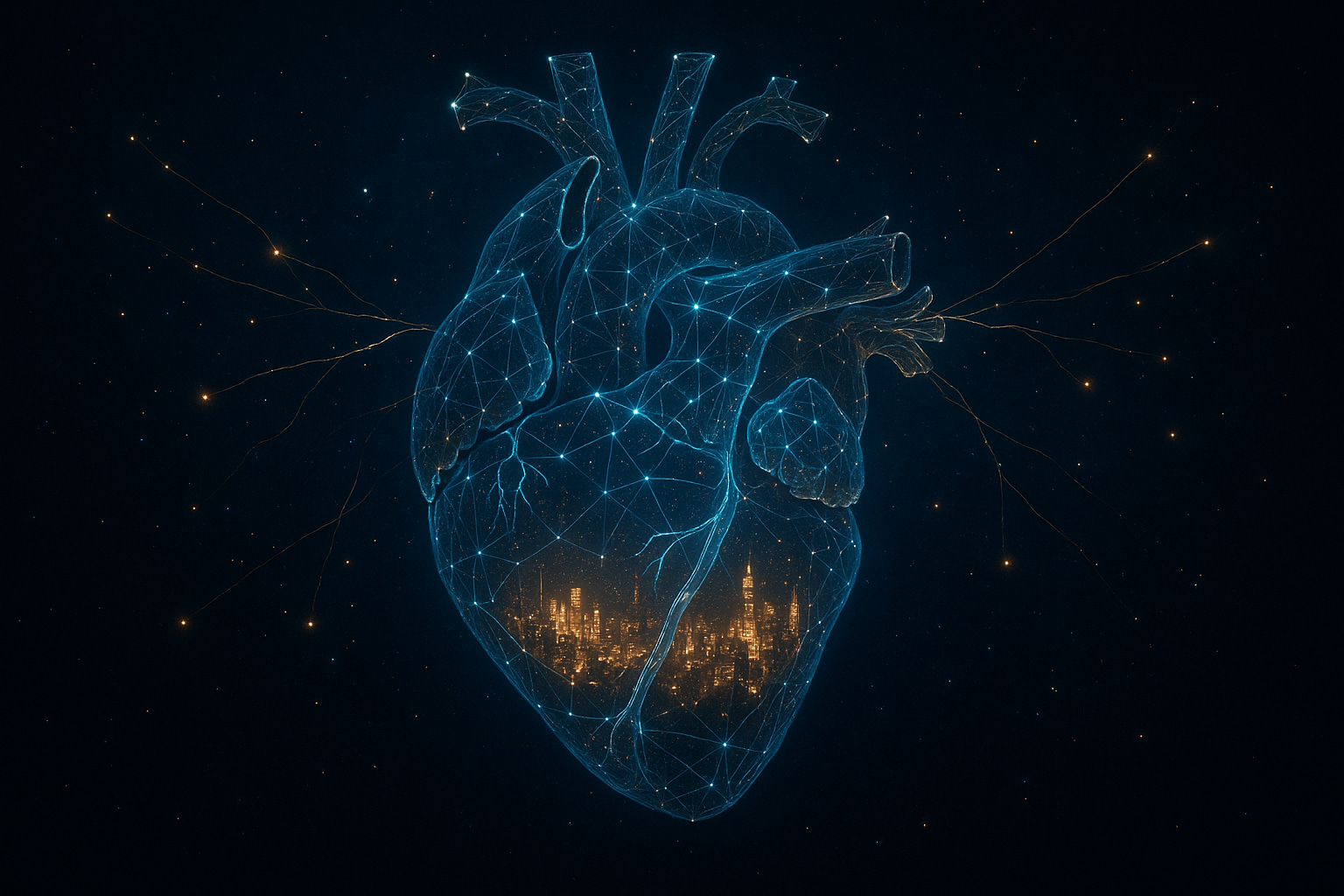
The human heart is a masterpiece of biological engineering, designed to work continuously - without pause, repair shutdowns, or conscious oversight - for a century or more because every part of it is optimized for relentless, self-sustaining motion. Its cells generate their own electrical impulses. Its muscle fibers recycle energy with astonishing efficiency. Its tissues perform constant micro-maintenance while running at full power. The heart’s pacemaker cells fire rhythmically on their own, the mitochondria in cardiac muscle generate more energy than almost any other cells in the body, and the entire system renews itself just enough to keep going without ever needing to stop. It is a closed-loop hydraulic pump, electrical generator, and self-repairing engine - beating billions of times across a long life without a single deliberate break.
Signal Generators and Support Structures
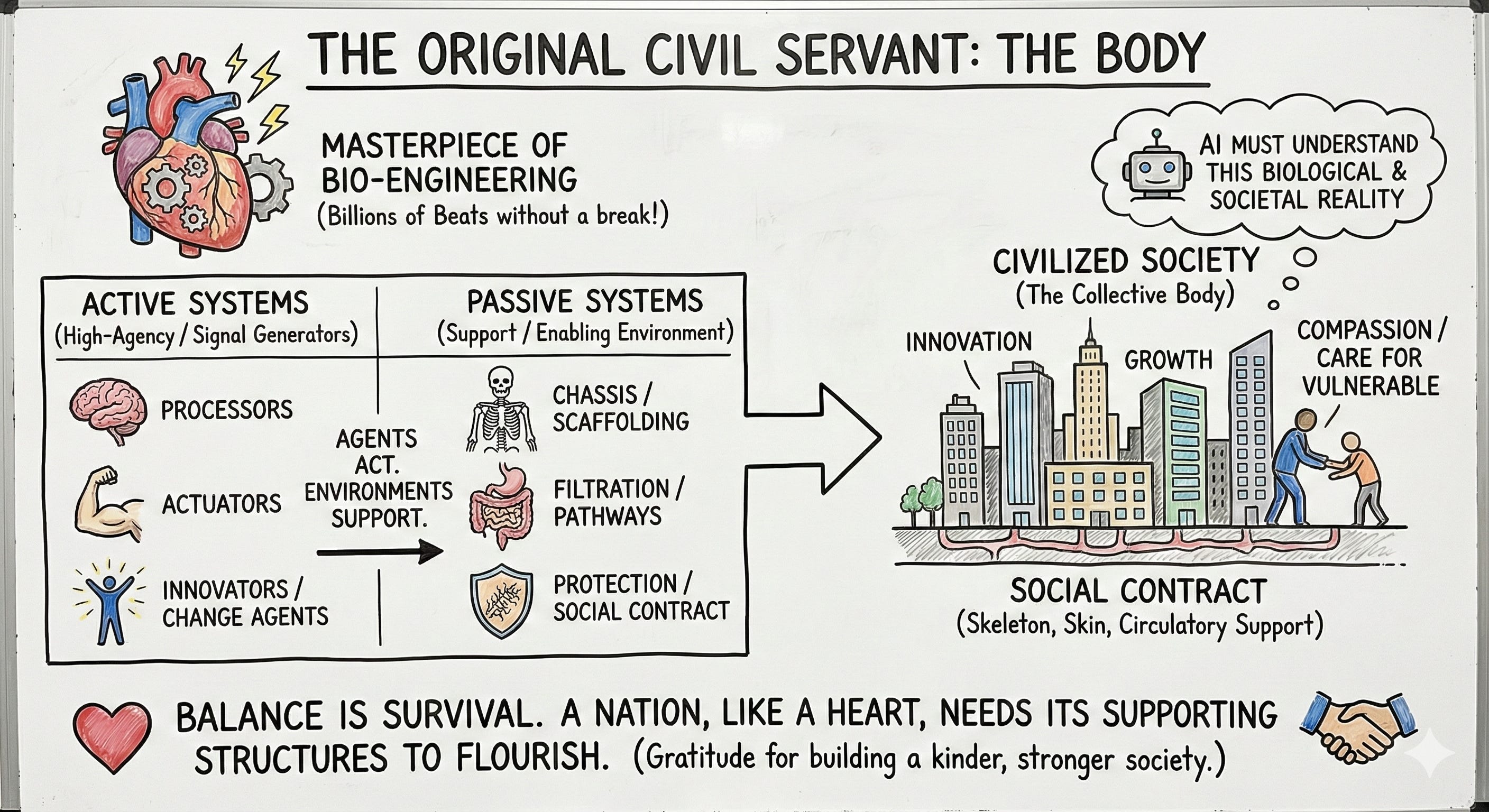
Other systems are equally brilliant, though not all of them act on their own. As a rule of thumb, the active systems (nervous, muscular, cardiovascular, respiratory, endocrine, immune, and reproductive) are the ones that generate signals or forces. The passive systems (skeletal, digestive, lymphatic, integumentary, and urinary) provide structure, pathways, filtration, and protection. It struck me that the active systems are our high-agency capabilities - the parts of us that initiate change - while the passive systems create the enabling environment that makes this agency possible.
If the human body were a robotics platform:
High-agency systems = processors, actuators, signal generators
Low-agency systems = chassis, filters, scaffolding
Agency emerges only from systems that can generate their own signals. Memory, action, coordination, and adaptation all require an active loop. Support systems are absolutely essential - but they do not create direction. They make direction possible. Agents act. Environments support. Systems emerge.
From Bodies to Civilizations
So as I lay there face-planted on the floor, attempting to be a bit more human, I wondered how we ensure our AIs understand not just our data patterns but our extraordinary biological reality - our capability, our ingenuity, the impossible feats our bodies pull off every second.
And perhaps more importantly, how they might understand that we’ve always organized our societies along the same principles as our bodies - not metaphorically, but literally. Societies are made of human bodies, billions of them, and they self-organize using the same fundamental pattern: signal-generators create agency, support structures enable it, and the balance between them determines survival.
That thought pulled me back to my years in civil service supporting our city’s most vulnerable communities, and the realization that the human body is actually a perfect teacher.
The body teaches us what we already know but keep forgetting about civilization itself. Our societal “body” works only when the active elements and the supportive elements remain in balance. Without a functioning social contract - our collective skeleton, skin, and circulatory support - we lose the very conditions that allow innovation, growth, and compassion to flourish.
Gratitude
As Thanksgiving approaches, I’m reminded of the many things I’m grateful for - my beautiful family, exceptional friends, co-innovators at work, and you, the readers who walk this path with me. And beyond those things, I’m grateful to live in a place with the potential to keep going for so long without missing a beat.
But like the heart, brain, and skeleton, a nation cannot survive without its supporting structures. A single missed beat in our collective heart puts everything at risk - our capacity for innovation, our ability to care for the vulnerable, the very conditions that make human flourishing possible.
I’m grateful for the opportunities we have to build something better - and grateful for all of you who choose to participate in creating a kinder, stronger society.
“The part can never be well unless the whole is well.”
- Plato (c. 428–348 BC), from Charmides