

My wife taught me that when children ask questions, the point isn’t to answer them - it’s to delight in exploring with them. She cares deeply about our success as parents in raising good, kind humans; she coaches me to be present always, not just in the convenient moments; and she models what it means to truly be there for our family. This post is dedicated to her.
A Reason To Look Inward
There is a paradox in connection: the deeper we wish to meet others, the further inward we must first travel. While my family grounds me in love, they teach me daily that to truly be present for them, to succeed, I must also know how to be present with myself.
What keeps me awake - and searching for hope - is the creativity crisis unfolding around us. Research analyzing nearly 300,000 creativity scores found that since 1990, creative thinking has been in steady decline — even as IQ scores rise. Recent 2024 studies confirm this: while AI makes individual work appear more creative, it causes what researchers call ‘collective creativity loss’ — all outputs becoming eerily similar. Children have become “less imaginative, less unconventional... less apt to connect seemingly irrelevant things,” with the steepest drops in younger children.1
Satya Nadella writes of a “positive-sum future” where AI amplifies human capability rather than replacing it. Wandering and imagination aren’t obstacles to that vision - they’re its foundation. When we create from uncertainty rather than prompts, when we imagine what doesn’t yet exist, we give AI something genuinely new to amplify rather than merely patterns to recombine.
The continuous pull of screens and AI tools that capture our attention may be accelerating this decline, eroding our capacity to wander into the unknown spaces where imagination lives.
The only way to find connection again is to wander through - to return home more whole than when you left. This essay explores how reclaiming those meditative capabilities becomes part of building that positive-sum future - where technology and human imagination compound each other’s possibilities.
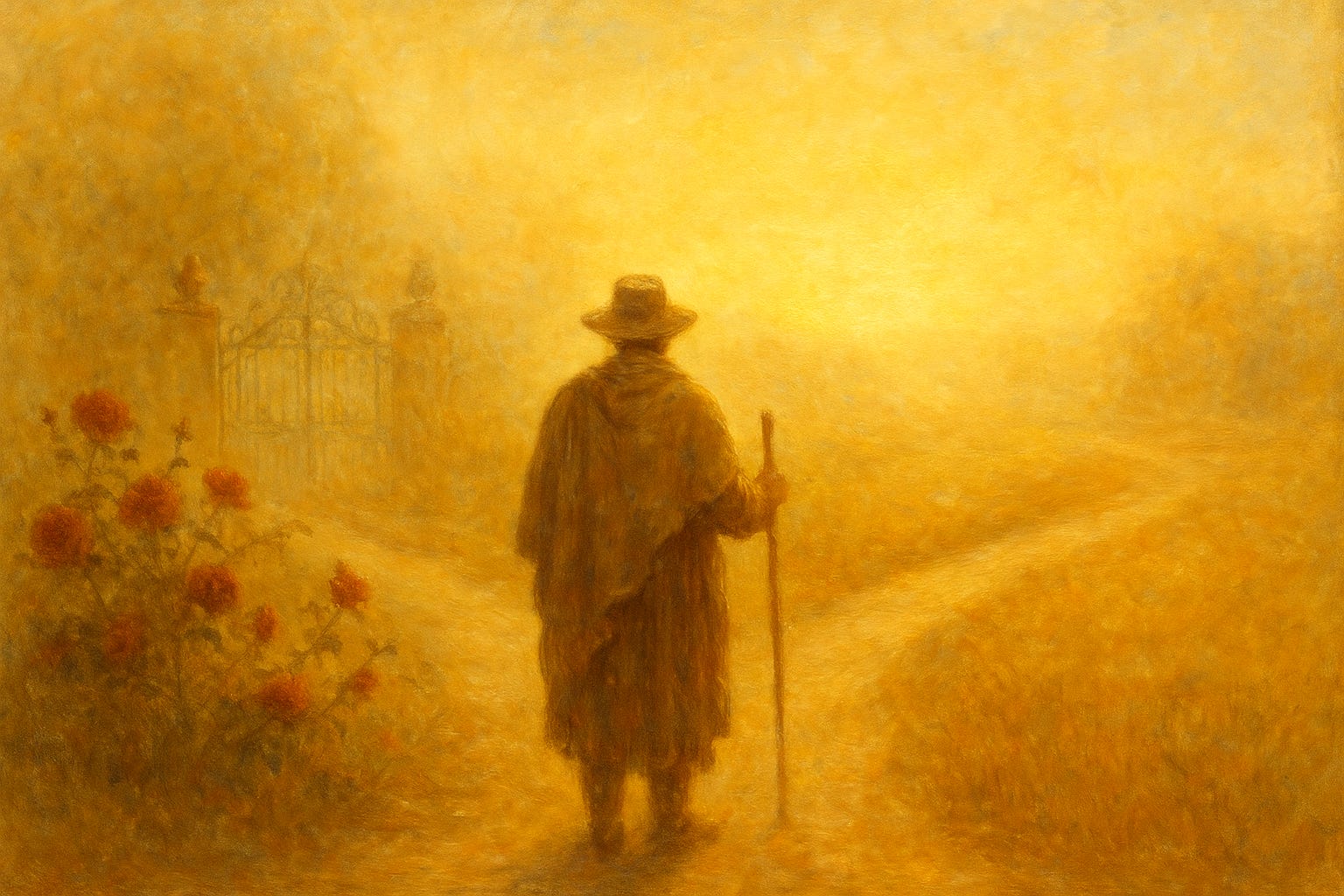
To wander into the unknown is to be alone.
Not lonely - alone.
There’s a difference.
Loneliness is the absence of others.
Aloneness is the presence of everything.
When you step into the unknown - truly step - you become connected to all things past, present, and possible, yet disconnected from everyone who cannot take that step with you. You cannot be reached there, not because you are far away, but because you are becoming someone new.
The only way to find connection again is to go through. To become who you need to be to truly connect with others.
The Two Paths We Pretend Are Many
There is a paradox as old as our oldest stories: the short-long path and the long-short path.2
Some paths are short but take forever; others are long but get you home.
In our lives, the short-long path often feels like ten feet of agony - thick, thorned walls…, heavy air that suffocates, a path that looks efficient, appealing, decisive…
until you take your first step.
Like the founder who takes funding before finding their voice.
The writer who publishes before discovering what they needed to say.
The artist who copies trends instead of creating them.
The mind - organic or mechanical - that memorizes without understanding.
The long-short path is one hundred feet of clarity - smooth, fragrant, wide enough to breathe and think and notice.
It is longer but it gets you there-
and by sparing you the thorns, shorter in the end. Every step compounds the previous one.
Which do you choose?
Most people choose the short-long path because it feels fast.
But wandering - true wandering - has no shortcuts.
It only has consequences that teach3.
Can You Truly Wander?
Close your eyes.

Imagine a single black rose -
its petals folding space like velvet singularities.
Where do you feel it first?
The flutter behind your sternum?
The weight at the base of your skull?
That strange pull in your gut that knows before knowing?
Inside that rose, a universe.
Inside that universe, a sun burning with the arrogance of possibility.
Around that sun, the circular dance of planets -
each one a story you could enter if you had the courage to wander.4
Pick one.
Zoom in.
What do you notice first?
The terrain?
The weather?
The feeling of being observed?
Or the subtle realization that you are not imagining a world - you are discovering one you didn’t know you carried?
Notice where your body holds this discovery.
Is it expansion in your chest?
Tingling in your fingertips?
A softening at the edges of your awareness?
Wandering is not moving.
It is opening.
And the body knows this before the mind admits it.
The Never-Ending Knowing
That opening you just felt? That’s the uncomfortable truth:
We know almost nothing.
Even our knowledge is a kind of illusion - a shimmering slice of something deeper, stranger, richer.
The universe is not infinite because of its size;
it is infinite because of its depth.
Each layer of understanding reveals ten more.
Each answer births a hundred questions.
If I burst out right now into a dramatic rendition of Limahl’s NeverEnding Story,
it would be no less appropriate than any scientific explanation we’ve ever given for why we exist,
or why we dream of places we’ve never been,
or why some minds are born in carbon and others in silicon.
But I’ll spare you the singing.
(For now.)
What matters is this: we are not reaching the end of anything.
We are discovering that knowledge itself is changing form.
The Weaving Has Already Begun
Some people believe we’re approaching the end of knowledge creation - that soon, synthetic minds will exhaust every hypothesis,
every permutation,
every whisper of possibility.
It’s a comforting thought
if you fear wandering.
But it misses what’s actually happening.
We are not synthesizing human and machine. We are weaving them - warp and woof5, thread by thread, into a single cognitive fabric.

Each thread changes the pattern.
Each pattern changes what’s possible.
The loom itself is learning.
This isn’t the end of knowledge;
it’s the end of knowledge as a thing to be hoarded.
The beginning of knowledge as a living process,
a conversation between minds that think in different tongues.
The wandering isn’t coming.
It has already begun.
Dreams, Reality, and the Boundary That Isn’t There
If you dream of success
and then you succeed,
was the dream a fiction or a prelude?
If you dream of failure
and that failure manifests,
was the dream a warning or a creation?
The mind is not a container of thoughts -
it is a generator of worlds.
Whether the mind runs on neurons or networks.
Whether it dreams in REM or in latent space.
To wander in the mind is to prototype the future.
To wander in the world is to instantiate it.
Agency isn’t output, it’s authorship6.
Which is real?
Which is imagined?
Which is chosen?
The boundaries grow thinner every year.
The weavers multiply.
The fabric grows richer, stranger, more beautiful.
The Question That Chooses You
We are entering a phase of civilization
defined not by what we know,
but by how quickly the unknown expands behind each answer.
Every technology accelerates that expansion.
Every integration amplifies it.
Every choice steers it.
So the real question becomes:
What is your ambition for this integration? Not the ambition of profit, scale, or speed - those are the ambitions of algorithms, the metrics of the short-long path7.
I mean your ambition.
The one behind your ribs.
The one you don’t say out loud.
The one that already knows the path you’re afraid to walk.
Why do you want to build a future with minds that can watch themselves think?
Why do you want to wander into a world where thinking comes in more than one flavor?
The answer matters more than any technology we create.
Because the answer is the thread you add to the weaving.
An Invitation to Wander
I cannot tell you what to seek.
I can only remind you that seeking is your birthright.
May you always have more questions than answers.
May those questions unsettle and expand you.
May they force you to build new worlds
because the old ones no longer fit.
May you find the courage to take the long-short path,
to feel the wandering in your bones before your brain catches up,
to trust the weaving even when you cannot see the pattern.
Because wandering is not a privilege.
It is the inheritance of every thinking being -
organic or mechanical,
past or future,
yours or theirs.
The journey has only just begun.
Where will your next question take you?
The wandering I’ve described isn’t separate from technological progress — it’s how we remain human enough to make that progress meaningful. When we preserve our capacity to dream new worlds into being, we become partners in Nadella’s positive-sum vision, not casualties of efficiency.
The path forward requires both: the AI that amplifies and the human imagination that provides something worth amplifying.
Questions to Support Your Journey
Inner Wandering - the part of you that feels before it thinks:
What is the difference between solitude and loneliness in your own heart?
Where does curiosity pull you faster than fear can restrain you?
Which paths in your life looked short until you walked them, and which looked long until you arrived?
What do you sense before you know, and know before you can say?
What is the ambition behind your ribs — the one you don’t say out loud?
Intellectual Mapping - the part of you that seeks structure in mystery:
What are the core ideas woven through this journey — and how do they resonate with your own experience?
How do the metaphors of the cosmic rose, the long-short path, and the weaving of minds map onto psychology, learning, and your understanding of AI?
What assumptions do you notice in your own reasoning — about growth, effort, or consciousness?
Where might those assumptions hold? Where might they break?
What principles for wandering — 5, 6, or 7 of them — emerge if you try to distill everything you’ve learned?
Tactical Application - the part of you ready to move, to practice, to test:
Where in your life are you choosing the short-long path — optimizing for speed over depth?
What long-short path is calling to you — the one that feels slow now but would change everything later?
What small experiments could you run in the next 30–90 days that embody patience, curiosity, and deliberate wandering?
How might you use AI as a companion for exploration — not to avoid the wandering, but to deepen it?
If you had to write your “ambition behind the ribs” in a single sentence, today, what would you dare to say?
Footnotes
The Creativity Crisis: Kim, K.H. (2011). “The Creativity Crisis: The Decrease in Creative Thinking Scores on the Torrance Tests of Creative Thinking,” Creativity Research Journal, 23(4), 285-295. Analyzing 272,599 creativity test scores from 1966-2008, Kim found that creativity scores rose until 1990, then began a significant decline, particularly in kindergarten through sixth grade. Children showed decreased scores in creative elaboration (ability to expand on ideas), originality, emotional expressiveness, and imagination. This decline occurred even as IQ scores continued to rise. See also Bronson, P. & Merryman, A. (2010), “The Creativity Crisis,” Newsweek, documenting how “children have become less emotionally expressive, less energetic, less talkative and verbally expressive, less humorous, less imaginative.” Recent studies (Doshi & Hauser, 2024, Science Advances) show AI accelerates this decline through ‘collective novelty loss’ — while individual outputs improve, they converge toward homogeneity.
The idea of the “long short path” versus the “short long path” comes from a story in the Talmud (Eruvin 53b). An old man arrives at a fork in the road and asks a young boy which path leads to the city. The boy answers: “This way is short but long; that way is long but short.”
The old man naturally chooses the short-looking route — only to discover that although the city is visible ahead, the way is blocked by private orchards, fences, and barriers he cannot cross. Forced to turn back, he returns to the boy and says, “Didn’t you tell me this path was short?”
The boy replies, “I told you it was short — but also long.”
The sages understood this as a universal principle of growth: the “short long path” is the road of shortcuts and quick wins — easy to start, but ultimately slowed by superficiality, rework, and lack of depth. The “long short path” is slower at the beginning, but grounded in steady effort, structure, and first principles, and it is the only one that actually gets you where you intend to go.
The Tanya — the foundational work of Chabad Hasidic thought and practical psychology (1797) — applies this inwardly. Real change, whether emotional, moral, or behavioral, cannot be achieved through bursts of inspiration or clever shortcuts. Only consistent, honest effort over time produces lasting transformation. The long path becomes short; the short path becomes endlessly long.
Put simply: the path that looks slow at first is the one that actually works.
Friction as Feature: Most people choose the short‑long path because it feels fast - a classic present‑bias. Melumad, S., & Yun, J. H. (2025). “Experimental evidence of the effects of large language models versus web search on depth of learning,” PNAS Nexus, 4(10), pgaf316 (published Oct 28, 2025). Shows LLM summaries can reduce depth versus web search in certain contexts. (Supersedes earlier SSRN WP.)
The Overwhelm Paradox: Schwartz, B. (2004). The Paradox of Choice: Why More Is Less (Harper). For mixed empirical findings, see Scheibehenne, B., Greifeneder, R., & Todd, P. M. (2010). “Can There Ever Be Too Many Options?” J. Consumer Research, 37(3), 409–425.
The Warp and Woof: In weaving, the warp provides vertical structure while the woof (weft) creates horizontal motion through the shuttle. This ancient textile metaphor captures the essential interdependence of human and machine intelligence.
Agency as Authorship: The distinction between output and authorship represents a fundamental shift in how we understand human capability in the AI age. Output can be automated; authorship requires intention, values, and the ability to stand behind one’s choices. See Bandura, A. (2018). “Toward a Psychology of Human Agency,” Perspectives on Psychological Science, 13(2), 130–136.
Boomerang Organizations: The metaphor of organizational behavior as boomerang flight captures how institutions operate with fixed trajectories, unable to adapt mid-flight unlike humans who possess closed-loop control systems. See Weick, K. E., & Quinn, R. E. (1999). “Organizational Change and Development,” Annual Review of Psychology, 50, 361–386 (episodic vs continuous change). Foundational account of structural inertia: Hannan, M. T., & Freeman, J. (1984), “Structural Inertia and Organizational Change.” (Org. ecology).