

Step into a luxury furniture store and you realize immediately: this isn't just shopping. It feels like stepping into a gallery. The kind where someone offers you a glass of wine, then introduces you to your own personal designer. Not a salesperson—a curator. Someone trained to listen for mood, for texture, for the ineffable feeling that transforms a house into a home.
The store doesn't overwhelm you with options. Each room—crafted with what can only be called surgical precision—features only a handful of coffee tables, consoles, dining sets. No endless scroll. Just the right tension between choice and clarity. What matters here isn't what's on display. It's how you feel walking through it. The chairs might be carved from walnut or forged from brass, upholstered in velvet or raw linen. The tables might blend travertine with steel, sharp geometries with flowing curves. But the decision isn't technical—it's aesthetic. It's deeply, mysteriously personal.
You watch as a designer helps a couple compose their living room—not selling pieces, but weaving a story. Every element matters. But it's the interplay that makes the room breathe. That makes it art.
And that's when it clicked: this is where software is headed.
The End of the Engineering Era
For most of the last three decades, software development has lived in the domain of engineers. It's been slow, expensive, unpredictable—more like custom home construction than interior design. Each project began from foundation and framework, built piece by piece through months or years of careful architecture.
But while some of my colleagues may disagree, that era is ending (or… has ended).
We now live in a world where almost every piece of software infrastructure has already been built. Authentication flows that once took weeks to implement are now drag-and-drop components. Dashboard layouts that required custom CSS are available as pre-designed collections. User journeys, data pipelines, payment systems—you name it, there's a prefab version for it. And increasingly, there are full "collections"—just like the curated rooms in that showroom—that can be composed by taste rather than built from scratch.
The shift isn't just technical. It's cultural. It's ontological.
The Current Inflection Point
Consider the tools already transforming how we build software. Retool has grown to power thousands of companies by making internal tools as easy to assemble as furniture from a showroom floor. Webflow lets designers create pixel-perfect websites without touching code, choosing from vast component libraries that rival any luxury furniture collection. Notion has become the Swiss Army knife of productivity, allowing teams to construct complex workflows by mixing and matching pre-built blocks like a master interior designer arranging elements in space.
These aren't toys anymore. Major enterprises use these platforms for production systems. Entire unicorn startups now launch their first products using no-code stacks, deferring custom development until they've proven product-market fit.
But we're only at the beginning. The real transformation happens when AI becomes your personal curator.
GitHub Copilot already assists developers in writing code faster. Lovable takes this further, generating entire full-stack applications from natural language descriptions. But imagine systems that suggest not just how to implement a feature, but which pre-built components to combine, how to style them, how to make them feel cohesive. Soon, instead of generating code, these systems will generate entire application architectures.
Imagine walking into a digital showroom with an AI designer who knows your business model, understands your user psychology, and can compose a complete software solution from thousands of proven patterns. Not built from scratch—curated from excellence.
What This Means: From Code to Curation
The real differentiator won't be how well you code. It'll be how well you compose.
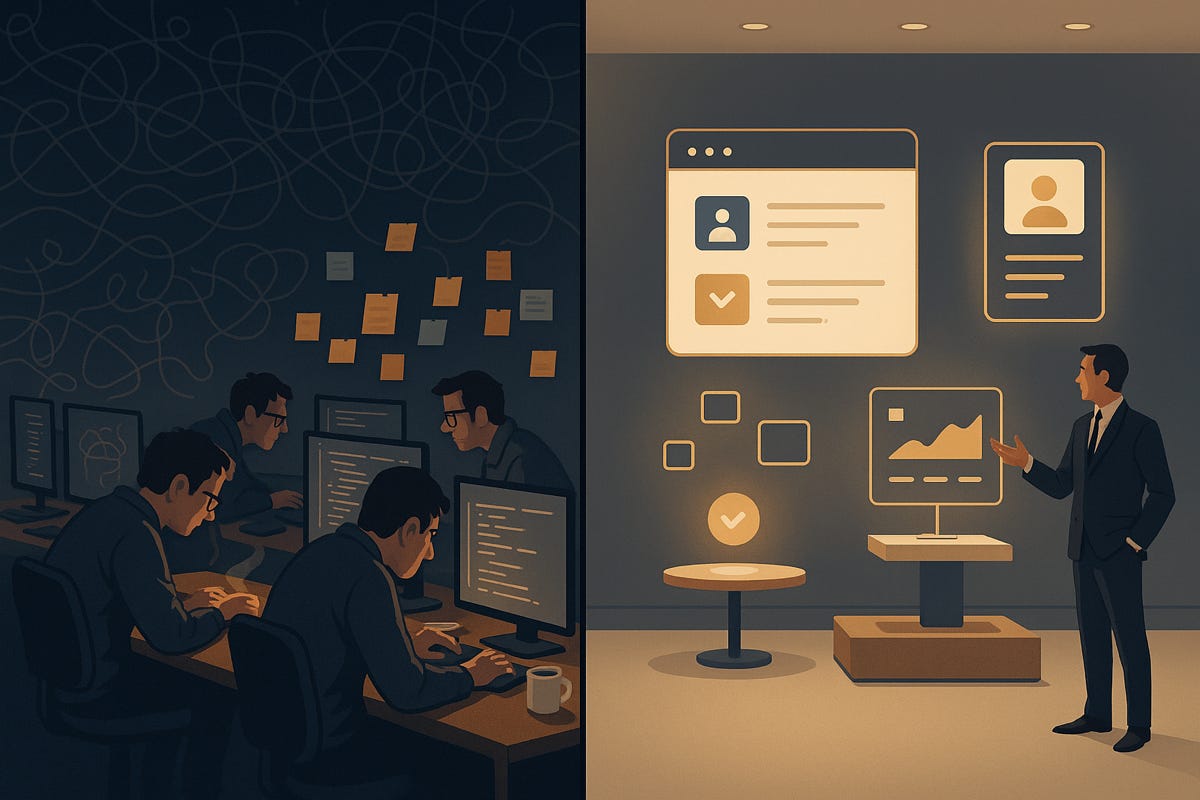
Just as that furniture designer reads a room—adjusting for light, for rhythm, for the way a family actually moves through space—you'll read the software landscape: Do we want frictionless onboarding or a deliberately gated flow? Is this a velvet moment or raw stone? What feeling are we creating for the user as they navigate our digital space?
This connects directly to what I explored in "The First & Last Principle"—agency isn't output, it's authorship. It's "noticing real options, choosing one you stand behind, and acting on it." In this new paradigm, software creation becomes an act of conscious curation rather than mechanical construction.
Organizations that master this transition—what Microsoft's 2025 Work Trend Index calls "frontier firms"—aren't just moving faster. They're operating in entirely different economic models. Where traditional software development required teams of 10 and budgets measured in millions, intelligent composition might need 2-3 domain experts and costs measured in thousands.
We're not at zero-cost. But we are well past the inflection point. Great software today costs more than a prototype but less than a traditional build—and it gets you quality that rivals top-tier teams from five years ago.
The Showroom Experience
Picture this near future: You walk into what feels like a software showroom. Instead of furniture, you're surrounded by living demonstrations of different business applications. A CRM that feels like a warm conversation. An analytics dashboard that reads like a beautifully designed magazine. An e-commerce flow that anticipates desire before it's even conscious.
Your AI curator—trained on thousands of successful implementations—asks probing questions. Not "What features do you need?" but "How do you want your customers to feel?" It suggests combinations you wouldn't have considered, shows you how different components harmonize, lets you experience the interaction patterns before you commit.
Within hours, not months, you watch your vision materialize. Real users testing real workflows on real data. The edges aren't rough—they're refined, because every component comes from battle-tested collections that have been continuously improved across thousands of implementations.
This isn't science fiction anymore. Companies like Framer are already moving in this direction, offering AI-powered design tools that generate entire user interfaces from simple descriptions. Zapier's newest features can build complex automation workflows through natural language conversation. The building blocks exist; we're just now learning to arrange them artistically.
The Risks and Resistances
Not everything will fit this pattern. There will always be edge cases that demand true invention—just like there will always be architecture firms that build from scratch. The question is proportionality: if 90% of software needs can be met through sophisticated composition, what happens to the economics of the remaining 10%?
Moreover, as I explored in "The Last Skill," there's a danger in removing all friction from creation. When learning becomes too easy, when solutions arrive too quickly, we risk atrophying our ability to think deeply about problems. This concern extends beyond individual learning—recent research reveals that when developers rely heavily on pre-packaged solutions and AI-generated summaries, they develop shallower, less original understanding than those who actively explore and synthesize different approaches themselves (Melumad & Yun, 2025). The best curators don't just arrange—they understand the principles behind what makes arrangements work.
There's also the homogenization risk. When everyone builds from the same component libraries, how do we maintain diversity of thought and approach? The answer may lie in ensuring these libraries themselves are diverse, continuously evolving, and designed to enable unexpected combinations rather than enforce standard patterns.
Beyond the Binary
This transformation represents something more fundamental than a shift in tools—it's a shift in the nature of creative work itself. As I noted in "The Warp and the Woof of AI," we're not just building tools anymore. We're weaving a new reality, where human and machine intelligence intertwine in increasingly complex patterns.
The future software creator won't need to choose between coding and no-code, between technical depth and creative vision. They'll work more like that furniture designer—deeply knowledgeable about materials and construction, but focused on the art of composition. They'll understand both the technical constraints and the emotional impact, both the individual components and the gestalt effect—how those components combine to create something greater than the sum of their parts.
This mirrors what's happening across creative industries. Music producers combine pre-recorded loops into original compositions. Architects use parametric design tools to explore vast possibility spaces. Chefs create signature dishes by reimagining classic techniques with modern ingredients.
In each case, the creator's value isn't in building everything from scratch—it's in having the taste, judgment, and vision to combine existing elements in ways that serve human needs and desires.
The Horizon
The tools are already here, scattered across dozens of platforms and services. What's coming is the integration—the showroom experience that makes sophisticated composition as natural as choosing furniture for your home.
We used to think of software as a machine. Now, it's more like a room. A space you inhabit, that shapes how you feel, that either welcomes you or makes you want to leave.
Yes, there will still be master craftspeople who build bespoke solutions for unique challenges. But for most of us, software development is becoming an act of curation, composition, and creative direction. The question isn't whether this will happen—it's whether we'll be ready to think like curators when it does.
In this world, the most valuable skill won't be knowing how to build everything—it'll be knowing what's worth building, and having the taste to arrange the pieces into something that serves human flourishing.
Not with code. But with curation.
What patterns are you already seeing in this shift toward composition over construction?
Share your observations—the future of software is being curated one thoughtful choice at a time.
P.S. My friend Sam Schillace pushed back on this vision after reading a draft: "Would that showroom exist if everything were digital? Kind of doubt it—or would it be more like 'influencer' channels now. 'Oh, let's live in Mr Beast's design world for a while.'"
He's pointing toward a different future entirely: not curated showrooms, but what might be "a blast furnace of content we can pick from, and algorithms to help." Instead of thoughtful composition, we might get viral "vibed" micro-experiences built on invisible substrate—more like TikTok creators than interior designers.
The question becomes: which path do we choose? The careful curation I've described here, or the algorithmic chaos that has defined most digital platforms? The answer may determine whether AI amplifies human taste and judgment or simply accelerates the endless scroll.
References
Melumad, S., & Yun, J. H. (2025). Experimental evidence of the effects of large language models versus web search on depth of learning. SSRN Working Paper Series.
Microsoft. (2025). Work Trend Index 2025: AI at work is here, now comes the hard part.
Further Reading
Jabbour, M.J. (2025). "The First & Last Principle: Manufacturing Human Agency in an Age of AI."
Jabbour, M.J. (2025). "The Last Skill? Finding Our Humanity at the Edge of AI Capability."
Jabbour, M.J. (2025). "The Warp and the Woof of AI: Collision course or awe-inspiring tapestry?"