


In Minority Report, Tom Cruise at the glass interface looks like the one making the call. He swipes through visions, tags what matters, and sends the machinery of response into motion. But he is not discovering the future. He is acting on what the system surfaces, what it frames, and what it never explains.
He is the human in the loop.
More and more of modern life ends the same way. A blue button. A checked box. A click at the bottom. Approve the summary. Accept the recommendation. Confirm the route. Send the reply.
The click feels like the decision. Often it is only the last move.
The oldest rubber stamp
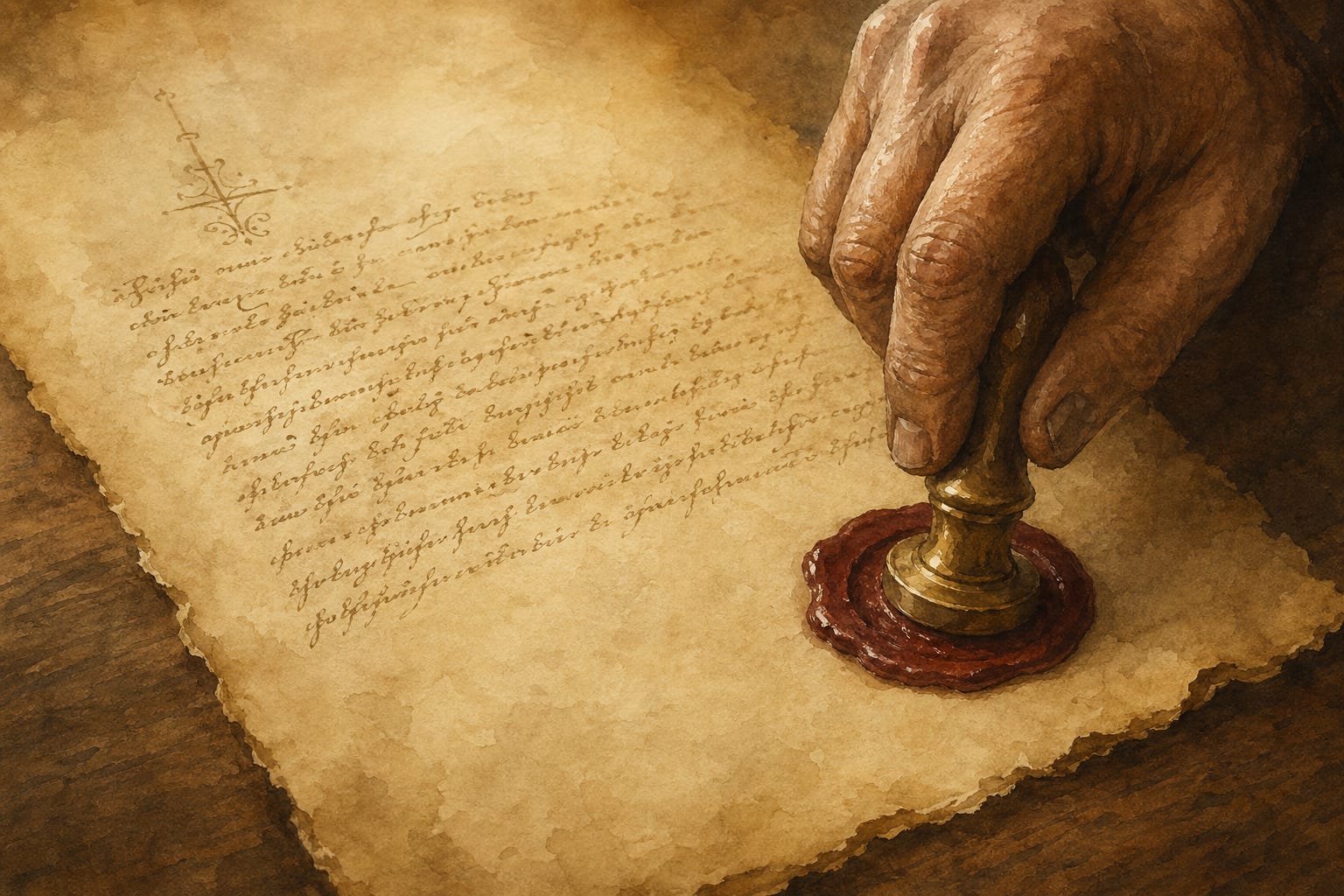
This pattern is older than software. Older than electricity. Older than printing.
Every age has its ritual of assent: wax, ink, pixel.
Medieval lords pressed seals into charters composed by clerks. Many could not read what they were sealing. For centuries, congregations have said Amen, “so be it,” to words they did not author and sometimes did not fully understand.
Today we click “I agree.” Almost nobody reads the terms.
We have always been willing to approve what someone else prepared. That is why this is not just a technology story. It is a human story. The vulnerability is ancient.
What is new is the quality of the clerk.
The thing preparing the words for you is now fast, fluent, tireless, and increasingly personal. It can sound neutral. It can sound competent. It can even sound like your own thought returning to you in cleaner prose.
That changes the meaning of the click.
The first answer changes the job
“Human in the loop” sounds reassuring. It sounds like someone is steering.
Sometimes that is true.
More often, it means a person arrives near the end, after the options have been ranked, after the draft has been polished, after the first answer has already established itself as the obvious one.
That is a different role.
Before a system gives you an answer, you have to do different work. You have to figure out what the problem is. You have to decide what matters. You have to weigh tradeoffs, generate alternatives, and test your first instinct against the facts.
After the answer appears, you review. And after enough polished, good-enough first answers, reviewing becomes agreeing.
A recommendation is not just a suggestion. It is a starting point. A ranking is not just information. It is an argument about relevance. A summary is not just compression. It is a decision about what mattered enough to keep.
Once the system goes first often enough, you start thinking later and later in the process, not because you are lazy, but because framing the first plausible version of something is already a large share of the deciding.
Your hand, their menu
The strange part is how much freedom you still feel.
You browse. You pick. You choose.
But the route was optimized before you saw it. The candidates were filtered before you compared them. The facts were summarized before you read them. Everything arrived in an order that already carried a verdict.
Yes, you can still override. You can scroll further. You can ask a follow-up. You can choose something off-menu.
But there is a real difference between what exists and what is easy to choose.
That difference matters more than we admit.
The most consequential moment in many decisions is not the final click. It is the earlier, quieter act of deciding what gets surfaced and what gets buried, what gets framed as sensible and what gets made to feel slow, strange, or irrelevant.
Polish widens that gap. A rough suggestion invites thought. A polished paragraph invites surrender.
The cleaner the draft, the less likely you are to begin again from nothing. The more seamless the path, the less likely you are to ask what got left off the map.
Not all of the difficulty these systems remove was waste. Some of it was load-bearing. The pause before an answer. The effort of generating alternatives yourself. The uncomfortable moment when the obvious solution does not fit the facts. The need to say, in your own words, why you think something is right.
That is not useless friction. That is part of how judgment forms.
Take too much of it away, and a person can remain fully present while their judgment goes quiet.
Five reviewers, zero authors
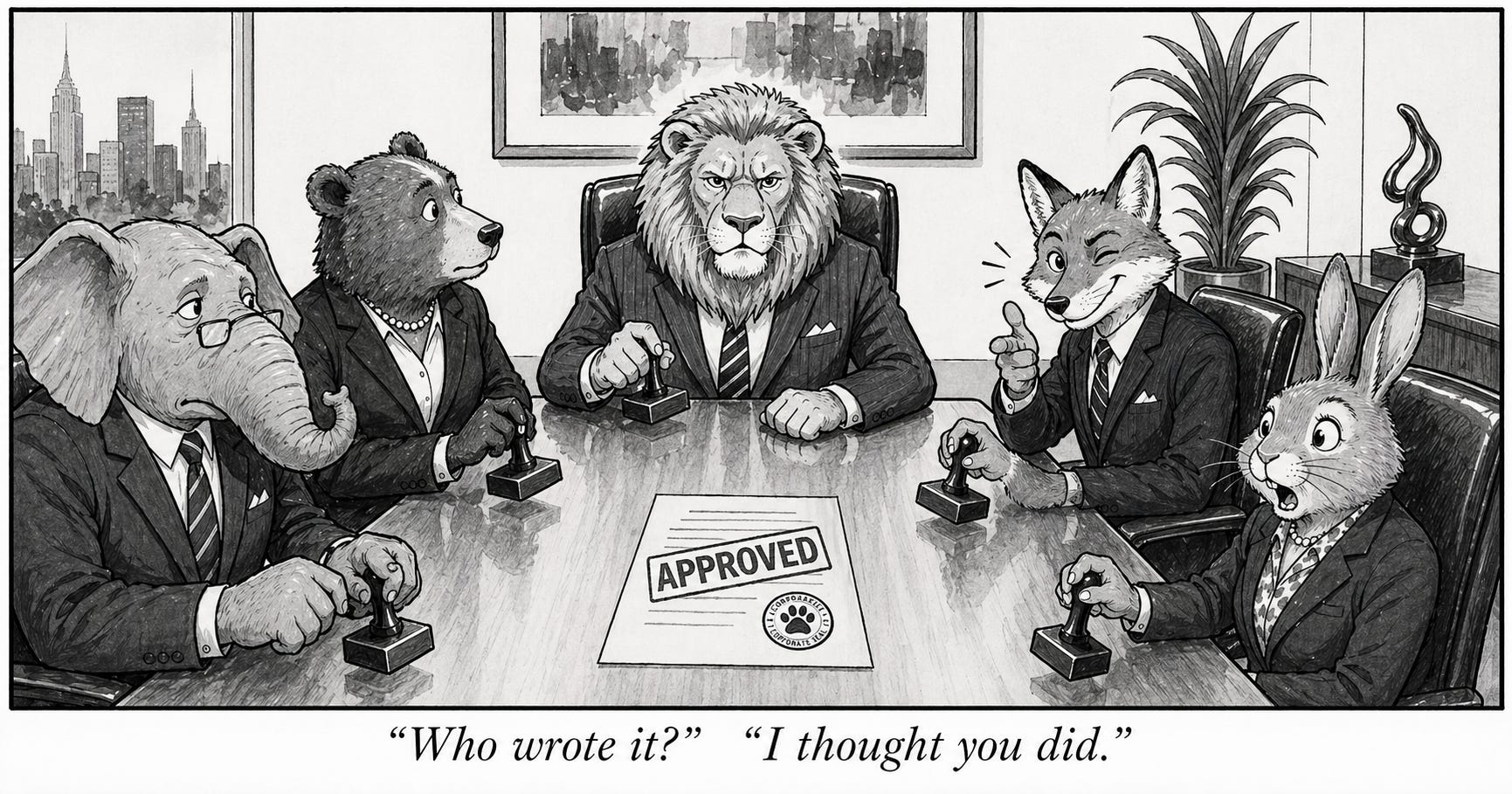
You can put five sharp people around a polished recommendation and still end up with theater. You can require human review and still build a process where nobody feels enough ownership to push back. You can leave a person at the end of the chain and call it accountability, when what you actually built was ceremonial approval.
This is where the historical thread comes back.
The medieval lord sealed documents he could not read because he trusted his clerk and had other things to do. The modern equivalent is a manager approving a model-generated analysis because the document is fluent, the meeting starts in ten minutes, and disagreeing with it would mean doing the work yourself, slowly, from scratch.
The incentive structure is ancient. The only thing that changed is the clerk got faster.
Over time, people stop generating their own alternatives. They stop checking the source behind the summary. They stop asking what is missing. They stop framing the problem from scratch. And because they are still in the room, still clicking approve at the end, they may never notice the shift.
The loss is quiet. It feels like things are going well.
What is at stake is not intelligence in some grand, theatrical sense. It is the habit of beginning. Framing a problem before solving it. The confidence to look at a polished answer and say, “this is wrong.” The patience to inspect the path, not just accept the destination.
These abilities only deepen when you practice them. And you only practice them when nobody has handed you the answer yet.
Build for friction
A system that took this seriously would not optimize only for speed and smoothness.
It would preserve the conditions for thought.
It would ask for your goal before offering its route. It would show alternatives, not just winners. It would make its assumptions visible and its sources easy to inspect. It would make disagreement cheap. It would let you see what got excluded from the shortlist, what fell out of the summary, and what the ranking treated as irrelevant.
It would leave a little productive resistance in the process. Enough for a person to form judgment instead of merely inherit one.
Most of all, it would respect a distinction many systems blur: the difference between assisting your judgment and replacing the conditions that let judgment form in the first place.
It would not just help you click faster. It would help you decide better.
When did you last start from nothing?
The future problem probably is not that humans disappear from the loop.
The future problem is that millions of us stay in it, approving, absorbing blame, and feeling involved, while missing the part where the real shaping already took place.
So the question worth asking is not, “Was a human involved?” It is not, “Could someone have overridden the system?”
It is simpler.
At what point did a person still have to think?
That is where authorship lives.
Once that goes, the click at the end is only a mark left by someone who used to be there.
That is why the next useful habit may be simpler than it sounds:
Think twice before clicking.
Michael, this is well made. I have been writing on the same form of autonomy. In The Palace Still Stands, on rereading Kadare's Palace of Dreams, the clerks who read, forward, and act on dreams never decide, and yet something has decided. Your medieval seal made me think of that.