

I can still feel my grandfather's piano through the lid under my palms.
He'd pull me onto the bench, growl "Sing something," and let the chords rumble up the bones until I couldn't tell where his music ended and my voice began.
That memory taught me what alignment feels like—when two people share tempo, everything flows.
I've been contemplating what the future of product leadership is going to look like. What the future of product development might feel like, and what will pull a team together when roadmaps fail to do so. Because in an age where AI amplifies everything we do, that shared rhythm matters more than ever.

The Vibration That Started It All
So when we ran a sync last week between Redmond, New York, and Cambridge, I felt the contrast. Everyone was playing well—just not to the same downbeat.
The engineer demoed what we could ship today. The researcher floated a multi-month workflow roadmap. The AI notetaker chirped, “Would you like help optimizing for velocity?”
Nobody was feeling the same moment. That's when it hit me: this isn't a time-zone problem—it's a time-perception problem. Every role operates on its own private tempo, each believing it's synced to "now."
What we needed wasn't another framework, but a gravity center—something with enough pull to align our different orbits.
The Vibration You Can Feel
Years later I understood why that piano memory lingers. When I press an acoustic guitar against my chest and strike a chord, the vibrations travel through ribs, sternum, lungs. I’m not merely hearing the music; I’m inhabiting it.
Sing with others and the air itself synchronizes. Breaths line up, the room finds one frequency. We don’t just make music together—we vibrate together. That is what our teams need: not another stand-up, but a shared rhythm you can feel.
In an era of AI copilots, our job might not just be to sync people—but to teach our systems the rhythm of human teams.
So what exactly is a product lead leading? Leadership executes vision through others; management keeps gravity, risk, and capacity in balance so that vision stays executable. In practice the title hardly matters—conductor, frequency-finder, rhythm-weaver. The vibration does.
The Product Manager Who No Longer Exists
Twenty years in product have crystallized one first principle—the half-life of a job title is now shorter than the sprint that proves it useful (see more about first principles here: “The First & Last Principle”). Yesterday the label was “Product Manager.” By lunchtime that same role had morphed into Python debugger, user-behavior analyst, resilience coach, and launch shepherd for an AI-generated feature. Roles aren’t evolving; they’re detonating. The blast radius keeps expanding—modern product managers now juggle market strategy, technical trade-offs, and team wellbeing far beyond the old roadmap brief (Parikh, 2025).
Work that once unfolded over weeks now completes in minutes, while the mental overhead of keeping every mind in phase only grows.
The Hidden Cost of AI Confidence
Cambridge thinks in architectural symphonies—calm, layered, elegant. NYC pulses at market-close frequency—urgent, tactical, fast. Redmond hums to two-week sprint drums—steady, pragmatic, precise. Each mind plays a different time signature.
Case studies inside agile tech teams echo the pattern: product managers frequently absorb product-owner duties to keep experiments moving, which blurs the once-clear handoff between strategy and execution (Tkalich, Ulfsnes, & Moe, 2022).
Put them in one call and you’re playing jazz with three metronomes while debugging the video feed.
The data bears this out. A meta-analysis spanning 106 experiments shows human–AI teams, on average, trail the stronger solo performer by 0.23 standard deviations—and by 0.27 SD on decision-style work (Vaccaro, Almaatouq & Malone, 2024). The problem isn’t raw speed—it’s the cognitive tax of checking and rechecking what the model just produced.
Ethan Mollick, who used AI as both collaborator and critic while writing his book Co-Intelligence: Living and Working with AI, calls this the “Cyborg” model—where human and machine pass the baton mid-sentence. But even in that dance, it’s the human who sets the tempo.
And the data backs it up: a Microsoft–CMU study of 319 knowledge workers found that greater trust in GenAI predicted lower self-reported critical-thinking effort—curiosity, sedated by automation (Lee et al., 2025).
It’s exactly the risk many of us in the field are flagging: AI can help us move faster—but only if we stay awake at the wheel.
From Process Charts to Gravity Centers
Traditional process charts assume a steady beat; gravity centers create the orbit that pulls teams together no matter the weather. Ours is a short “Idea Demo” every Thursday morning. Anyone—research, design, ops—can show a half-baked spark. Within three weeks the ritual became our de-facto tuning fork: context catches up, tempo evens out, decisions land faster than fresh project tickets.
These aren't meetings; they're magnetic moments. Alignment isn't scheduled—it's entrained. In a world spinning like a tornado, these gravity centers become our tuning forks—clear frequencies that cut through the chaos.
—Intermission—
My five-year-old just tugged my sleeve: “Papa, can we dance?” Encanto blares from her iPad. Five minutes of shared beat resets alignment better than another slide deck. We danced. The best part of my day!
—Okay, back to writing.—
When the Room Found Its Rhythm
By week four Cambridge dropped an insight, Redmond riffed the architecture, NYC framed the market hook, and I wove code with coaching. In an era of AI-accelerated time compression—where, as I explored recently, "a few hours to rest feels like stepping away for a week"—these gravity centers become our temporal anchors.
Output spiked, but the real win was compound imagination—ideas layering like jazz, not piling like tickets. Other groups asked what changed. The answer isn’t another Kanban board; it’s the deliberate hunt for shared rhythm in a world where job descriptions expire overnight.
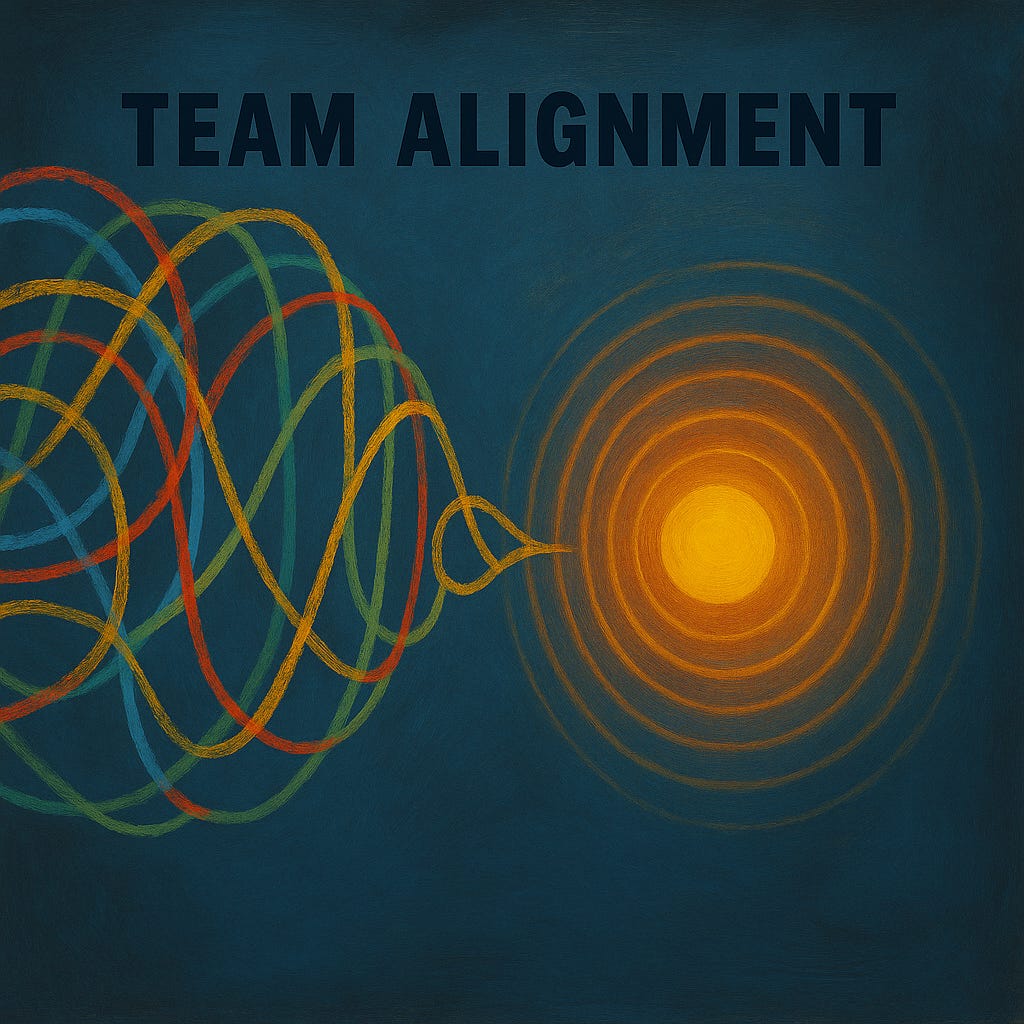
Compression isn’t just speed—it’s speed without sync. It flattens nuance, distorts tempo, and burns trust. But under the right conditions, compression can amplify: harmonies tighten, clarity cuts through the noise. It all depends on who strikes the tuning fork first.
Strike Your Fork Before the Funnel Forms
AI will keep swallowing yesterday’s skills.
Titles will keep detaching from their job descriptions. Yet one human super-power compounds in the chaos: the ability to sound a clear note and pull every loose part into orbit.
So: what’s your gravity center? The backlog can wait; finding your team’s natural frequency can’t.
Before the next release cycle spins into another tornado, strike your fork. In the comments share one ritual—however small—that keeps your crew vibrating as one. We'll turn those notes into a score loud enough to steady the storm.
Because somewhere, in every synchronized team, there's still a kid with their palms on the piano lid, learning that alignment isn't something you manage—it's something you find and feel.
References
Lee, H., Sarkar, A., Tankelevitch, L., et al. (2025). The Impact of Generative AI on Critical Thinking: Self-Reported Reductions in Cognitive Effort and Confidence Effects From a Survey of Knowledge Workers. Microsoft Research / Carnegie Mellon University, CHI ’25 proceedings.
Parikh, N. (2025). The evolving role of product manager: A systematic review. Foundations of Management, 17(1), 37–56. https://doi.org/10.2478/fman-2025-0003
Tkalich, A., Ulfsnes, R., & Moe, N. B. (2022). Toward an agile product management: What do product managers do in agile companies? In *Agile Processes in Software Engineering and Extreme Programming – XP 2022* (pp. 168–184). Springer, Cham.
Vaccaro, M., Almaatouq, A., & Malone, T. (2024). When combinations of humans and AI are useful: A systematic review and meta-analysis. arXiv:2405.06087.
Further Reading
The First & Last Principle – Why product roles decay faster than roadmaps
Out of Time - How downtime hits differently today
What Is a Kanban Board? – A quick primer on the tool we didn’t rely on
Co-Intelligence: Living and Working with AI by Ethan Mollick – A practical piece on syncing with AI not just technically—but cognitively.