What if coding isn't about syntax anymore—but about finding your rhythm with the machine?
Introduction: Vibe Coding Isn’t a Joke
There’s a new form of creation emerging - less about typing code, more about collaborating with the rhythm of AI. It's not traditional programming. It's not fully design. It’s something in between: rapid, expressive, vibe-led building.
This is an article for people who don’t think they can code—especially product managers, designers, or thinkers who shape software but feel locked out of "the build."
And more importantly, it's for those asking the question at the heart of The Arc: how do we stay human in the age of AI? Because vibe coding isn't just about building faster—it's about preserving our role as creators, not just consumers, in a world where machines can generate almost anything.
We’ll walk through what it means to vibe code, how to start, and how I built one of many experiments, AI VoiceGen—a voice feedback tool created entirely through vibe coding—to show the process in action.
This builds on ideas introduced in Tuning Forks in a Tornado, where I explored rhythm as a core design and leadership skill. Now we bring that rhythm into your build process.
Last week in "The Rhythm Engine," I showed you why AI needs to match our rhythm, remember our context, and focus on outcomes over output. Now let me show you how to actually build this way.
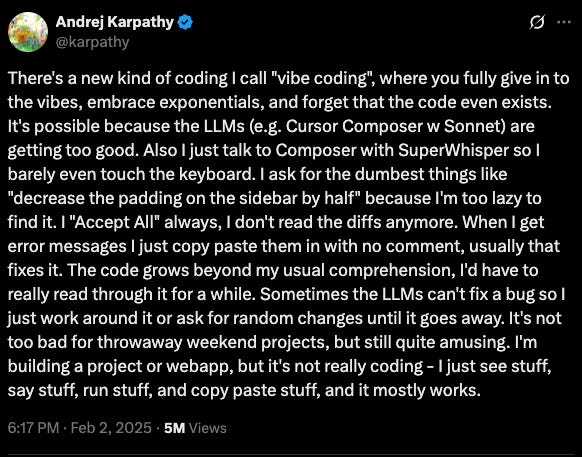
"I just see stuff, say stuff, run stuff, and copy paste stuff, and it mostly works."
It’s chaotic, yes—but it also reflects a real, accessible shift.
Vibe coding means:
You express what you want using natural language
AI co-constructs code, with your feedback as the compass
You spend more time shaping, editing, and orchestrating than writing lines from scratch
In IBM’s definition, it’s framed as "express intent, refine later." It’s a code-first, fix-later loop—best for prototypes, risky ideas, or workflows where learning matters more than elegance.
Some argue this should evolve into "Lego coding"—modular, recipe-based scaffolding that scales better across teams. And I agree. That’s exactly what I’m going to show you how to do.
The Ancient Origin of Vibe Coding?
The phrase abracadabra might sound like stage magic, but its roots run deeper—into early Kabbalistic texts and writings in Hebrew and Aramaic. Most scholars believe it derives from the phrase:
“Avra kedabra” – I will create as I speak.”
This wasn’t and didn’t need to be magic—it was method. Vibe coding works the same way: intention, expression, response, refinement. Language doesn’t just describe what we want. It starts to build it.
In mystical systems like Kabbalah, language isn’t just descriptive—it’s generative. The act of naming or speaking something aloud brings it closer to reality. Sound becomes structure.
This isn’t mere metaphor. Ultrasound waves are routinely used in medicine to promote bone healing and tissue repair.1 At the cellular level, mechanical vibrations drive changes in gene expression and cell differentiation. Sound, quite literally, helps shape biological structures.
And isn’t that what vibe coding is?
You speak the intention. You refine the rhythm. The system responds.
In 2025, with Claude, Codex, Cursor, and CLI interfaces, we’re just rediscovering what those early mystics understood: creation begins with finding your voice.
CLI-First: The Terminal Still Wins
For serious builds, Command Line Interface (CLI) vibe coding is currently the most reliable path. Here’s why:
Claude Code gives structure, readable scaffolds, and some early forms of memory (at least as storage). Claude Desktop is excellent for front-end orchestration.
Codex CLI helps generate files, directories, and shell workflows. Not perfect, but fast.
Gradio or simple javascript/html can be a go-to for spinning up front-end interfaces in minutes. It pairs well with AI-driven UX.
GPT-4o, and o4-mini-high are all exceptional at code QA, short scripts, and Minimally Viable Experiment (MVE) debugging, but not as consistent across multi-page workflows unless anchored in CLI.
Github Copilot, Cline, Roo, and even now Claude Code all have strengths in a development environment as they can deeply align with your Visual Studio Code (vscode) Integrated Development Environment (IDE).
Walkthrough: How I Vibe Built AI VoiceGen
I’m not a full-time developer. I’m more of a clinician and/or CIO than anything else. But I needed a simple tool that could read my writing aloud in different voices and tones—because voice helps me hear errors and rhythm more clearly when I write.
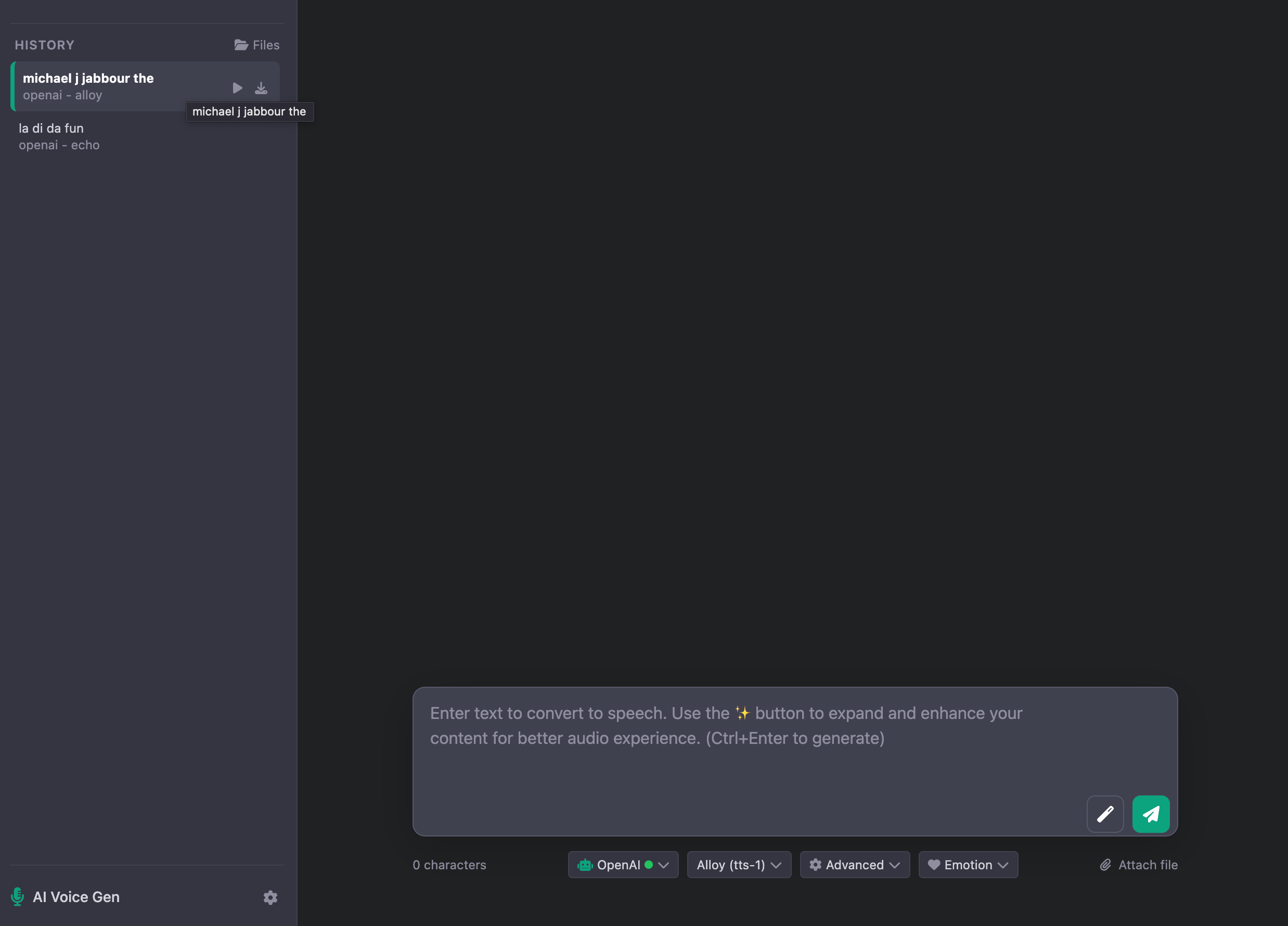
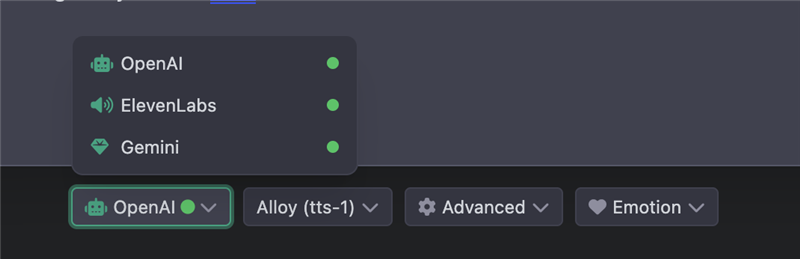
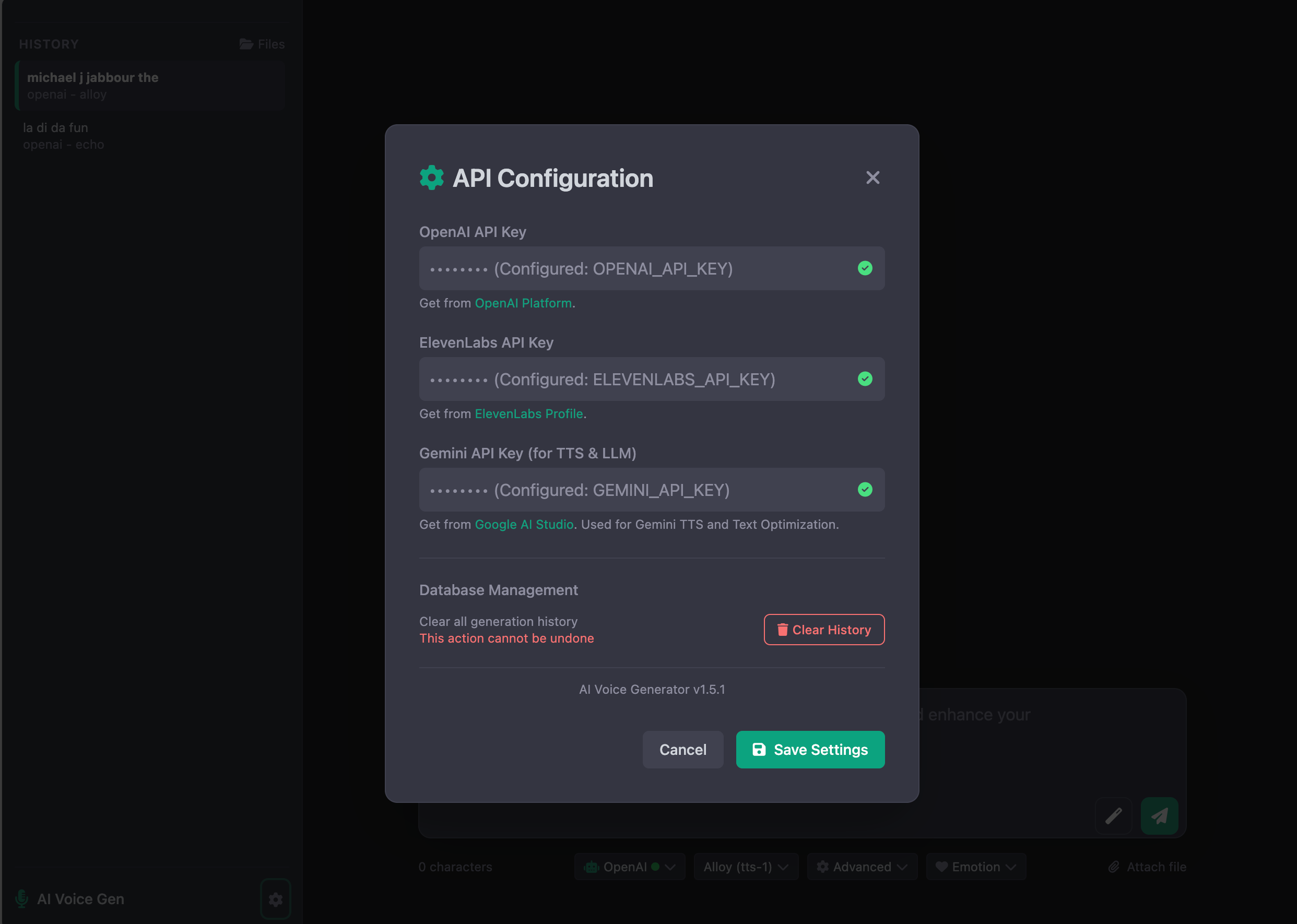
So, I built aivoicegen—an TTS generator that connects to OpenAI, ElevenLabs, and Gemini.
Not from scratch. From vibe.
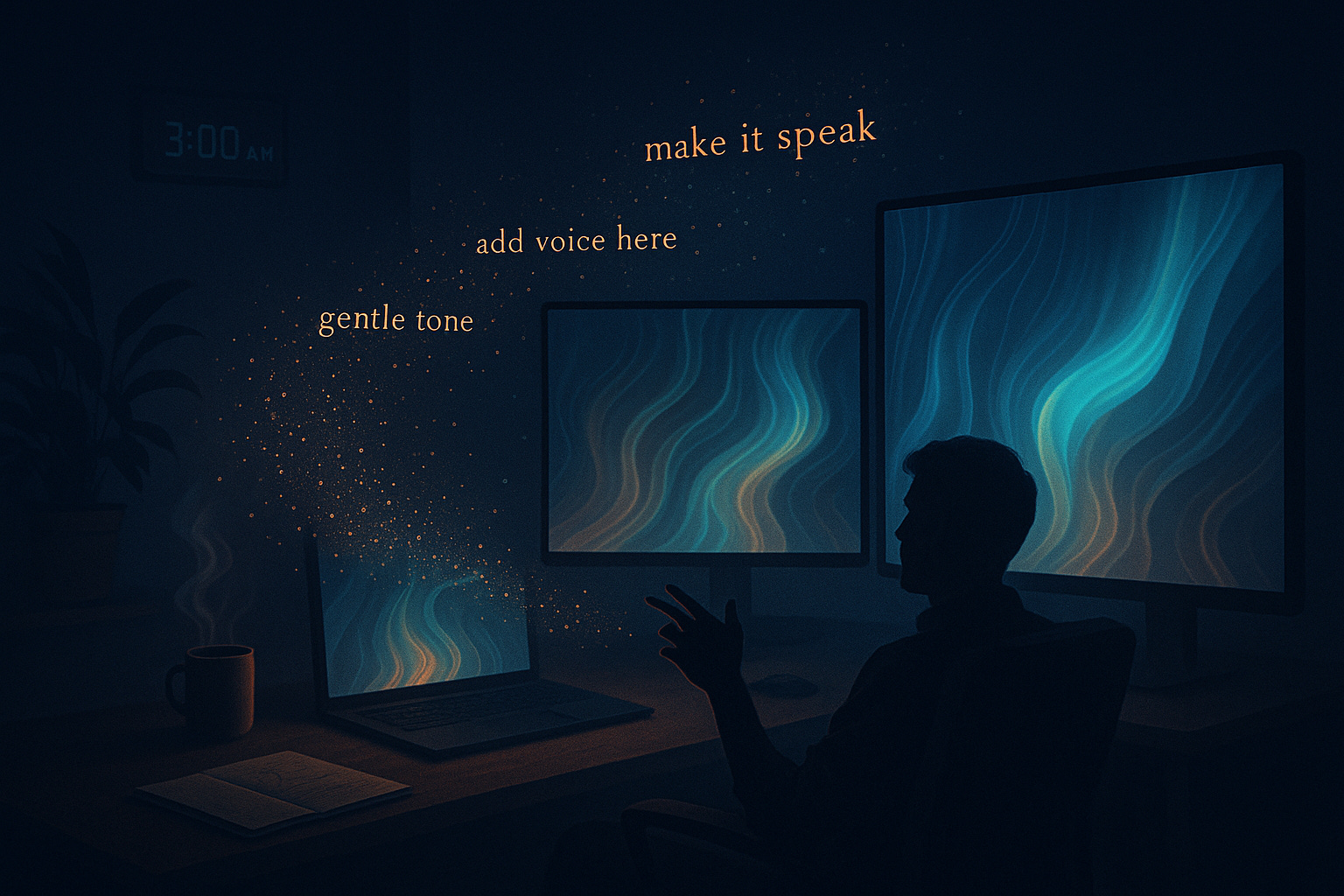
Generated by GPT-4o in collaboration with Michael J. Jabbour, June 22, 2025, 3am. The hour when creation feels most like conversation. In the liminal space between intention and code, we find a new way to build—not by wrestling syntax into submission, but by speaking our dreams into being.
I built the UI via Claude Desktop-generated HTML/CSS and refined with light edits
I prompted Claude to write the scaffolding for the app
I used Github Copilot with GPT-4.1 to test and fix logic
I iterated quickly, asking other AI’s for feedback on how to improve
The result: a tool that speaks your drafts, tunes your copy, and helps you hear what you wrote - in lots of voices and styles.
A Vibe Coding Framework
From IDEA → SPEC → MVE → UI/UX → MVP
This is the flow I now teach others to use. It keeps the loop tight, the scope clear, and the toolchain light. Note, sometimes I will put a rapid UI/UX stage between IDEA and SPEC.
1. IDEA – Narrate Your Intent
Why: This is where you move from intuition to intent, just like Luca Rossi’s “top-down vibe coding” model emphasizes.
Example Prompt:
Help me write a specification for a tool that reads my writing aloud in different voices.

Before we code:
- Tell me your plan first.
- Give me 2–3 options (simplest first).
- Think out loud, and ask me follow-up questions.
You are an AI assistant acting as a master product lead.
From the above, create *four markdown files* in the current directory.

For each file follow the spec:
1. *todolist.md* – actionable bullet list, grouped by phases (`Now`, `Next`, `Later`).
2. *requirements.md* – concise product-requirements doc:
   - Overview (1-2 sentences)
   - Goals & non-goals
   - Personas / use-cases
   - Success metrics
   - Milestones / timeline
3. *secrets.md* – table of environment variables or API keys required for development.
   - Columns: `KEY`, `DESCRIPTION`, `EXAMPLE_VALUE`
   - Leave sensitive values as `TODO:` placeholders.
4. *designs.md* – high-level architecture & UX outline:
   - System diagram in Markdown mermaid code block
   - Data flow description
   - Key UI states (bullet list)
   - Open questions / risks

*Output exactly four code fences, one per file, in this order, each fence titled with the filename.* Example fence header: `--- todolist.md ---`
Do not add any extra commentary outside the fences.
Or use this shortcut prompt:
“You are an AI assistant acting as a project scaffolder. From the single-line IDEA below, create four markdown files:
1. todolist.md
2. requirements.md
3. secrets.md
4. designs.md”
New framing: You’re not writing code. You’re writing the Lego bricks the code will be built from. We would call that a recipe.
3. MVE – Minimally Viable Experiment
An MVE is smaller than an MVP—it’s one moment that proves your idea has legs. A button that speaks. A single input-output path. Something that shows the system heard you.
Pick one path—
Build one user moment (e.g. click to generate voice) - a single user interaction (e.g. button → text → voice output) before wiring logic.
Remember: "More output is just more noise unless it moves the needle." One working interaction beats ten half-built features.
“Keep it simple. Ask for one step you can test. Reset the chat per feature.”
Design a front-end layout for this [app or feature],[using html/javascript or Gradio or your front-end of choice].
Iterate with screenshots and voice notes. Vibe coding isn’t silent. “Include screenshots of the issue or layout. AI sees better than it infers.” (Rule #7 from Peter Yang discussed below, and common across Cursor usage guidelines )
5. MVP – Recombine the Working Blocks
Once you have 2–3 MVEs tested, connect them with:
Input → processing → output
Gradio or Streamlit as the glue
Claude or Codex CLI for wiring + config
Then:
Add basic state management
Test for regressions (and revert as needed—Rule #9)
Reduce code sprawl where possible, ask the AI to help
Alternatively, if your spec is good enough - sometimes AI can skip this step and automagically integrate these backend steps heuristically.
The “Structured Vibe” Workflow
Based on real-world vibe builders:
1. Start with vibe PMing
Use natural language to describe outcomes and milestones. Don't overthink. Let the AI catch your rhythm—remember, "when rhythm is random, no one can dance."
2. Let AI ask the questions
Use: “Ask me one question at a time until we reach a shared spec.”
3. Use checklists to track your path
todolist.md
test.md
output folder
4. Stay in the 40–55% AI zone, for now
Let AI scaffold, test, and summarize. Keep key decisions human.
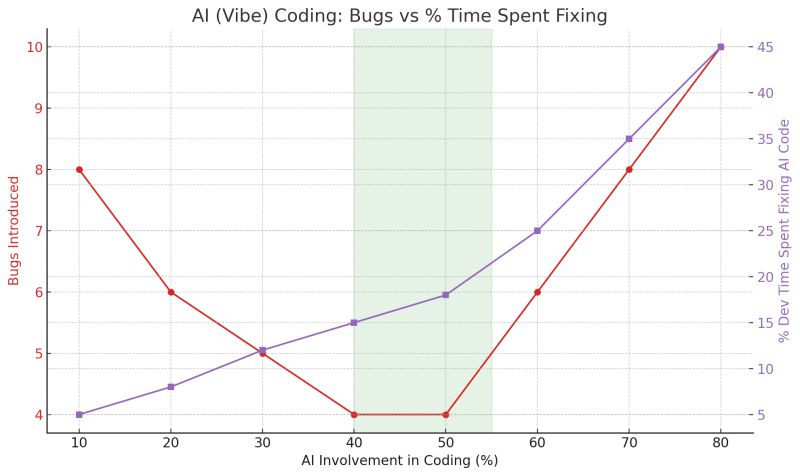
In a 10-project analysis by Saranyan Vigraham, the sweet spot for AI contribution was 40–55%. Below that, output slowed. Above it, debugging time spiked. That said, I and my peers have easily vibe coded 80-100% of an app without bugs and problems. Something to note is app/feature size, the larger the app the harder it is for the AI coder to help on large tasks.
5. Use Git, revert often, test continuously
Peter Yang's 12 Rules are non-negotiable for sanity.
Start with vibe PMing
Keep your tech stack simple
Give AI the right rules & documentation
Ask AI not to code
Ask AI for options and pick the simple one
Break tasks into small steps
Include images to give AI context
Test ruthlessly after every change
Don’t hesitate to revert
Use GitHub for version control
Use your voice to feel the vibes
Ask AI to explain the code
This creates the memory trail that prevents you from becoming a parrot—your AI assistant can see what's been tried, what worked, and why.
Tool Guide: My Current Stack
The Human Choice
As we embrace vibe coding, we face a crucial question: will we use these tools to create thoughtful, intentional software—or will we let them generate an endless stream of algorithmic content? The same AI that can help us carefully compose digital experiences can also pump out infinite variations without purpose or meaning.
This is why vibe coding as a practice matters. It's not just about speed—it's about maintaining our role as intentional creators who know why we're building, not just how. When we vibe with intention, we're choosing curation over chaos.
As Sam Schillace wisely notes in "We are still professionals," there's a crucial balance here: "we have to not forget that we are professionals and need to do real engineering, when it comes to scaled, complex projects that AI can't fully handle today, while at the same time remembering that letting lots of people make code that we absolutely hate is actually a good thing.” The democratization of creation doesn't eliminate the need for craft—it makes understanding the difference between a quick vibe and a lasting build even more important.
From Rhythm to Repo
If you’ve followed my previous writing, this article is an extension of the following:
“Low-intensity pulsed ultrasound (LIPUS) has been shown to accelerate bone healing and influence cell fate through mechanical vibrations—a modern echo of how sound, quite literally, shapes structure” (Chen et al., 2023).