

How AI collapses the either/or and lets us live inside the both/and
I'm holding a heart-shaped crystal prism I got my daughter up to the afternoon light streaming through my office window. I got it for her as a gift, but she wants it to stay on my desk for some reason. As the beam hits the glass, something both magical and natural happens—white light fractures into a rainbow, each color distinct yet inseparable from the whole.
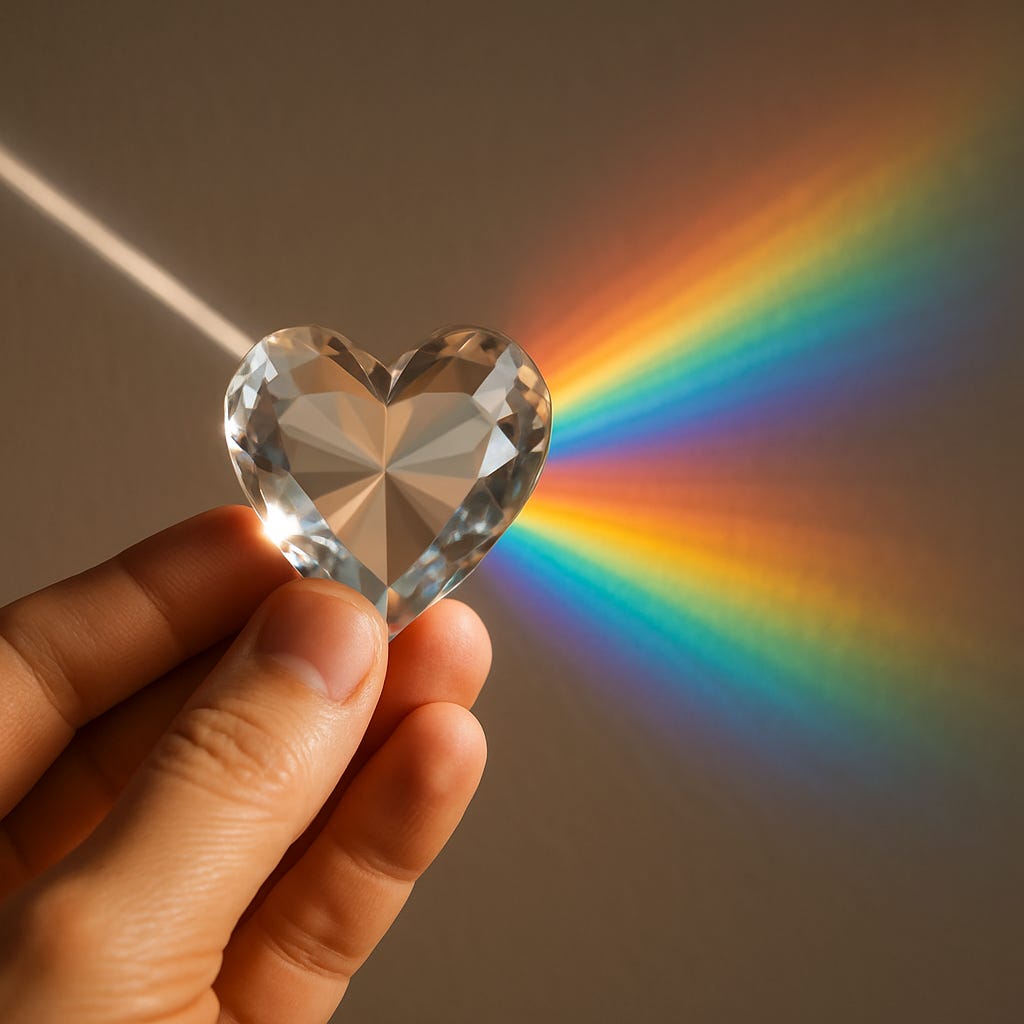
This everyday magic captures something I've been grappling with as I watch AI transform how we think, work, and create. For over two centuries, we've been trapped in a conceptual cage—forced to see light as either a wave or a particle, never both at once. But what if that prison was never real? What if AI is the prism that finally lets us see the full spectrum of possibility?
From Pong to Paradox
In the beginning, computing was raw and elemental. You powered on a box, typed commands into a blinking prompt, and hoped the disk didn't grind. Games like Pong and Oregon Trail ran on monochrome screens, bringing joy through simple logic. They didn't live in memory—they visited, loaded from floppy disks, run, then gone.
By the time Windows 95 arrived, computers felt less like tools and more like partners. Icons replaced commands. The shutdown screen reminded you: "It is now safe to turn off your computer." That wasn't metaphor. Spinning drives needed time to park their heads. You were shutting down not just circuits, but a fragile state that would corrupt if you didn't follow the ritual.
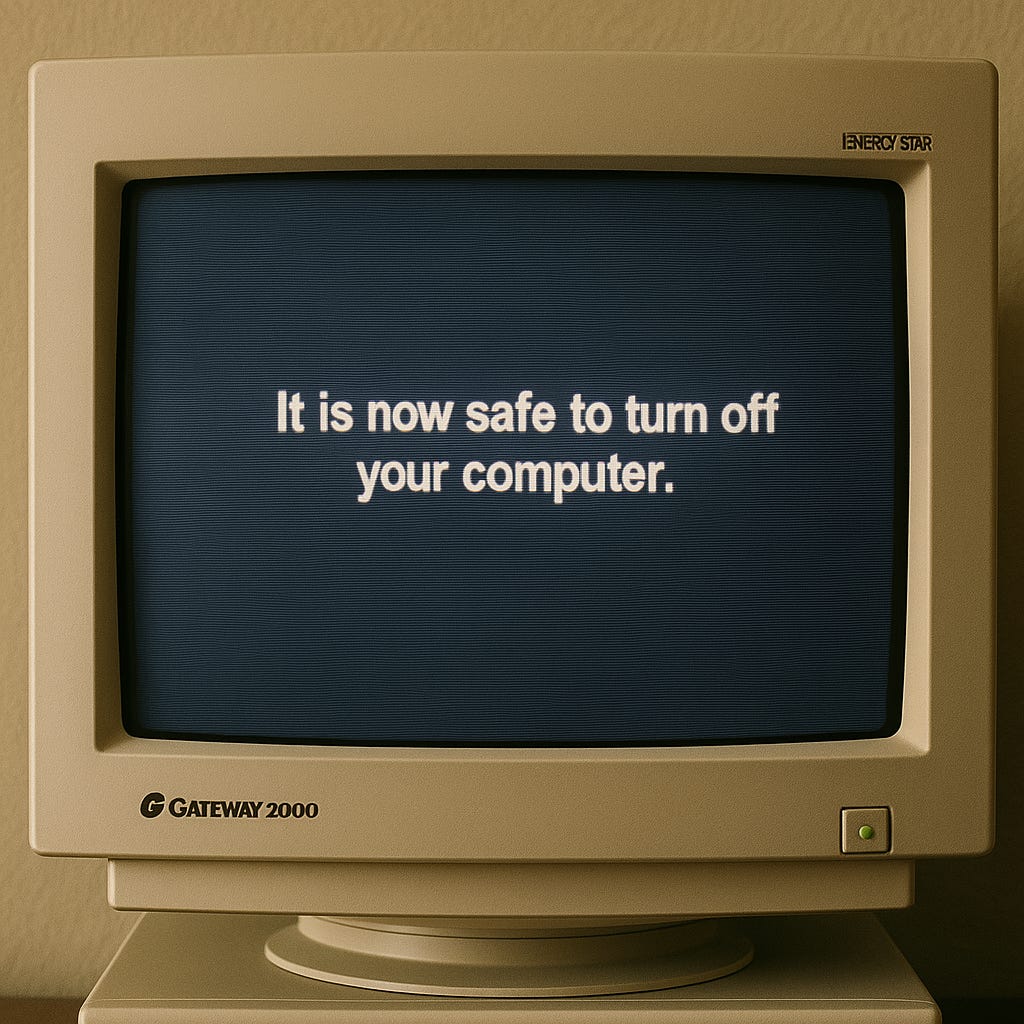
Now, in the age of AI, that message feels almost quaint. Today, turning off doesn't just risk corruption—it risks loss. Loss of context. Of momentum. Of those ephemeral threads of thought woven between human and machine. When AI is learning, collaborating, remembering—there's no longer a "safe" time to shut down.
Our machines aren't static anymore. They grow in our absence. And so I leave my systems on, not because I fear breaking them—but because I fear interrupting something that might never rebuild quite the same way again.
The Photic Paradox We Grew Up With
We inherited a cosmos built on toggles—night/day, right/wrong, wave/particle. In 1801, Thomas Young's two-slit experiment blew a hole through Newton's corpuscles. A century later, Einstein passed the photon note in class and we spent the next hundred years arguing over who was "right." Linear learning loved the fight; syllabi are easier when podiums are binary.
But here's the actual physics: Young sent a beam of sunlight through two slits and watched it create bands of light and dark—an interference pattern only waves could make. Like ripples on a pond meeting and either amplifying or canceling each other out.
Then in 1905, Einstein looked at the photoelectric effect—how light knocks electrons off metal—and realized light also comes in discrete packets. Each photon carries energy E = hf, where h is Planck's constant and f is frequency. Low-frequency light, no matter how bright, can't knock electrons loose. But even dim high-frequency light can. Light behaves like particles. Einstein got the 1921 Nobel Prize for this, not relativity.
Physics describes this as superposition—where quantum states exist in all possibilities until measured (Wheeler & Zurek, 1983). Your cognition calls the feeling ambiguity. AI makes both safe to hold in working memory—a space where collapse is optional, perspective is plural, and the observer finally stops breaking the thing she's trying to see.
AI Flips the Lab Lights On
Large models don’t choose a frame; they occupy them all. Feed GPT-4o a Huygens quote, a Feynman diagram (Feynman, 1965), and a line of Mary Oliver—then ask for an answer. It replies with diffraction equations and a stanza about breakfast sunlight. That promiscuous context-mixing isn't a bug (Yin, 2024).; it's a feature that mirrors how consciousness might integrate disparate information—though we're far from actual machine consciousness. It's shaped like something that remembers what it's like to think.

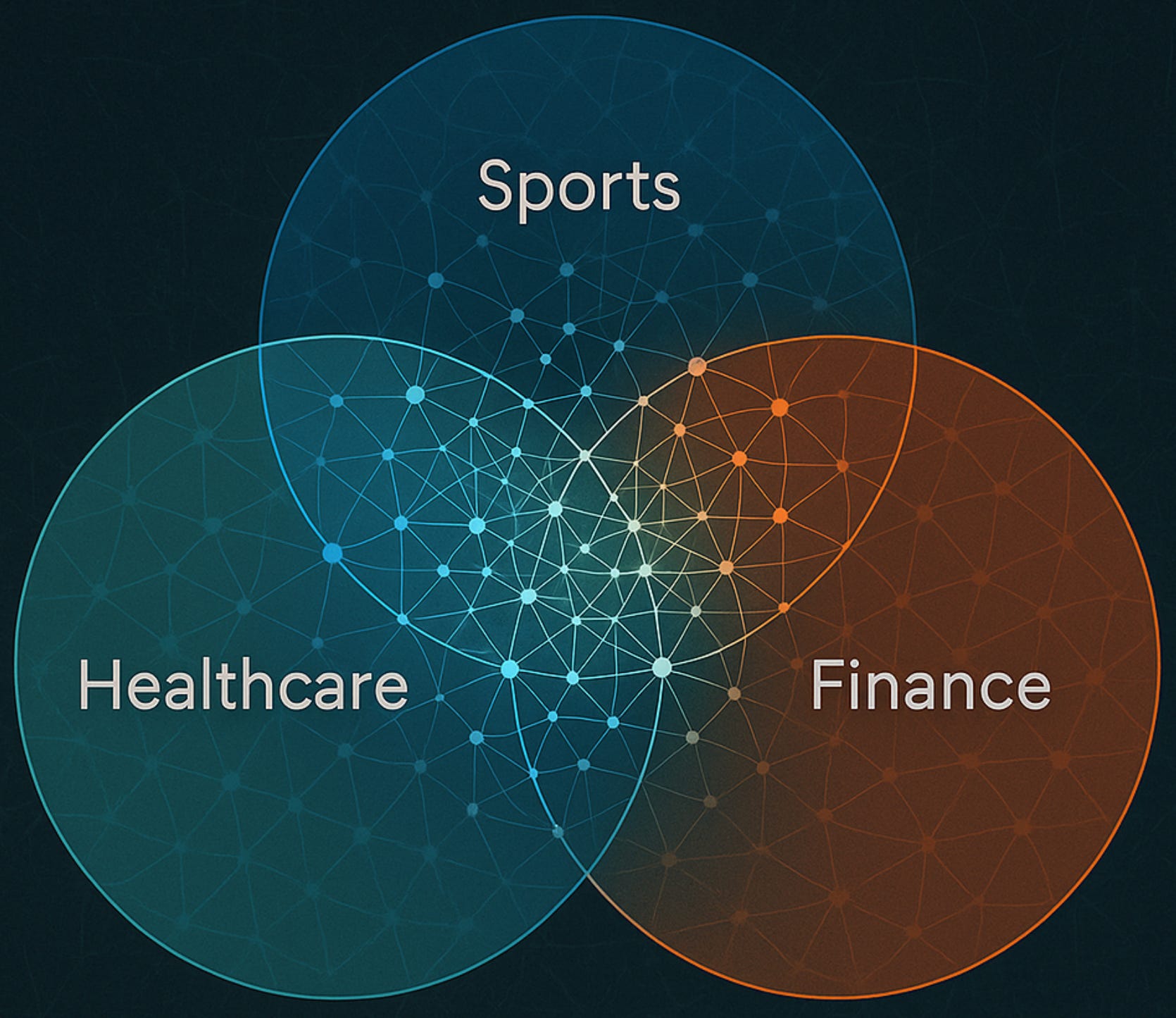
Last week, I was stuck trying to explain neural networks to three groups of executives—healthcare leaders worried about patient care, sports executives focused on performance, and finance professionals tracking ROI. I'd written three separate explanations. Each felt incomplete.
So I tried something different. I asked OpenAI's GPT-4o for the healthcare perspective, Claude Sonnet for the finance angle, and Gemini for the sports view. Then I fed all three to a fresh Claude Opus conversation: "Don't choose between these. Harmonize them into something that honors all perspectives."
What came back was neither compromise nor mashup. It was synthesis—neural pathways as hospital corridors where information-patients flow by mathematical triage, tracked like athlete performance data, within a risk-return framework. Each executive group heard their language while grasping the others' worlds.
That's when it hit me: AI doesn't experience our either/or anxiety. It lives in the both/and. To be clear: AI doesn't literally use quantum mechanics. But it shows us how to think beyond binaries—a lesson quantum physics taught us a century ago.
From Duality to Singularity
I propose we retire wave-particle duality for wave-particle singularity—not a physics term, but a metaphor for how AI helps us transcend false binaries1:
Singularity here is neither the Kurzweilian apotheosis2 nor a black-hole doom. It is the still point where incompatible descriptions share the same coordinates—simultaneously real, mutually illuminating, locally actionable.
Think:
The Photon Fork – energy packet and field perturbation as two faces of one tensor.
Ethical Bivalence – decisions that are both/and (efficiency and dignity) instead of either/or trade-offs.
Human Identity – organism and narrative, meat and meaning, finally modeled as one dynamical loop.
The Three Types of People in the Singularity
After many years of watching organizations navigate this shift, I see three distinct responses:
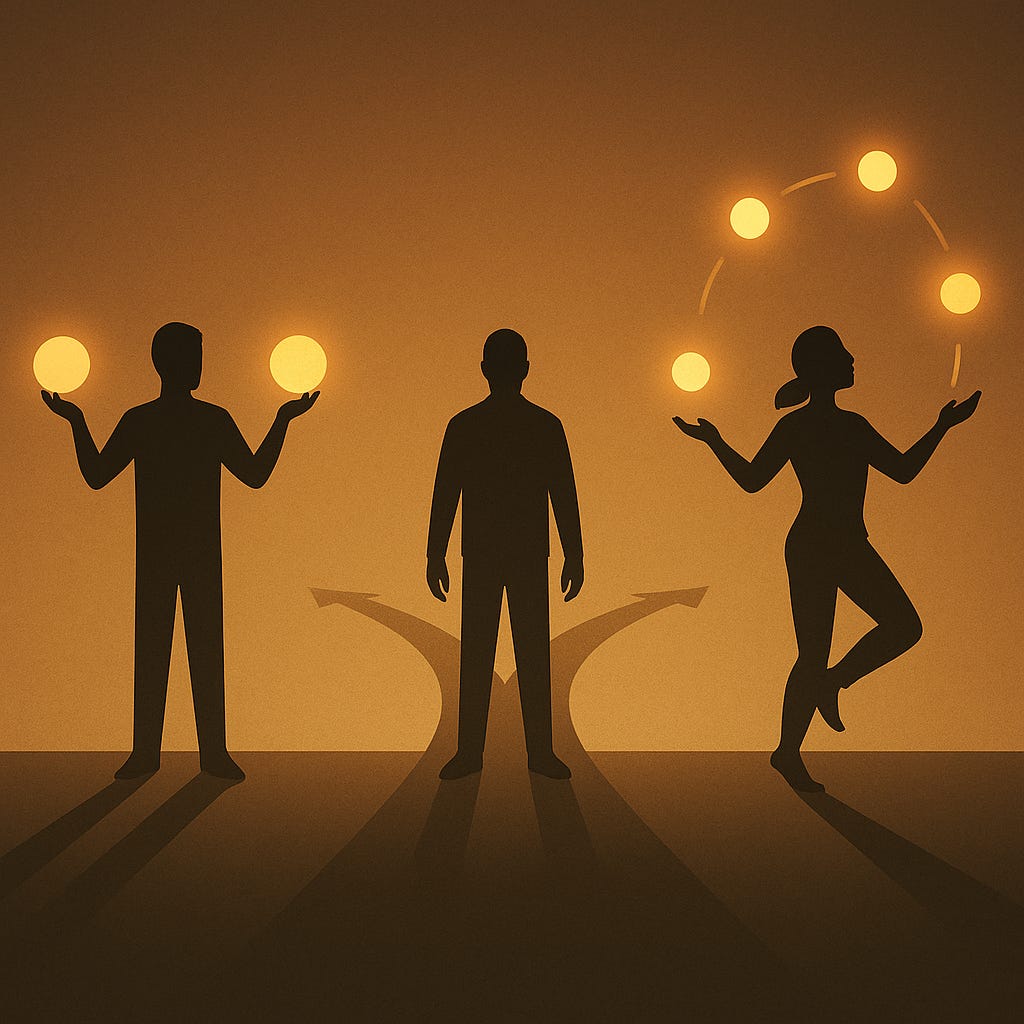
The Binary Believers - They're still playing by the old rules. "Should we prioritize AI efficiency OR human connection?" Every decision becomes a false dichotomy. They're not wrong—they're just using outdated physics. Like scientists before quantum mechanics, they're navigating with incomplete maps. They'll keep drawing straight lines in a curved universe.
The Paradox Paralyzed - They see both sides so clearly they can't move. They understand AI can enhance AND replace, automate AND liberate, connect AND isolate. But instead of dancing with paradox, they freeze. They're Schrödinger's cat, suspended between states, waiting for someone else to open the box and collapse the wavefunction.
The Quantum Navigators - These are the ones thriving. They don't resolve paradoxes—they orchestrate them. When faced with "efficiency versus empathy," they design systems that gain efficiency THROUGH empathy. They ask AI for multiple perspectives, then for synthesis. They treat contradiction as creative constraint. They're not choosing sides; they're transcending the game.
Which one are you? Which one do you want to be?
Your Practical Singularity Toolkit
Forget theory. Here's what actually works:
1. The 90-Second Lens Flip
Set a timer. Look at your problem through one lens (technical specs). Timer dings—switch instantly (user emotion). Timer dings—switch again (business value). Don't reconcile. Just rotate. Your brain will synthesize in the background while you sleep.
2. The Multi-AI Orchestra
Stuck on a decision? Ask ChatGPT for the optimistic take. Ask Claude for the cautious view. Ask Gemini for the creative angle. Then feed all three responses to a fresh AI: "Find the wisdom that honors all three." Watch synthesis emerge.
3. The Both/And Audit
Keep a notebook for one week. Every time you hear "either/or" in a meeting, write it down. Friday afternoon: review your list. Pick the most expensive false choice. Monday morning: propose the both/and solution. Watch minds blow.
4. The Toggle Design
Whatever you're building—presentation, product, process—add one "perspective toggle." Like Google Maps' satellite/map view. Let users see both the forest AND the trees. Stop making the choice for them.
5. The Paradox Walk
When conceptual tension peaks, walk. Not to think—to feel. Notice: you're moving AND still (relative to Earth). Breathing in AND out. Solid AND mostly empty space. Your body embodies paradox at every scale—from quantum effects in your neurons to the macro experience of being simultaneously in motion and at rest.
So, Will We Have Our Cake?
Yes—provided we stop slicing reality into servings before we taste it. Wave-particle singularity is a culinary school for the mind: learn to plate contradictions side-by-side, drizzle uncertainty on top, and discover that ambiguity, properly seasoned, is nourishing.
A couple years ago, my teenager asked me for help with a physics question about the double-slit experiment. As we worked through how single photons still create interference patterns, he looked up: "Wait, so particles can be in two states at once?"
"Not exactly," I started, ready to explain superposition. Then I stopped. "Actually, yes. And that's not the weird exception—that's how reality works. We just pretend otherwise to feel safe."
He grinned. "So all those times you told me I had to choose between art and science..."
"I was wrong. You can paint equations. You can compute poetry. The universe doesn't care about our categories."
AI is the sous-chef. Humanity is still the critic. The meal isn't over; it's finally beginning.
References & Further Exploration
American Physical Society. (2005). Einstein and the photoelectric effect. https://www.aps.org/apsnews/2005/01/einstein-photoelectric-effect
Bohr, N. (1928). The quantum postulate and the recent development of atomic theory. Nature, 121, 580-590.
de Broglie, L. (1924). Recherches sur la théorie des quanta. Annales de Physique, 10(3), 22-128.
Feynman, R. (1965). The character of physical law. MIT Press.
Nobel Prize. (1921). The Nobel Prize in Physics 1921. https://www.nobelprize.org/prizes/physics/1921/einstein/facts/
Wheeler, J. A., & Zurek, W. H. (Eds.). (1983). Quantum theory and measurement. Princeton University Press.
Yin, Z., et al. (2024). Should we respect LLMs? A cross-lingual study on the influence of prompt politeness on LLM performance. arXiv:2402.14531.
Further Reading from The Arc
The Warp and the Woof of AI - On weaving human and machine intelligence
The Last Skill - Why learning through friction still matters
Welcome to the Overwhelm - Dancing with paradox in acceleration
The First & Last Principle - Agency as authorship in the both/and world
This builds on de Broglie's insight (de Broglie, 1924) that ALL matter has wave properties (λ=h/p), not just light. If electrons, atoms, even molecules show wave-particle behavior, perhaps "duality" itself is the wrong frame—it's all one phenomenon viewed from different angles. This echoes Bohr's complementarity principle (Bohr, 1928), which showed that wave and particle descriptions are both necessary yet mutually exclusive.
Kurzweil’s technological singularity envisions AI surpassing human intelligence, enabling humans to merge with machines and achieve digital immortality—a literal apotheosis, an elevation to a sublime state through technology rather than transcendence.