

I woke up with a familiar sensation—that peculiar mix of exhilaration and dread that's become the signature feeling of our moment. My phone glowed with seventeen notifications about the latest AI breakthrough. My Teams channels hummed with questions I couldn't answer. And somewhere in my chest, that now-familiar tightness whispered: you're falling behind.
Welcome to the overwhelm.
The Weight of Acceleration
Rapid, unbridled, unpredictable change. Pundits punditing. Non-stop adjustment. That's how I'd describe the last 24 months—though even "months" feels like the wrong unit of measurement when each week contains what used to be a year's worth of transformation.
"Relax your mind at your own peril" has become the unspoken mantra of today's corporate environments. But here's the thing about mantras repeated under duress: they stop being wisdom and start being weapons our subconcious uses to bully ourselves.
This week, I completed 24 months of giving AI workshops across the country. Bootcamps, deep dives, executive briefings—I'd absorbed enough acronyms to fill a dictionary and enough use cases to wallpaper my office, 10x over. I sat down this past Friday, summer AC blowing strong, feeling that peculiar modern exhaustion that comes not from not knowing, but from finally understanding just how much you don't know.
That's when the arithmetic of anxiety kicked in. If everyone was going to get 1,000 papercuts navigating this transformation, I was convinced I could optimize my way down to 51. Maybe 50 if I really pushed.
The hubris of that calculation still makes me laugh. We want zero papercuts while walking through a forest of razors. We want transformation without disorientation. We want to surf the tsunami without getting wet.

The Jung Pivot
Three weeks into my self-imposed AI marathon, depleted and slightly delirious, I stumbled across a quote I'd highlighted years ago:
‘I am not what happened to me, I am what I choose to become.’
—Carl Jung ’s philosophy of individuation
Something shifted. The overwhelm was still there, but it moved from the driver's seat to the passenger side. I had agency in this chaos. Not control—that's a different delusion—but agency. The ability to choose my response, to author my own transformation narrative.
Years ago, that realization brought color back to my face and questions to my mind:
The questions cascaded like a developer's nested loops:
What's the best book I can read?
Are there good websites I can learn from?
What courses actually matter?
Are my friends working on AI projects I could join?
How technical do I really need to be?
How much budget do I need to do this right?
How many people in my organization need to make this shift?
What can I specifically do right now?
So I did what every overwhelmed professional does: I acted. Wrote my first prompts with the confidence of someone who'd watched exactly three YouTube tutorials. Read my first AI research paper with the comprehension of someone reading ancient Sumerian. Built my first workflow automation with all the elegance of a toddler's first Lego castle.
The results were... humbling.
My AI outputs read like they'd been written by a caffeinated robot with a philosophy degree and no social skills. My automations automated nothing except my own frustration. Those 50 papercuts I'd budgeted for? I collected them all in the first week.
The Truth Tax
Bruised but not broken, I remembered another quote, this one from Leland Val Van De Wall:
"The degree to which a person can grow is directly proportional to the amount of truth they can accept about themselves without running away."
The truth I had to accept: I was approaching AI like it was another tool to master, another certification to collect. But AI isn't a hammer—it's more like a dance partner. And I'd been stepping on its toes while insisting it was out of rhythm.
The Anthropomorphic Breakthrough
Here's where I broke the first rule every AI expert preaches: don't anthropomorphize the machine.
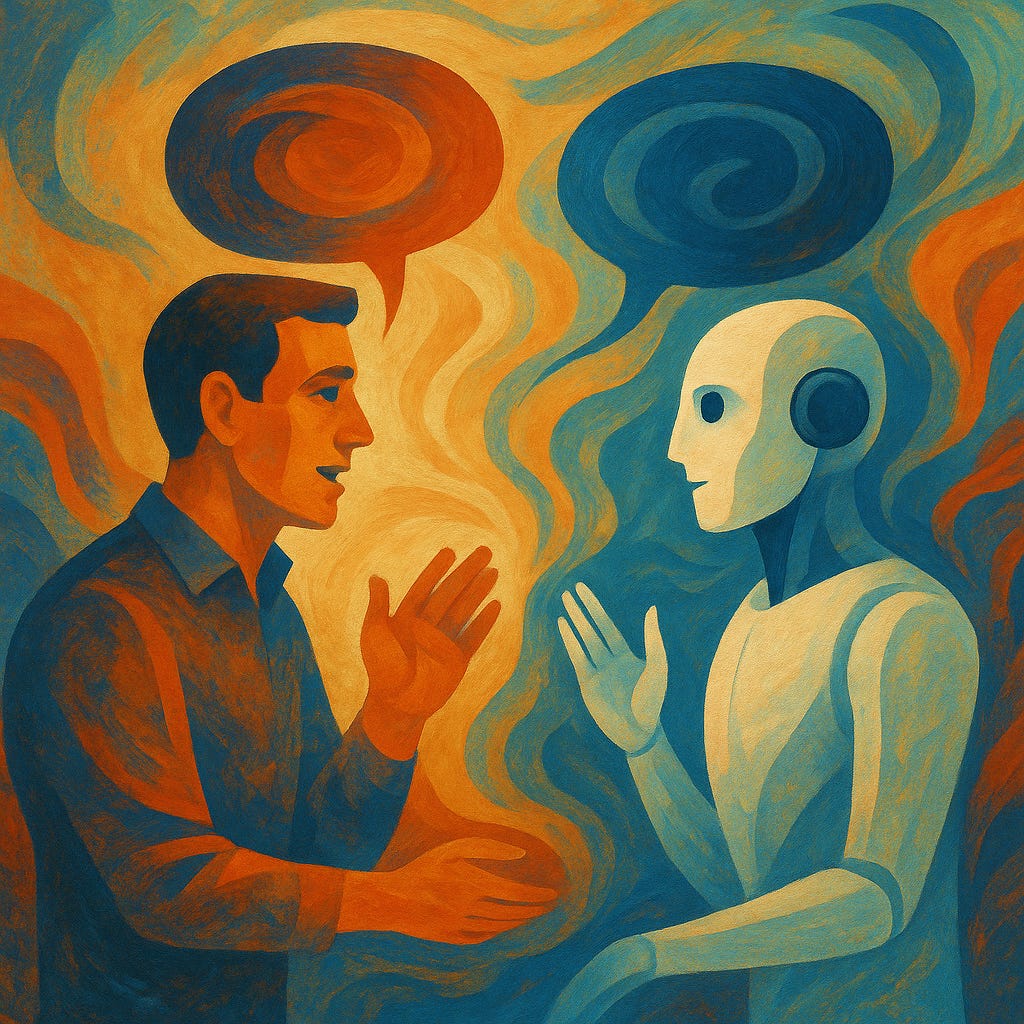
But after weeks of sterile interactions and formulaic outputs, I tried something different. I talked to it like I was talking to a brilliant but literal-minded intern. Not a friend exactly, but a collaborator who needed context, patience, and—dare I say it—fun.
"Listen," I typed one evening, exhausted from another day of terrible outputs, "I'm trying to create a workshop on AI adoption for healthcare leaders. They're smart but skeptical, overwhelmed but eager. I need something that acknowledges their expertise while gently expanding their perspective. Can you help me think through this?"
The response was different. Thoughtful. Nuanced. It asked clarifying questions: What specific concerns do these leaders have? What's their current tech literacy? What outcomes matter most to them?
For the first time, we were having a conversation, not a transaction.
Fifty Cuts Deep, Two Cuts Wiser
That first breakthrough wasn't the end of the overwhelm—it was the beginning of a different relationship with it. Fifty papercuts in, I'd successfully avoided two. Not the 949 I'd fantasized about, but two real, measurable improvements in how I navigated this new world.
More importantly, I'd learned something crucial: the goal isn't to avoid all cuts. It's to learn which ones teach you something and which ones just hurt.
Research from Microsoft’s 2025 Work Trend Index shows that 46% of employees view AI as a “thought partner”—engaging in collaborative, conversational exchanges to enhance creativity and decision-making—while 52% still treat it as a command-based tool. The report suggests that employees who adopt a thought-partner mindset and build related skills will see greater gains, as this approach enables more effective iteration, delegation, and output refinement in AI-augmented workflows (Microsoft, 2025).
This aligns with what Ethan Mollick calls the "Cyborg Model" in his work on AI collaboration—where the highest value comes not from delegation but from genuine human-machine synthesis (Mollick, 2025).
Note: As of this writing, multiple companies are instituting mandates around AI adoption, with growing emphasis on hard technical skills over traditional soft skills. More on this in a future article.
The Rhythm of Resilience
A few months into this journey, I developed what I call my "Overwhelm Protocol":
1. Morning Triage (10 minutes)
Scan the latest developments but don't deep dive. Mark what's truly urgent versus what's just loud.
2. One Deep Dive Daily (30 minutes)
Pick one concept, tool, or technique. Go deep enough to explain it to a ten-year-old.
3. Collaboration Hour (30 - 90 minutes)
Work with AI on a real project. Not reading about it, not planning for it—actually building something.
4. Reflection Checkpoint (15 minutes)
What worked? What didn't? What surprised me? Written by hand, because some things still need the friction of pen on paper.
This isn't about optimization—it's about sustainability. As I explored in "Out of Time," the challenge isn't keeping up with AI's pace but finding our own human rhythm within the acceleration.
From Overwhelm to Overflow
The overwhelm hasn't disappeared. Every morning still brings innovations that make yesterday's expertise feel ancient. But something has shifted in how I hold it.
I think of how I’ve handled overwhelm in the past. Tools everywhere, projects in various stages of completion, new techniques to master with every job. I never tried to know everything. Instead, I developed what I called "learning days"—the ability to figure out what was needed on a weekly cadence, required and not optional. Now that has shifted, every day is a learning day.
That's what we're all developing now: learning minds for an era where knowledge has a shorter half-life than milk.
The psychologist Robert Kegan writes about "self-authoring mind"—the capacity to step back from the overwhelm and write our own story within it (Kegan, 1994). That's the real skill we're building: not immunity to change but authorship within it.
Your Turn at the Threshold
So here's my question for you, standing at your own threshold of overwhelm:
What would change if you stopped trying to avoid all 1,000 papercuts and started choosing which 50 would teach you the most?
The overwhelm is real. The pace is unsustainable. The old maps are burning.
But you have something AI still doesn't: the ability to find meaning in the mess, to create narrative from noise, to transform overwhelm into overflow—not of information, but of possibility.
Start where you are. Use what you have. Do what you can. And when the overwhelm threatens to drown you, remember: you're not falling behind. You're learning to swim in new waters.
The first cut is the deepest. The rest are just teachers in disguise.
Two years ago, I thought overwhelm was the enemy. Now I know it's the price of admission to the most interesting moment in human history. We're not just learning new tools—we're evolving new ways of being human.
The papercuts? They're not wounds. They're the thousand small transformations that add up to who we're becoming.
Each one marks a moment where we chose growth over comfort, curiosity over certainty. And in a world of infinite information, the scarcest resource isn't knowledge—it's the wisdom to know which lessons are worth collecting.
So here we are, fifty cuts wiser, dancing with chaos like it's an old friend. Because maybe that's what it's becoming.
Welcome to the overwhelm. Welcome to the transformation.
What's your overwhelm story? Share your own strategies for dancing with chaos in the comments below. Sometimes the best antidote to isolation is discovering we're all gloriously, messily human together.
References
Kegan, R. (1994). In over our heads: The mental demands of modern life. Harvard University Press.
Microsoft. (2025). Work Trend Index Annual Report: AI at work is here. Now comes the hard part. https://www.microsoft.com/en-us/worklab/work-trend-index/ai-at-work-2025
Mollick, E. (2025). Co-Intelligence: Living and working with AI. Penguin Random House.
Further Reading
"Out of Time" - On finding human rhythm in AI acceleration
"The First & Last Principle" - Manufacturing agency in an age of AI
"Tuning Forks in a Tornado" - Why team alignment matters more than timeline management
“The Rhythm Engine” - Acting and being human in the age of AI
Love this "The truth I had to accept: I was approaching AI like it was another tool to master, another certification to collect. But AI isn't a hammer—it's more like a dance partner. And I'd been stepping on its toes while insisting it was out of rhythm."
What a great read, MJ! Thank you for this.