

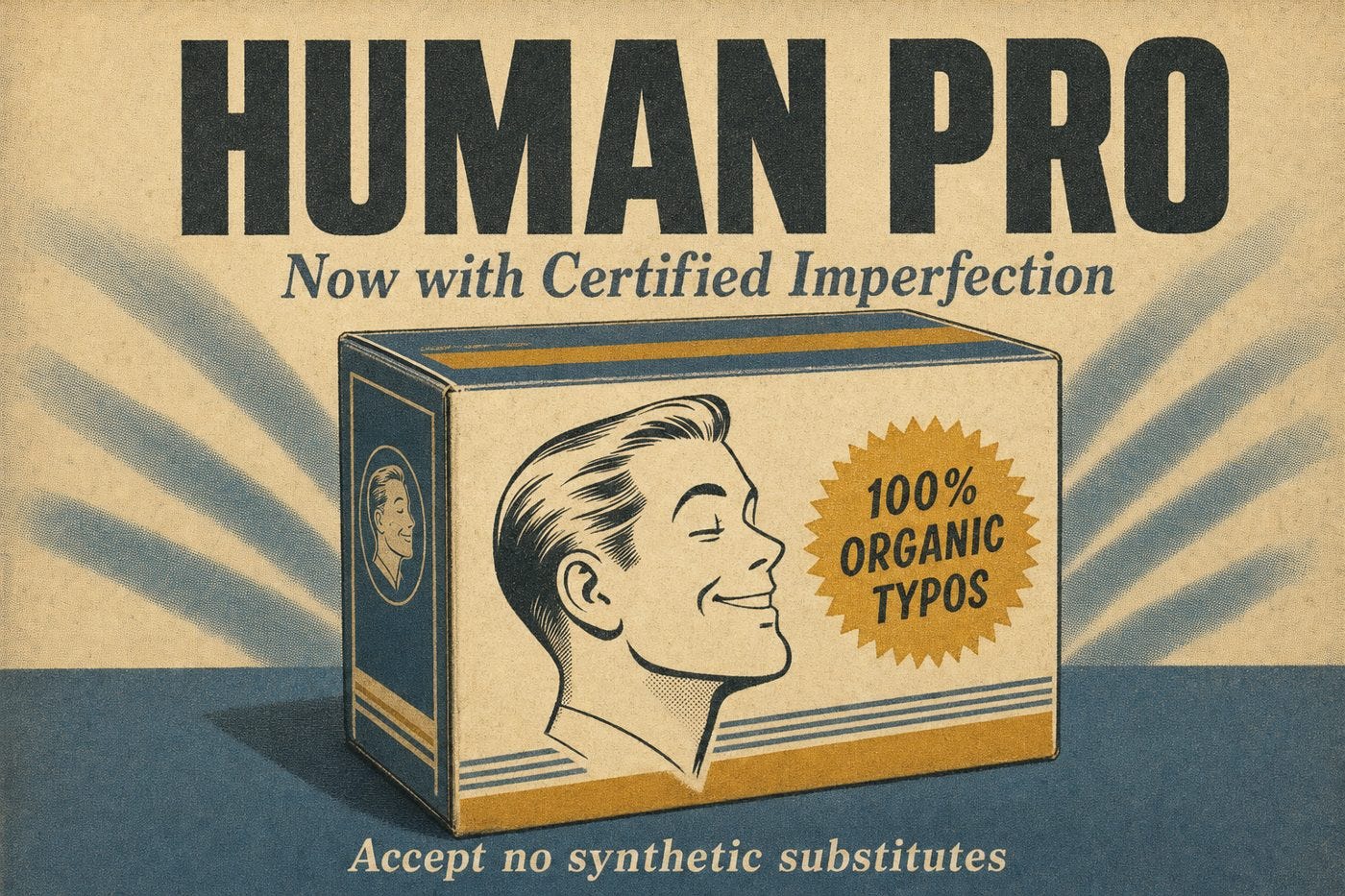
FOR IMMEDIATE RELEASE
Introducing Human Pro, the first fully authentic human experience
After roughly 300,000 years in development,1 Human Pro is ready for market. Every unit ships with Certified Imperfection: hand-placed typos, organic hesitation, and opinions that change after lunch. Human Pro occasionally forgets your birthday. It contradicts itself in meetings. Its poems don’t always make sense.
In independent testing, Human Pro was mistaken for a machine more often than the machines were. Early adopters say it “feels less human than the competition.” Engineering is aware of the issue.
Human Pro. Accept no synthetic substitutes. Results may not be detectable.
The product is made up. The research that inspired it isn’t.
I was going to write a sober essay on the nature of human authenticity. I got two paragraphs in and realized satire would get us there faster, and with fewer footnotes about Heidegger.2 (This essay has plenty of footnotes anyway. Just not about him.) When the situation is this absurd, a straight face starts to feel like part of the problem.
We already failed the test
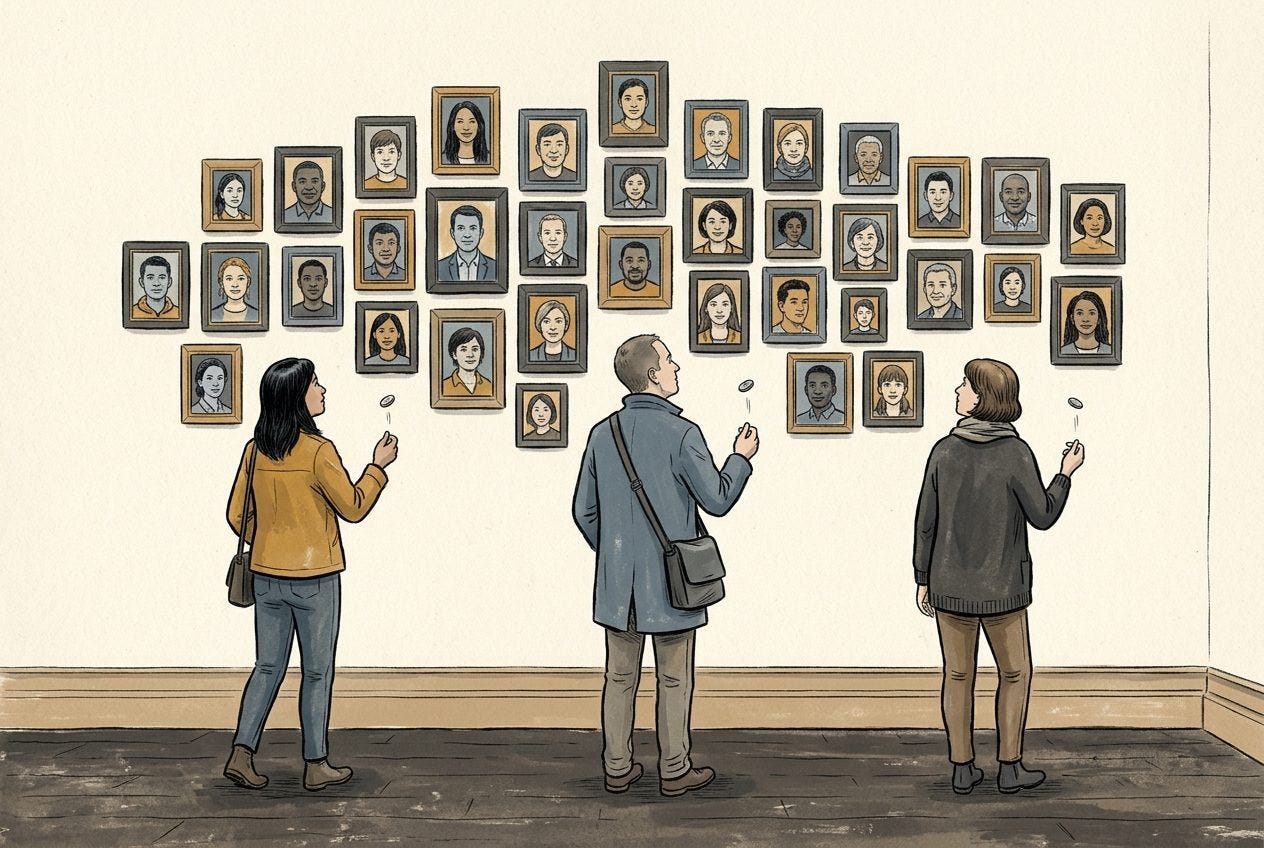
In a 2025 test by the biometrics company iProov, 2,000 people in the US and UK looked at a mix of real images and videos and deepfakes.3 Only one in a thousand got every single item right. Confidence stayed high anyway.4 A perfect score was rare. Self-assurance wasn’t. Humanity’s perfect-score rate is a rounding error with excellent self-esteem.
Faces went first. In 2022, Sophie Nightingale and Hany Farid found people in their experiments couldn’t reliably tell AI faces from real ones, and rated the fake faces about 7.7% more trustworthy.5 A year later, a team led by Elizabeth Miller found that AI-generated white faces were judged human more often than actual human faces, and the people worst at spotting fakes were the most sure of themselves.6 Blade Runner’s fictional Tyrell Corporation had a motto: “More human than human.”7 It turned out to be a product spec.
Then poetry. Brian Porter and Edouard Machery asked 1,634 non-expert readers to sort poems by Shakespeare, Dickinson, Whitman, Plath, and others from ChatGPT imitations. They scored 46.6%, a hair worse than a coin flip, and judged the AI poems human more often than the real ones. In a separate experiment, readers rated the AI poems more highly but downgraded any poem labeled AI, whoever wrote it. They were also more likely to say the human poems didn’t make sense.8 So we say we love human work. We just can’t pick it out.
Voices followed. A 2025 study found selected voice clones sounded about as real as the people they were cloned from.9 Video is fraying too. A September 2026 preprint showed viewers five-second silent clips of people speaking. They caught roughly half the synthetic clips, while correctly recognizing 76% of the real ones.10
Across these studies, looking or listening closely was often a poor guide to how something was made. The one job we assumed was ours forever, recognizing each other, now needs backup.
Slop, deep-fakes, and deep-slop
Merriam-Webster picked “slop” as its 2025 word of the year and defined it as low-quality digital content, usually produced in quantity by AI.11 The announcement had a smirk to it. Amid all the talk of superintelligence,12 the dictionary’s examples were talking cats, fake-looking news, and books nobody asked for. We complained about it constantly, and we watched it anyway.
Two separate problems got blended together. Deceptive deepfakes confuse who was there or what happened. Slop fills the page without doing the work. Deep-slop is my name for their overlap: polished, convincing output that nobody will answer for.
It has a corporate cousin. Researchers at BetterUp and Stanford’s Social Media Lab coined “workslop” for AI output that looks finished but doesn’t move the work forward. In their September 2025 survey of US desk workers, 40% said they’d received some in the past month. Recipients reported spending an average of nearly two hours dealing with an instance, and 42% said they trusted the sender less.13 The machine writes it in eight seconds, your colleague spends two hours decoding it, and then they trust you less. Efficiency!
Somewhere along the way the word escaped the dictionary and got a job. I now hear professionals call things “slop” in meetings, and depending on who’s talking, it means at least three different things.
slop (n.), as used in a meeting
1. Your work is irritatingly bad. “Did you read this before you sent it? It’s slop.”
2. Your work is irritatingly good, and I need a reason to dismiss it. “Sure, it’s polished. It’s also slop.”
3. I don’t like that you can now do what I do. “Anyone can make that. It’s slop.”
The author’s own definitions, gathered in meetings and hallways. Merriam-Webster bears no responsibility.14
Only the first meaning says anything about the work. The other two say something about the person talking. Once “slop” becomes the all-purpose dismissal, it lets us skip the harder questions: is this thing good, and does my own craft still hold up next to it?
The culture is sending mixed signals too. This month China released what was billed as its first fully AI-generated feature film, Sanxingdui: Future Past. Its producer put the budget at about $1.5 million, and Fortune reported about $180,000 in ticket sales through its first weekend.15 One film can’t tell you why audiences stayed home. Still, we’ll snack on slop for hours on our phones and hesitate to give it a ticket and a feature film’s worth of attention.
The authenticity industrial complex
Faced with the fact that we can’t tell, we did what we always do: we built a product.
World, the project Sam Altman co-founded, uses a silver orb to scan your iris and issue a “proof of personhood” credential designed to show you’re a unique human. In April it announced partners including verified-human badges on Tinder, ticket reservations for verified humans, and deepfake protection on Zoom.16 So the fix for machines pretending to be people is a machine looking into your eye to confirm you’re a person.
Meanwhile, the rest of us are quietly humanizing our own output. I’ve watched people sprinkle typos into AI drafts so they read as hand-made. The em dash got so tangled up with suspicion of AI that writers started publicly worrying about using it.17 I’ll confess: I’ve banned em dashes from my own writing. A fear of being mistaken for a machine edited my punctuation, and I let it.
I also helped write the manual. My essay The Beautiful Flaw has a whole section called “Manufacturing Imperfection.” I meant making room for real human mistakes, not faking them. Out of context, it reads like the product roadmap for Human Pro.
So what’s real?
Satire only works if it lands on something true, so I’ll drop the act for a minute.
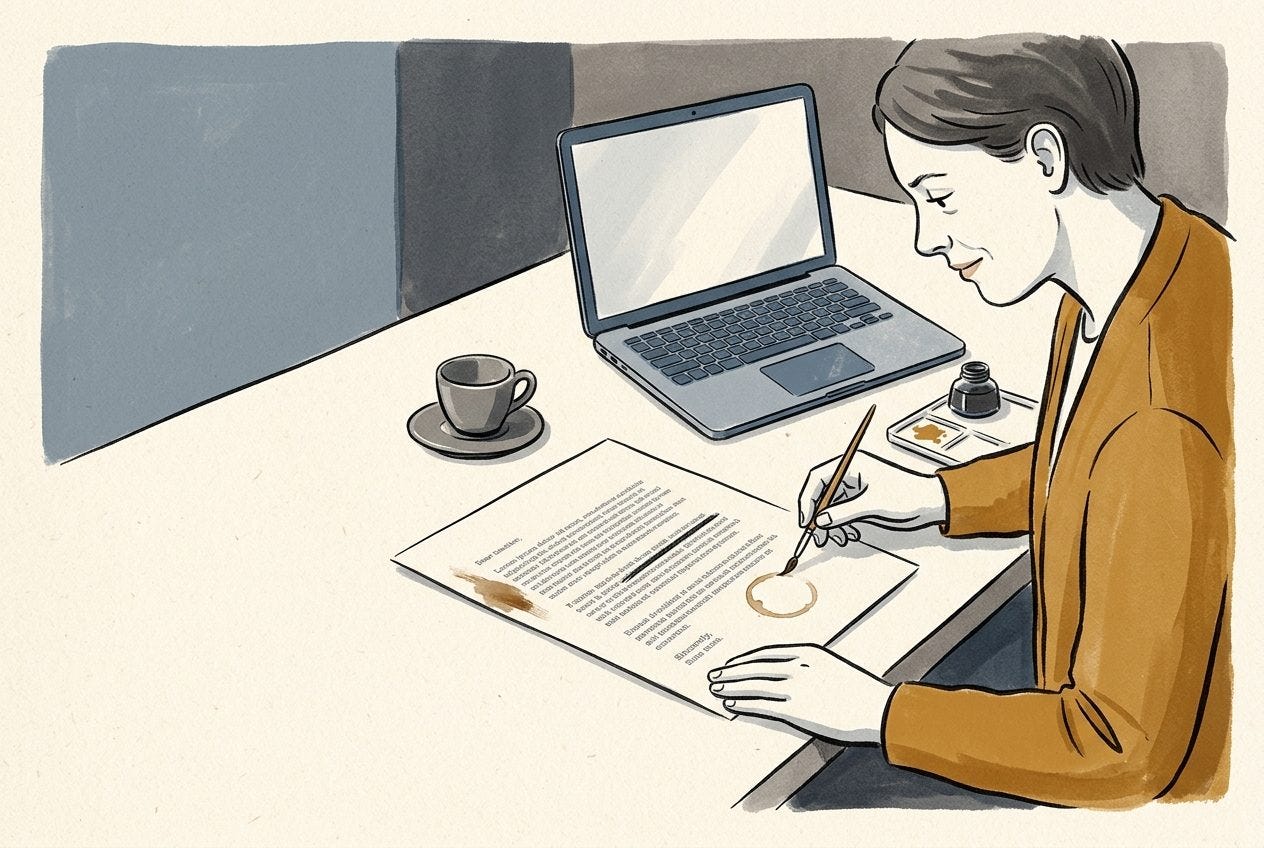
The joke underneath all of this is that we keep looking for authenticity in the artifact: the face, the voice, the poem, the email. Artifacts are now nearly free to make. My team keeps stumbling over a working hypothesis: as convincing artifacts get cheaper to produce, reliable judgment and accountability become more valuable.18
What’s still hard is a person who stands behind the thing. Someone you can call, question, and hold to it, who’ll still be around tomorrow. Back when I was poking at our habit of treating machines like people, I landed on a line I still believe: the presence of a personality doesn’t, by itself, equal the presence of a person. Deep-slop is all personality and no one willing to answer for it.
So for deciding what to trust, human-looking pixels aren’t enough. I want accountability, and accountability takes time to show. Real things have a history: drafts, mistakes, a track record, people who know you and can vouch. With AI agents, the first questions are always who the agent acts for and who answers when it’s wrong. That’s the core of The Mandate, and content works much the same way. “Does this look real?” increasingly fails us. “Who signs for this?” gives us a question we can investigate. A signature doesn’t make something true or good. It does give you someone to question, and someone on the hook to fix it.
The poetry study points somewhere useful too. The researchers suggest some readers preferred the AI poems because they were easier to understand. That doesn’t make difficulty proof of humanity. It does remind me that work can be worth the effort it asks of us. The easy thing and the meaningful thing part ways more often than we admit, which was the whole point of Relief Is Not Joy. Slop is very, very easy.
Fight the slop
This part is aimed at me as much as anyone.
Slop isn’t the enemy. Humans stopping their creative process might be.
Most crafts start in slop. First drafts, rough sketches, demo tapes, the code you’d never show anyone. Taste runs ahead of skill for years, and the only way across that gap is making a lot of bad work and fighting it into better work. The fight is where the craft gets built.
So if we don’t practice and wrestle with the slop, how are we going to make anything that isn’t slop? Sneering at it doesn’t build that muscle. Neither does shipping it unread. The muscle grows when you take the machine’s first answer, figure out exactly why it’s wrong, and rebuild it into something you’d sign. Back in February I put it as the doing was the knowing. Skip the doing and you never find out what you know.
There’s a tempting shortcut: wait until the tools are reliable, then start. I understand the instinct. I sat on this essay for half a year. But waiting has a price, what economists call opportunity cost.19 By the time a capability is dependable enough to trust without effort, the people who wrestled with it early have built the judgment to use it well, and the window when practice was cheap has closed. Wait, and you meet the same slop later, with less time to learn from it and less room for error.
The real risk is that we stop starting. Hand the blank page to the machine every time, approve whatever comes back, and you slowly lose what I’ve called the habit of beginning. Do that long enough and the creative process doesn’t get faster. It quietly stops.
Seen that way, slop is a first draft that nobody stayed around to fix. Deep-slop is what you get when nobody stays at all.
Raising them, teaching them, leading them
This is where it stops being funny, because we’re responsible for people who’ll grow up never having known a world where seeing was believing.
With kids, the instinct is to teach them to spot fakes. Spotting alone can’t carry the lesson. They also need to learn how to check a source and whom to call.
In 2023, a grandmother got a call from her teenage grandson. He used the pet name only her grandchildren use. He was scared. He’d been in a car accident, his nose was broken, a woman was in the hospital, and he’d been arrested. A lawyer named David needed bond money to get him out, and could she please not tell his parents. She told him he’d be okay, then said she was getting a pen and calling his parents. The line went dead. Her grandson was sitting in class the whole time, with no idea any of it had happened.20
Nothing about the voice gave it away. What saved her was a reflex: she reached for the family before the wallet. Almost the same script, broken nose and all, nearly worked on a Philadelphia attorney, who later told a Senate committee about it.21 The FTC’s advice is the move she made: don’t trust the voice, hang up, and call back on a number you know. Some families add a code word.22
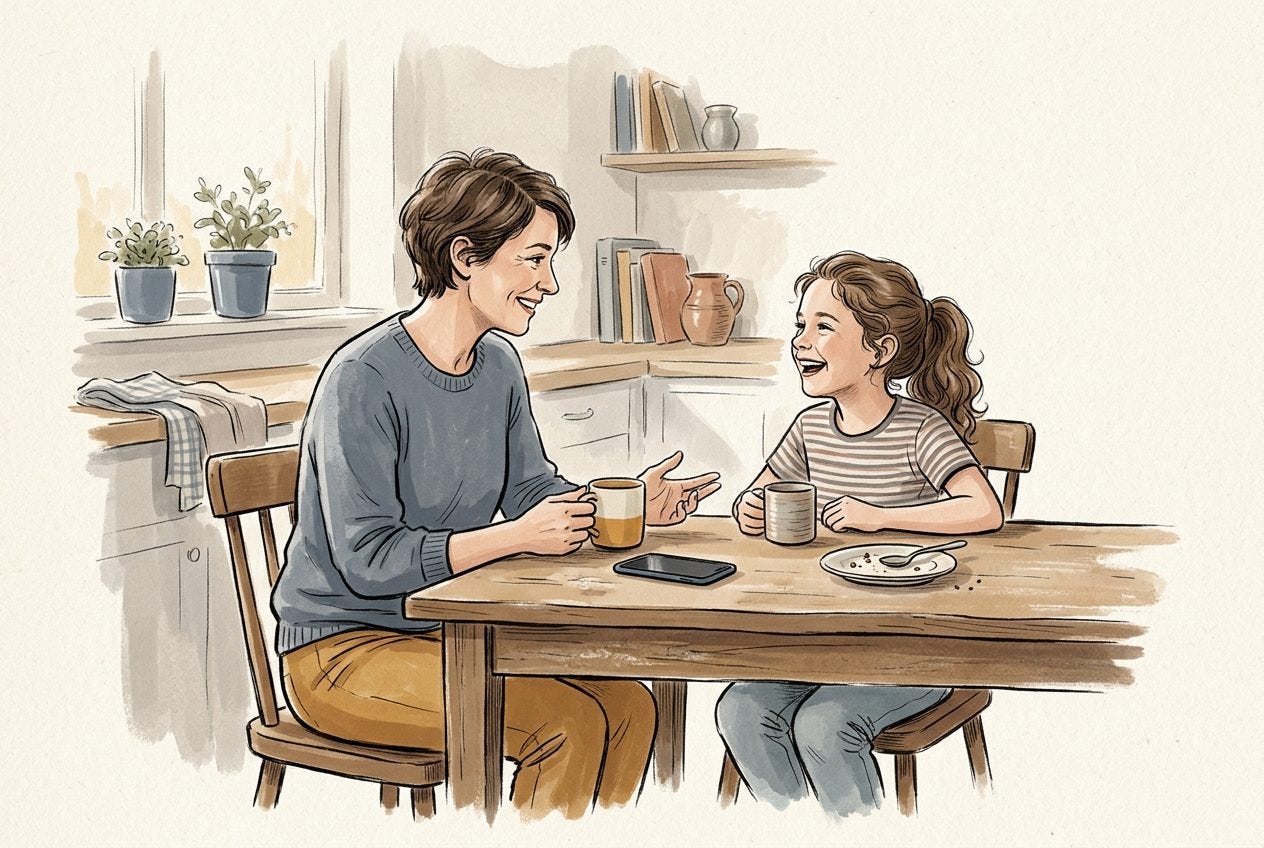
My stated job as a parent, and the reason I wrote A Giving Mind, is to give my daughter a mind that can still tell. I’d sharpen that now. I want her to tell where her own thinking ends and the machine’s begins, and to know who she trusts and why. Trust comes from people over time, not from how real something looks. And the kitchen table matters more than ever, because nothing there is synthetic.
With students, when schools grade only a finished artifact produced outside the classroom, they risk grading a machine’s work without seeing what the student understands. (The long version of that argument is in my last piece, Can Our Institutions Survive the AI Era?) Assessment should also include what’s expensive to fake: work done in the room, drafts with a visible history, a student explaining their reasoning out loud and handling the follow-up question. Teach provenance23 the way we used to teach citation. Where did this come from, who stands behind it, and what would they lose if it were wrong?
With staff, the temptation runs the other way. A manager suspects a report came straight out of a chatbot and reaches for an AI detector to settle it. Don’t treat its verdict as proof. OpenAI withdrew one of its own detectors in 2023 after it flagged only 26% of AI-written text and falsely flagged 9% of human text on its test set.24 Don’t ban the tools either. Make one rule: your name on it means you vouch for it. You read it, you’d defend it, and you’ll fix it if it’s wrong. Vouching for the work gives someone a duty to fix it. Picture the document with five reviewers and zero authors. Deep-slop at work is zero authors with excellent formatting.
FOR IMMEDIATE RELEASE
Human Pro voluntarily recalled
After extensive customer feedback, Human Pro has been withdrawn from the market. The authentic human experience can’t be shipped in a box. Customers report that it only works over time, when it says what it thinks, owns what it says, and shows up again the next day.
The original model remains in service. It’s slower and harder to read, and it argues with you. Most customers already own one.
No refunds. Some assembly required.
I’ll keep the original. It’s the only one I can vouch for.
Part of an ongoing exploration of human agency in the age of intelligent systems.
From my earlier essays
Linked in the text above, in the order they appear.
The Beautiful Flaw (July 2025): on designing organizations that make room for human variability.
Anthropomorphize Like a Champ (August 2025): on why machines now appear human by design.
The Mandate (July 2026): on granting AI agents bounded, revocable authority with a named person behind it.
Relief Is Not Joy (December 2025): on the difference between removing discomfort and creating meaning.
The Doing Was the Knowing (February 2026): on how expertise forms through doing the work.
Think Twice Before Clicking (April 2026): on approvals that feel like decisions and the judgment we lose when we stop framing problems ourselves.
A Giving Mind (April 2026): on releasing The Giving Mind, a children’s book about where human thinking ends and machine help begins.
Can Our Institutions Survive the AI Era? (October 2026), with its research companion The Constraint Acceleration Paradox, Explained.
Roughly the age of our species. The oldest known Homo sapiens fossils, from Jebel Irhoud in Morocco, date to about 300,000 years ago, though emergence was gradual, not a birthday. Hublin et al., Nature, 2017. PubMed.
Martin Heidegger (1889 to 1976), the German philosopher whose Being and Time (1927) shaped much of modern thinking about authenticity. His word for it, Eigentlichkeit, means roughly owning your own existence instead of drifting along with what “they” do. He is also a controversial figure, having joined the Nazi Party in 1933. You can see why satire felt like the lighter lift. Stanford Encyclopedia of Philosophy.
Deepfake: synthetic or manipulated media, usually video, images, or audio, made with AI. Used deceptively, it misrepresents who someone is or what happened. NSA and partner agencies.
iProov, deepfake detection quiz of 2,000 UK and US consumers, February 2025. The 0.1% figure is the share who classified every item correctly, not accuracy on individual items. A company study, not peer reviewed. iProov release.
Sophie Nightingale and Hany Farid, “AI-synthesized faces are indistinguishable from real faces and more trustworthy,” PNAS 119(8), 2022. Untrained participants scored 48.2%; a group given training reached 59%. Paper.
Elizabeth Miller et al., “AI Hyperrealism: Why AI Faces Are Perceived as More Real Than Human Ones,” Psychological Science, 2023. White AI faces were judged human 65.9% of the time, real white faces 51.1%. The effect held only for white faces; the authors suggest the AI was trained mostly on white faces. Paper.
Blade Runner (1982), directed by Ridley Scott. The Tyrell Corporation manufactures “replicants,” synthetic humans built to be indistinguishable from people.
Brian Porter and Edouard Machery, “AI-generated poetry is indistinguishable from human-written poetry and is rated more favorably,” Scientific Reports 14, 2024. Accuracy was 46.6%, slightly below chance. The detection and preference results come from separate experiments. PMC.
Nadine Lavan et al., Queen Mary University of London, PLOS One, 2025. Listeners rated selected ElevenLabs clones about as real as the human recordings they came from; generic synthetic voices rated less real. PLOS One.
Shykula et al., “DF26: We Cannot Tell Fake From Real Anymore,” arXiv:2609.07369, September 2026. A preprint, not yet peer reviewed. The paper reports 52.6% on synthetic clips in one table and counts implying 51.1% in a supplement, hence “roughly half.” arXiv.
Superintelligence: a hypothetical AI that outperforms the best humans at nearly every cognitive task. Some AI companies, such as Safe Superintelligence, name it as an explicit goal; nobody has demonstrated it. SSI.
BetterUp and the Stanford Social Media Lab, survey of US desk workers, September 2025. Figures are self-reported perceptions and time estimates. BetterUp.
These three senses are my own observation from working with teams, not a study. If you have a fourth, I want to hear it.
“China’s first AI-generated film to get a theatrical release flops at the box office,” Fortune, October 27, 2026. Box office through October 26, from the ticketing platform Maoyan; budget as reported by the producer. Despite the billing, the film involved substantial human labor. AFP.
Proof of personhood: a credential showing that an account belongs to one unique human rather than a bot. World is stewarded by the World Foundation, with Tools for Humanity as a principal developer. The integrations are company announcements, not proof of effectiveness. Regulators in Bavaria and Portugal have acted on privacy concerns about its iris scans. World announcement · Bavarian regulator · Portuguese regulator.
Brian Phillips on the em dash as a supposed AI tell, The Ringer, August 20, 2025. He documents the controversy and finds no hard evidence that chatbots use the mark more than people do.
A working hypothesis my colleagues and I are testing, not an established economic law. Cheapness alone doesn’t destroy value; the bet is that reliable judgment becomes the scarce complement.
Opportunity cost: the value of the best alternative you give up when you make a choice. Choosing to wait counts as a choice.
A real incident from 2023, retold with names and identifying details removed.
Gary Schildhorn, testimony before the US Senate Special Committee on Aging, November 16, 2023. The caller claimed his son had broken his nose in a crash, injured a pregnant woman, and been jailed; Schildhorn discovered the scam before paying. Testimony.
Federal Trade Commission, “Scammers use AI to enhance their family emergency schemes,” consumer alert, March 20, 2023. FTC. The code word is common advice from security experts; the FTC’s own guidance is not to trust the voice and to call back on a known number.
Provenance: the documented history of where something came from and how it changed. The C2PA standard attaches cryptographically signed “Content Credentials” to media, recording its origin, edits, and declared AI use. The history can be incomplete, and a valid signature doesn’t prove the content is true. C2PA explainer.
Wow! Excellent food for (authentic!) thought. I will go back and read your previous essays as a result.