

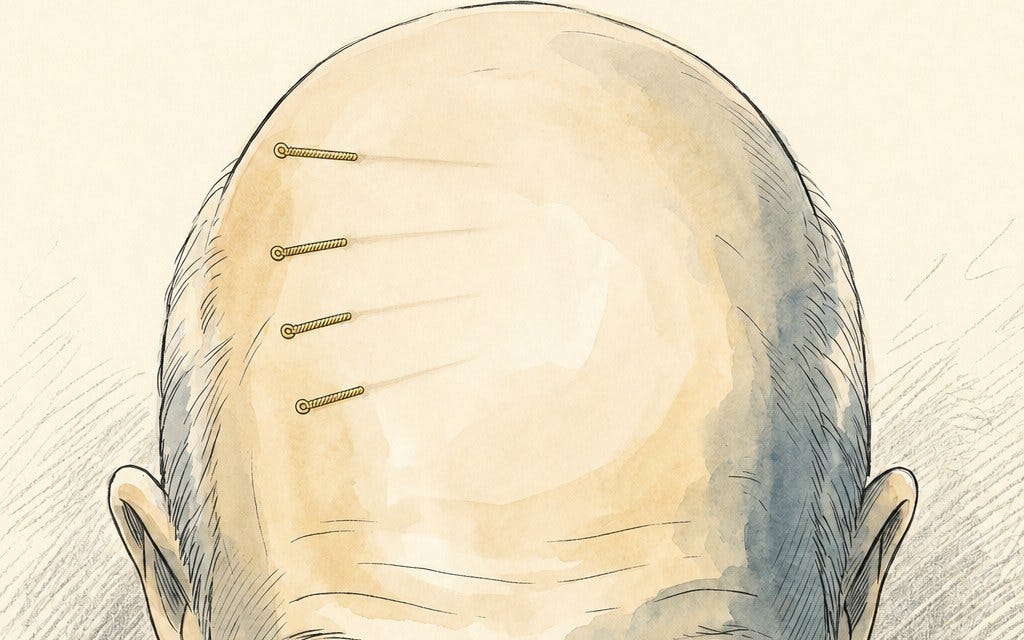
Years ago, in a hospital, I was asked to treat a man after a stroke. One side of his face drooped and his speech slurred. The treatment he needed was scalp acupuncture.1 It was minimally invasive, it was indicated, and almost nobody in the room had seen it done.
He was anxious about needles, like many people. So was his family, and so was the hospital staff. Unfamiliar treatments can make everyone nervous, especially when the stakes are high.2 A tense room gives the person holding the needle one more thing to manage.
Like anyone who puts a sharp object into another person’s body, I’ve learned to quiet the noise around a procedure by shrinking the task to three questions after the diagnosis: where, how deep, and how much.
Where comes from the diagnosis and map. The scalp lines are treatment conventions within Chinese medicine that also draw on descriptions of motor and sensory brain regions, rather than precise, validated maps of an individual brain. In this map, the lower part of the motor line on the side opposite the droop is used for the face and speech.
How deep comes from anatomy. The needle enters at a shallow angle, somewhere between 15 and 30 degrees, passes through the skin, and glides about three centimeters along the loose layer between the scalp and the skull, where it stays for the whole treatment. Too steep and you meet bone. Too shallow and it drags in the skin. Placed well, the patient barely feels it travel.
How much is the dose. You twirl the needle fast for a few minutes at a time, then let it rest and do it again, watching for the sign that the stimulation has landed: warmth or tingling spreading on the affected side.3
The room stayed loud. The problem in front of me got small and exact, which is where I like it. The stimulation was uncomfortable for him and for everyone watching, and it was necessary, with a real chance to relieve years of pain and frustration. I focused, and he focused with me. We treated him several times, and his symptoms eased and then faded nearly completely.
That story repeats across clinical life. It isn’t quite lying on a bed of nails, though it can feel that way for everyone in the room.
Whenever someone tells me great work requires stress, I think of that room.
Most of us picked up the idea early. Tight deadline, tight shoulders, and the knot in your chest the night before a launch. We wear the strain like a badge. If it hurts, it must matter.
Most of that strain is waste. It’s effort that never reaches the work.
For most of us, the workday is a stream of small alarms: the inbox, the ping, and the calendar booked back to back. After enough years, the alarm starts to feel like drive. Now AI can carry much of what made work heavy. It can also make our days faster and louder than they’ve ever been. We get to pick which.
That leaves two questions. Can these tools help us do better work while carrying less tension? And what do we have to protect to get there?
Tension and friction aren’t the same thing
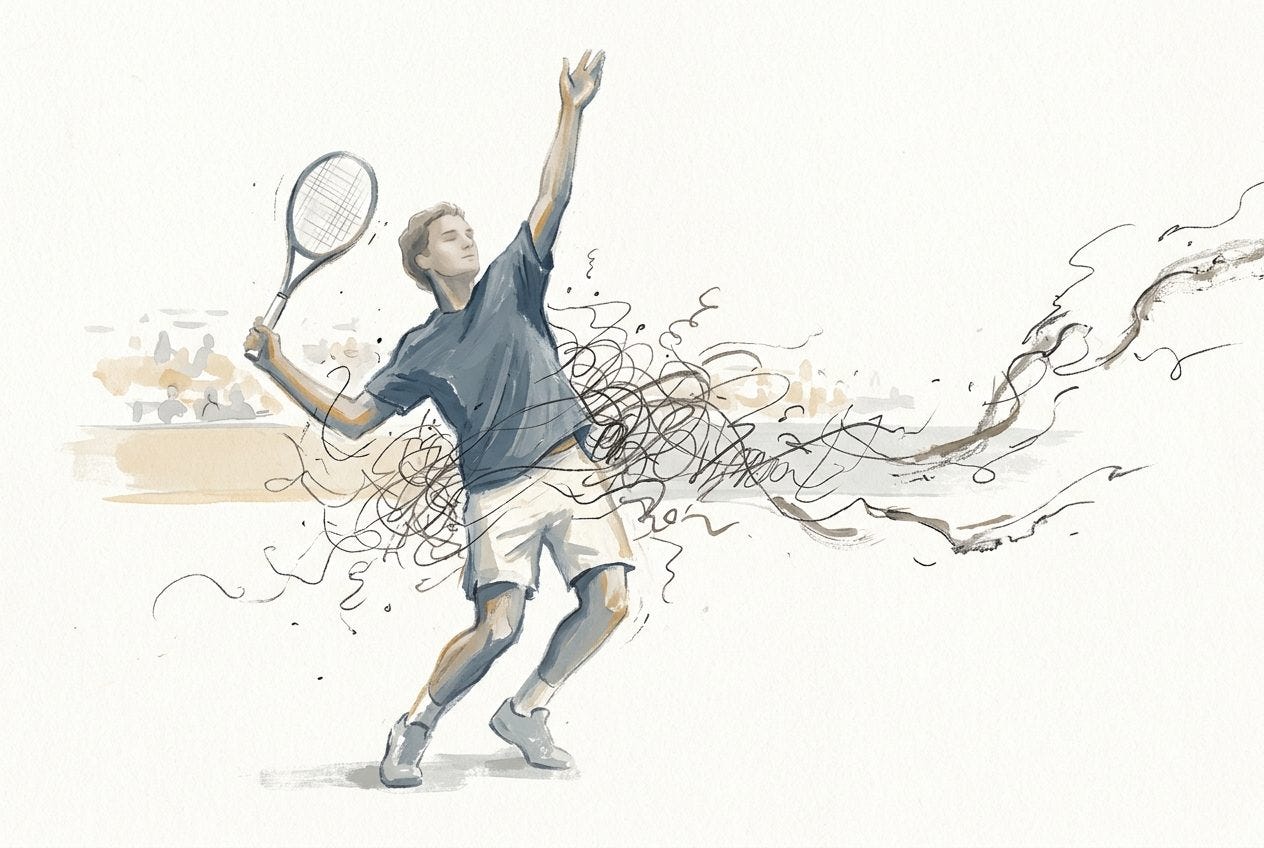
Tim Gallwey, a tennis coach, reduced it to one line: performance equals potential minus interference.4 His players weren’t short on skill. They had a voice in their heads, narrating and judging every shot, and it kept getting in the way of a body that already knew what to do.
By tension, I mean the needless bracing around the work, not every sign that the work matters. Tension lives on the interference side of that equation. You spend your energy bracing, worrying, switching tasks, and starting over, and the work gets none of it.
Friction is the problem pushing back: the proof that won’t close, the symptom that doesn’t fit, the design that keeps breaking. When friction goes, growth goes with it. I’ve been making that case since The Last Skill? My patient’s treatment had plenty of friction. The anxiety in the room was pure interference.
Researchers have drawn a similar line. Back in 2000, Marcie Cavanaugh and colleagues split workplace stress into two kinds.5 Challenge stressors are things like responsibility and hard problems. Hindrance stressors are red tape, fuzzy roles, and politics. The first kind can motivate; the second tends to obstruct. Either can wear people down. Researchers still argue about how cleanly the data split, but I’ve yet to meet a manager who doesn’t recognize it.
How we read stress matters too. Alia Crum, Peter Salovey, and Shawn Achor worked with employees at a financial firm in the middle of layoffs. Employees who watched short videos framing stress as something that can sharpen you reported fewer psychological symptoms and better work performance, both self-reported, than the comparison groups.6 Same pressure, different story about it.
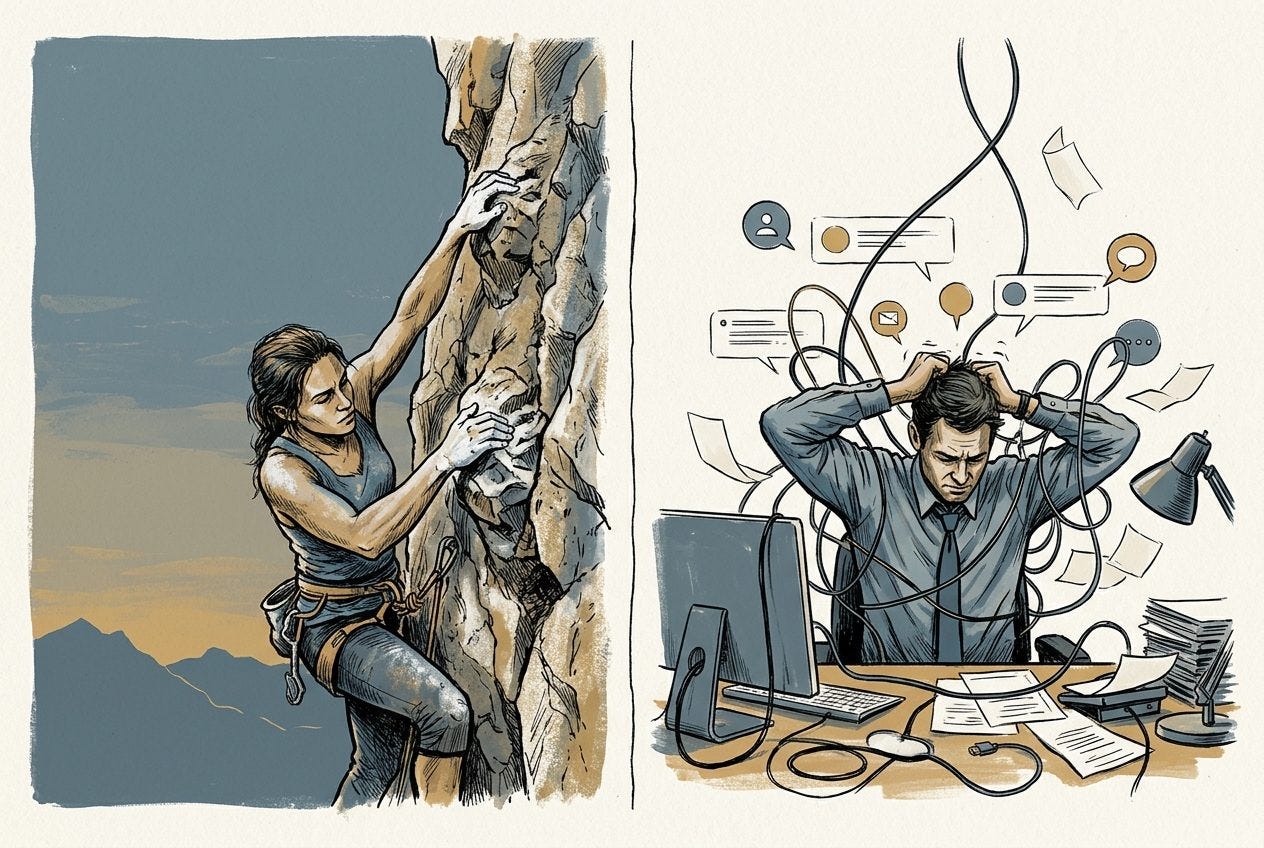
I call the place where this works the growth zone, the band between too easy and too hard. Good work lives there. It asks for everything you’ve got on the problem and as little bracing as you can manage on everything else. You still want hard things. You want the right ones, without the clench.
Where the tension comes from
I went back through two years of these essays looking for what makes work tense. Four things keep showing up, and hard work isn’t one of them.
Activation energy
How it feels: The task you keep not starting, and the guilt that grows around it
What’s happening: The work is awkward more than hard; starting costs more than doing
Essay: The Forgotten Task
Overwhelm
How it feels: A week that holds a year of change; a few hours off that feel like falling behind
What’s happening: Change outruns our ability to absorb it, and the work now runs in parallel
Essay: Welcome to the Overwhelm, Out of Time
Speed without sync
How it feels: Everyone moving fast, nobody moving together
What’s happening: Each role keeps its own tempo, with no shared rhythm pulling them into time
Essay: Tuning Forks in a Tornado
Threat
How it feels: A low hum of worry about what the tools mean for your job and identity
What’s happening: Nobody has named what is ending; the depth of a transformation sets the depth of the pain
Essay: Hair and Nails, Total Transformation
These four patterns are my synthesis of earlier essays, not a research taxonomy.7
In my experience, the hard problem is often only part of what wears people down. They burn out on the startup cost, the noise, the missing rhythm, and the fear sitting under all of it. Somebody arranged the work that way, which means somebody can arrange it differently.
What AI can take off the table
This is where AI earns its keep, as long as we point it at the interference first.
Start with the awkward stuff: the blank page, the first step, and the form nobody wants to open. Agents are good at exactly that. My name for the fix is activation-energy surgery. Break the task down, get it out of your head, and make it repeatable. Lower the cost of starting and the finish tends to follow.
Then there’s context. Much of overwhelm is holding too many threads at once. A system that keeps track of what changed, who decided what, and what’s next hands back the working memory you need for judgment. And as agents pick up more of the verbs,8 including the clerical work that only exists to move other work along, your role shifts toward the parts that need you: direction, judgment, and meaning.
The evidence is encouraging, especially for people new to a job. In a study of 5,172 customer-support agents at one company, an AI assistant raised issues resolved per hour by 15% on average and about 30% for less-experienced and lower-skilled agents. Customer sentiment improved, and agents were more likely to stay.9
That’s half the picture. The same tools can pile interference on. A line from an older essay still holds: AI might be tireless, but we’re not meant to be. When every task splits into a dozen agents running in parallel, the pace of the work drifts away from the pace of a person, and an afternoon off starts to feel like a week.
Point the tool at interference and you get room to breathe. Point it at volume and it’ll fill that room faster than you can think.
What AI shouldn’t take
There’s a trap here, and I’ve written about it before: relief isn’t joy.
Relief looks backward and asks what you can get out of. Joy looks forward and asks what you might become. AI is very good at relief. Hand it everything uncomfortable and you’ll feel lighter for a bit, then oddly empty, because some of that discomfort was carrying your growth.
One learning experiment makes the risk concrete. In a field experiment at a Turkish high school, students given unrestricted GPT-4 did 48% better on practice problems, then scored 17% worse on the closed-book exam than classmates who never had it. A tutor version with learning safeguards built in helped even more in practice and showed no statistically significant exam advantage over classmates who had never used it.10 Getting the answer isn’t the same as learning how to reach it.
Work isn’t so different. Expertise forms in the doing: the curating, the reasoning, and the acting. Back in February I put it as the doing was the knowing. Hand all of it off and you end up with a calm person in a cockpit they can no longer fly.
There’s a quieter version in how we approve things: the click that feels like a decision. The polished summary, the meeting in ten minutes, the yes. Low stress, sure. Nobody’s thinking anymore, either.
So I draw the line on purpose. AI gets the interference: the startup cost, the clerical layer, the context juggling, and the waiting. I keep the friction, which means framing the problem, owning the reasoning, and practicing the skills that keep my judgment sharp. It’s the bedside discipline again: decide where the effort goes, how deep, and how much. In that hospital room I kept the needles and set down the noise.
What I’m trying
None of this happens by accident. I’ve been testing a handful of habits, some for myself and some for the people I lead. They fit on one page, so I put them on one.
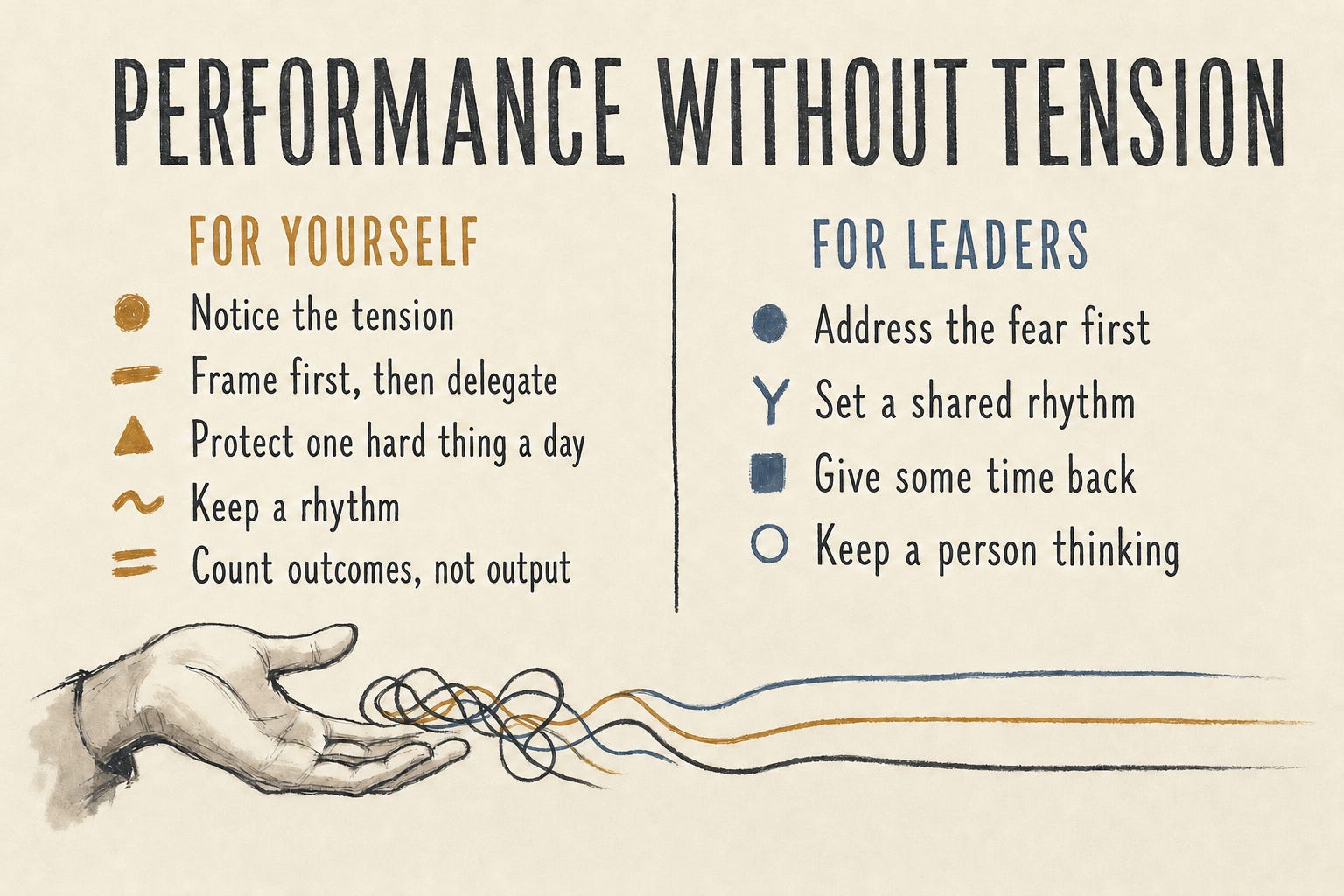
The left column is personal. Noticing the tension means noticing when your shoulders creep up and asking whether the problem is hard or the setup is. Framing first means deciding what the problem is and what good looks like before you hand anything to an agent. Protecting one hard thing a day keeps at least one piece of real thinking in your own hands. A rhythm, like a daily release or a weekly review, beats bursts of heroics. Counting outcomes means asking what changed, not how much got produced.
The right column is for leaders. Addressing the fear means saying plainly what you know about the tools and people’s jobs, what you don’t know, and when you’ll know more. Setting a shared rhythm comes from Tuning Forks in a Tornado: give the team one shared tempo to tune to, the way a struck fork gives an ensemble its pitch. Giving some time back means that when AI frees up hours, some of them go back to people as breathing room instead of more volume. Keeping a person thinking means every decision that matters has someone who reasons through it, not just someone who clicks yes.
If you only try one, notice the tension for a week. Most people I’ve asked find the setup pile is bigger than the hard-problem pile.
For leaders, start at the top of that column too. You can’t ask for relaxed, excellent work from people who are wondering whether their job survives the quarter. In that hospital, the family’s fear became part of the case. On a team, fear of being replaced does the same thing.
The loose grip
For most of working history, tension and performance came as a package. Somebody had to fight the forms, chase the context, and push through the awkward start, and that same somebody had to do the thinking.
AI lets us unbundle them. We can hand off much of the interference and keep the friction that makes us better. We make that choice every day, and leaders make it for everyone who works for them.
I still think about that patient. The treatment was hard and uncomfortable, and it needed doing. The fear around it was another thing to manage. Once he and I set the fear down, the work could land.
The best performers I’ve known were rarely the most tense. Their effort went where the work was. We finally have tools that can help more of us work that way, once we let go of the clench we learned to call commitment.
Part of an ongoing exploration of human agency in the age of intelligent systems.
Notes and sources
From my earlier essays
The essays linked above, with a brief guide to their themes.
The Last Skill? (April 2025): friction, embodiment, and why learning isn’t a file transfer.
I’m Cancelling the Apocalypse (August 2025): leading from the growth zone instead of doom or denial.
The Forgotten Task (September 2025): activation energy, and why tasks fail because they’re awkward.
Out of Time (April 2025): dimensional work and the pace of agents.
Relief Is Not Joy (December 2025): removing discomfort versus creating meaning.
The Doing Was the Knowing (February 2026): how expertise forms through doing the work.
Think Twice Before Clicking (April 2026): approvals that feel like decisions.
Also in “Where the tension comes from”: Welcome to the Overwhelm (June 2025), Tuning Forks in a Tornado (May 2025), Hair and Nails (March 2026), and Total Transformation (December 2025).
Scalp acupuncture: a Chinese medicine methodology in which fine needles are threaded at a shallow angle under the scalp along treatment lines. Different systems use different maps. Clinicians use it in neurological rehabilitation, including after stroke. Zhu’s Scalp Acupuncture is one example, not a label for all scalp acupuncture. See Wise and Lorenc (2023) and Wang et al. (2017). The latter is a trial protocol describing technique, not proof of efficacy.
Fear works on both sides of the needle. Needle fear is common, affecting roughly 20 to 30% of young adults and fewer people at older ages (McLenon and Rogers, Journal of Advanced Nursing, 2019, paper), and fear may contribute to fainting during acupuncture (Lee et al., Korean Journal of Acupuncture, 2023, paper). On the clinician’s side, a 2025 systematic review linked acute stress with worse technical performance, largely in simulated surgery; this does not establish that clinician stress causes worse patient outcomes (Tam et al., Surgical Endoscopy, review). A later observational study of 793 procedures found higher physiological stress early in surgery was associated with fewer major complications; it cannot establish causation.
Technique as commonly taught: filiform needles 2.5 to 3 cm long, inserted at 15 to 30 degrees and advanced into the subgaleal layer along a standard scalp line, then twirled for 2 to 3 minutes, repeated during a 15- to 30-minute retention. The lower two-fifths of the vertex-temporal anterior oblique line (the motor line) is indicated for central facial paralysis and motor aphasia. Training summary, using World Federation of Acupuncture-Moxibustion Societies line names. On evidence: a 2022 network meta-analysis of 29 Chinese trials of acupuncture-related treatments found scalp acupuncture plus speech therapy beat speech therapy alone for post-stroke aphasia, but the trials were small and often poorly blinded. Feng et al., Frontiers in Neurology.
W. Timothy Gallwey, “The Inner Game of Work: Building Capability in the Workplace”, The Systems Thinker (1997). Gallwey gives the formula as performance = potential − interference.
Challenge and hindrance stressors: Cavanaugh, Boswell, Roehling, and Boudreau, “An empirical examination of self-reported work stress among U.S. managers,” Journal of Applied Psychology 85(1), 2000. Later meta-analyses disagree about how cleanly the two kinds separate. Spector (2019) on the debate.
Crum, Salovey, and Achor, “Rethinking stress: The role of mindsets in determining the stress response,” Journal of Personality and Social Psychology 104(4), 2013. Outcomes were self-reported. Paper.
These four sources are my reading of my own essays, offered as a working frame rather than a measured finding.
The verbs: shorthand from my earlier writing for the operations people perform on information (curating, reasoning, updating, acting), as opposed to the data itself or the goals behind it.
Brynjolfsson, Li, and Raymond, “Generative AI at Work,” Quarterly Journal of Economics 140(2), 2025. One company’s customer-support operation; experienced agents saw little gain. Published paper.
Bastani et al., “Generative AI without guardrails can harm learning: Evidence from high school mathematics,” PNAS 122(26), 2025. One school, one subject, one model generation. Open-access paper; Wharton summary.